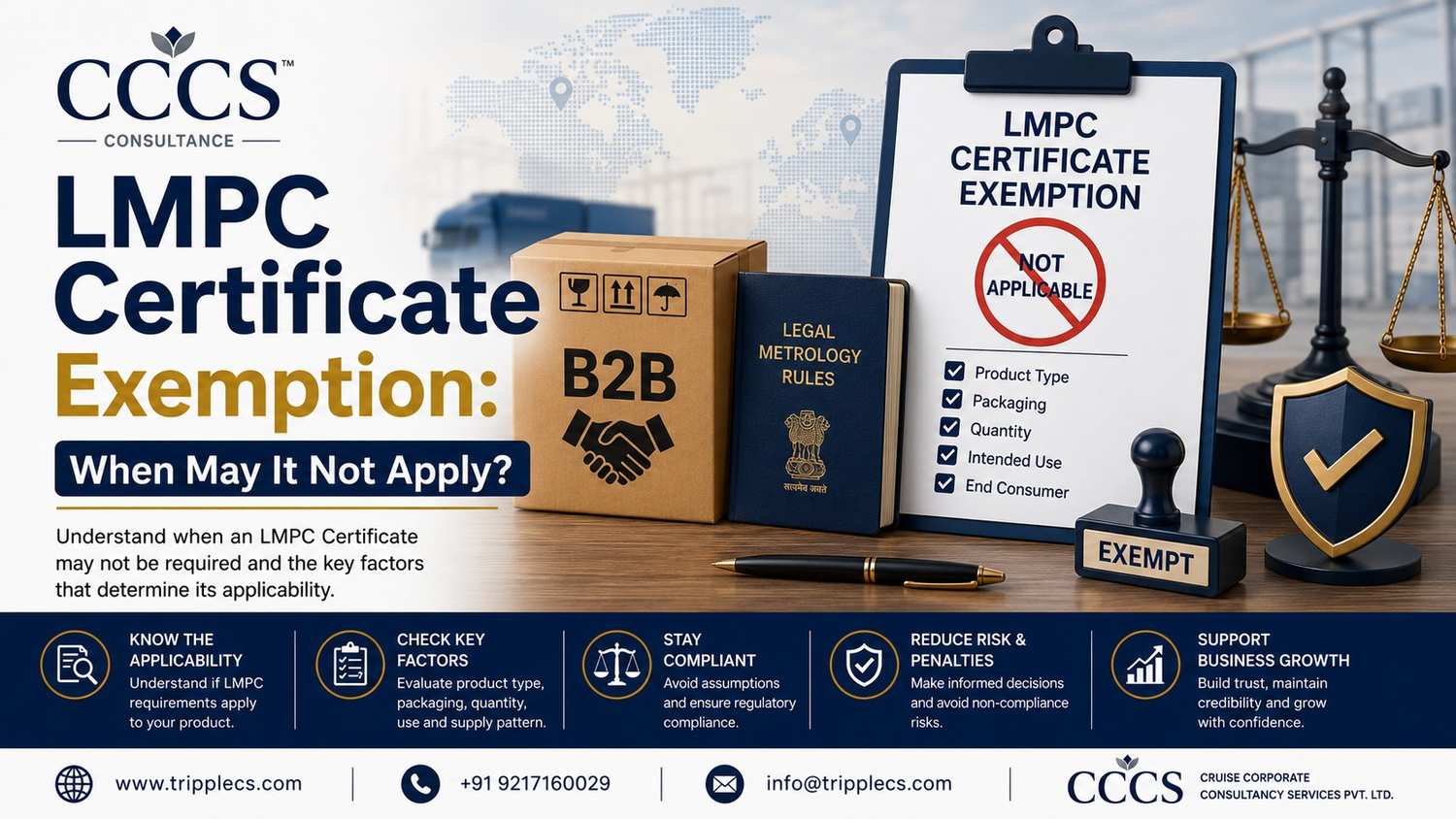

Not every packaged product entering a business automatically creates the same Legal Metrology obligation.
This is an important point because companies often approach LMPC compliance from one of two extremes. Some assume that every packaged commodity requires the same registration, while others hear about an exemption and immediately conclude that their products are outside the rules.
Neither assumption is a reliable compliance strategy.
Businesses searching for LMPC Certificate Exemption should first understand that exemption is not simply about finding a category on a list. The nature of the product, package, quantity, intended use, buyer and commercial arrangement can all be relevant when determining how Legal Metrology requirements apply.
For a business, the more useful question is therefore not:
“Is there an LMPC exemption?”
It is:
“Does an exemption actually apply to our specific business situation?”
The Word “Exempt” Can Create False Confidence
Exemption sounds straightforward.
If something is exempt, businesses naturally assume there is nothing further to consider.
Regulatory matters are rarely that simple.
A particular transaction, package or commodity may fall outside certain requirements under applicable rules, but that does not necessarily mean every regulatory responsibility connected with the product disappears.
This distinction matters.
Before relying on an LMPC Certificate Exemption, a business should understand exactly which requirement is being considered and why the exemption is believed to apply.
An assumption made before importing, manufacturing or distributing goods can become much harder to correct after commercial activities have already begun.
Start with How the Product Reaches the Customer
A useful compliance review begins with the actual commercial situation.
Consider two products that look almost identical.
One is packaged and offered directly to individual consumers through retail stores.
The other forms part of a different commercial or institutional arrangement.
Although the physical products may appear similar, their regulatory treatment may require different consideration depending on the applicable Legal Metrology provisions and the circumstances in which they are supplied.
This is why photographs of a product or a simple product name may not provide enough information to determine an exemption.
The entire commercial context matters.
Quantity Can Change the Compliance Question
The quantity contained in a package can also be relevant when evaluating the applicability of packaged commodity requirements.
Businesses handling larger packages sometimes assume that size alone automatically gives them an exemption.
That is not a safe conclusion.
Quantity thresholds and the circumstances in which goods are packaged or supplied need to be considered against the current regulatory framework.
Instead of using a general statement such as:
“Our package is large, so LMPC does not apply,”
a business should be able to establish why the relevant provision applies to that particular package.
The difference between an assumption and a defensible compliance position is evidence.
Who Receives the Product Matters Too
The final destination of a packaged commodity can be just as important as the product itself.
Some goods are prepared for ordinary retail customers.
Others may be supplied for industrial, institutional or other specific commercial purposes.
That difference can affect the regulatory analysis.
This is why companies should clearly understand:
- Who purchases the product
- How the product is supplied
- The purpose for which it is supplied
- How the package is presented
- Whether it enters ordinary retail distribution
- What Legal Metrology provisions apply to that arrangement
The answers provide a much stronger foundation for assessing an LMPC Certificate Exemption than simply comparing the product with something another company sells.
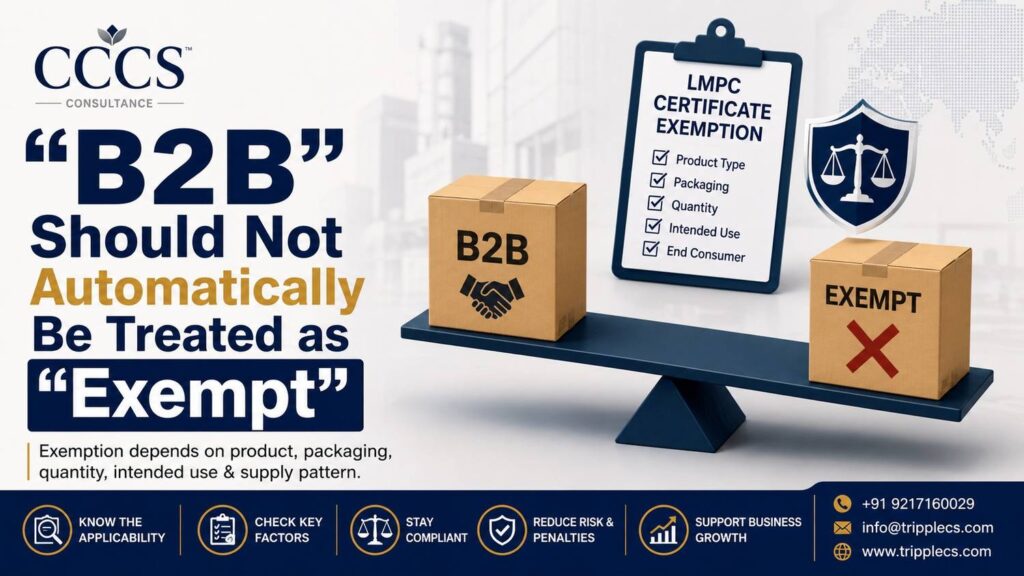
“B2B” Should Not Automatically Be Treated as “Exempt”
One common area of confusion is business-to-business supply.
A product being sold from one business to another does not, by itself, provide enough information to conclude that LMPC requirements are irrelevant.
Businesses operate under many different B2B models.
A distributor purchasing products for resale is different from an organization acquiring goods for a specific internal or institutional purpose. Likewise, the packaging and intended commercial use may differ.
Therefore, describing a transaction as “B2B” should be the beginning of the assessment—not the end of it.
The actual supply arrangement needs to be understood.
Imported Products Need an Independent Exemption Review
Importers should be particularly careful when relying on information provided by overseas manufacturers.
A foreign supplier may say:
“This product does not require this certificate in other markets.”
That statement may be completely accurate for those markets.
It does not automatically establish the position in India.
Indian Legal Metrology requirements need to be considered according to the circumstances applicable here.
Similarly, the fact that another importer brings a comparable product into India does not prove that the same exemption applies to every business.
Companies importing packaged commodities should evaluate their own products and commercial arrangements rather than building a compliance decision around someone else’s experience.
Exemption Does Not Mean “Ignore the Package”
This is another important distinction.
Even when a business believes a particular exemption may be available, packaging should not automatically be removed from the compliance conversation.
Other declarations, product-specific regulations, labeling requirements or statutory obligations may still need consideration depending on the commodity.
A responsible business therefore avoids thinking in binary terms:
LMPC applies = compliance required
LMPC exempt = nothing required
Real compliance is usually more nuanced.
The objective should be to understand the complete regulatory position of the product rather than simply obtaining an exemption answer.
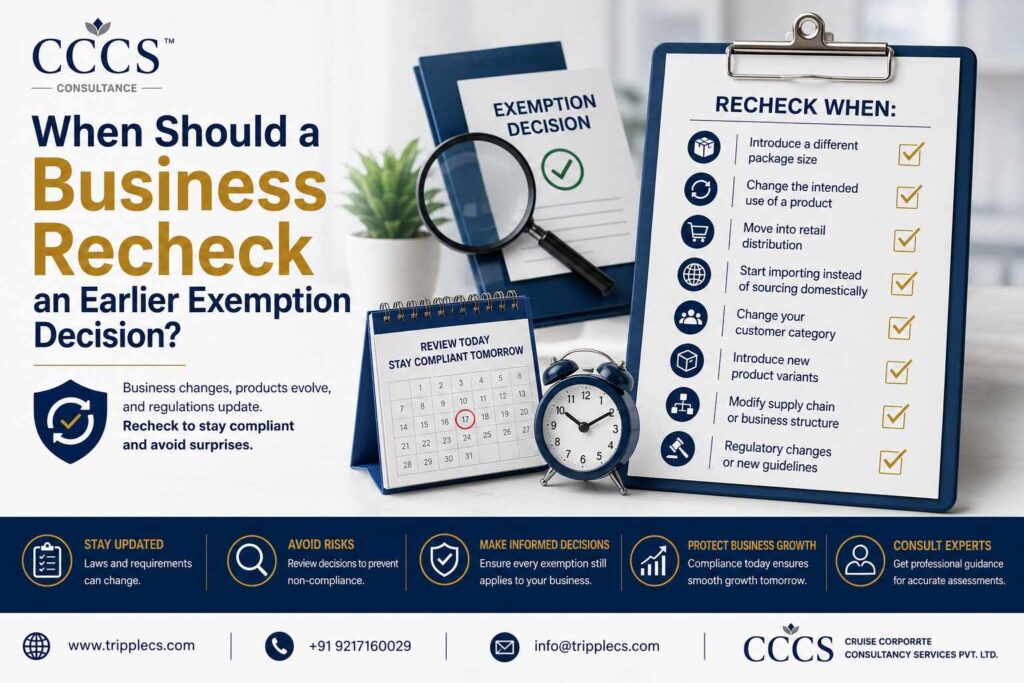
When Should a Business Recheck an Earlier Exemption Decision?
An exemption assessment should not necessarily be treated as permanent.
Businesses change.
Products change.
Commercial arrangements change.
A company should consider reviewing its earlier position when it:
- Introduces a different package size
- Changes the intended use of a product
- Moves into retail distribution
- Starts importing instead of sourcing domestically
- Changes its customer category
- Introduces new product variants
- Modifies its supply-chain structure
- Becomes aware of relevant regulatory changes
A conclusion that was appropriate for one commercial model may need reconsideration when the model changes.
A Written Compliance Position Is Better Than an Office Assumption
In many companies, compliance knowledge lives informally.
Someone says:
“We checked this last year.”
Another employee remembers:
“Our consultant said it wasn’t required.”
But nobody knows which product was reviewed, what packaging was considered or whether the commercial arrangement has since changed.
This becomes risky as teams grow.
Businesses benefit from maintaining clear records of why a particular compliance position was taken and what circumstances supported it.
That creates continuity when employees change, suppliers change or management revisits the decision later.
It also encourages compliance decisions to be based on facts rather than organizational memory.
An Exemption Should Support Business Confidence, Not Create Doubt
The purpose of evaluating an LMPC Certificate Exemption is not simply to avoid an unnecessary registration.
The real value is clarity.
If an applicable exemption is available, the business should understand the basis for relying on it.
If the exemption does not apply, discovering that early gives the company time to address the relevant compliance requirement properly.
Both outcomes are useful.
Uncertainty is the problem.
A clear answer allows management to make sourcing, packaging, importing and distribution decisions with greater confidence.
Where Professional Assessment Becomes Valuable
Online information can help businesses understand general Legal Metrology concepts, but exemption questions often depend on details that a general article cannot fully assess.
At Cruise Corporate Consultancy Services Pvt. Ltd., we look at the business circumstances surrounding the product rather than treating the word “exemption” as a universal answer.
A professional assessment may consider factors such as the nature of the commodity, package characteristics, quantity, business role, intended use and supply arrangement before determining what deserves further compliance attention.
The objective is straightforward:
Understand the business first. Then evaluate the compliance position.
Before You Rely on an LMPC Exemption
If someone tells you that your product is exempt, ask one more question:
“Why?”
There should be a clear regulatory and factual basis behind the answer.
Knowing that an exemption exists is useful.
Knowing why it applies to your particular product and business model is far more valuable.
That difference can help a business avoid unnecessary compliance work while also reducing the risk of relying on an exemption that was never applicable in the first place.
Need Clarity on LMPC Applicability?
If your business manufactures, imports, packages or distributes commodities and you are uncertain whether an LMPC Certificate Exemption may apply, professional review can help you understand your position before making an important commercial decision.
Cruise Corporate Consultancy Services Pvt. Ltd.
🌐 Website: tripplecs.com
📞 Phone: +91 9217160029
Our consultants can review the circumstances surrounding your products and help you understand relevant Legal Metrology compliance considerations.
An exemption should be something your business can explain—not something it simply assumes.