

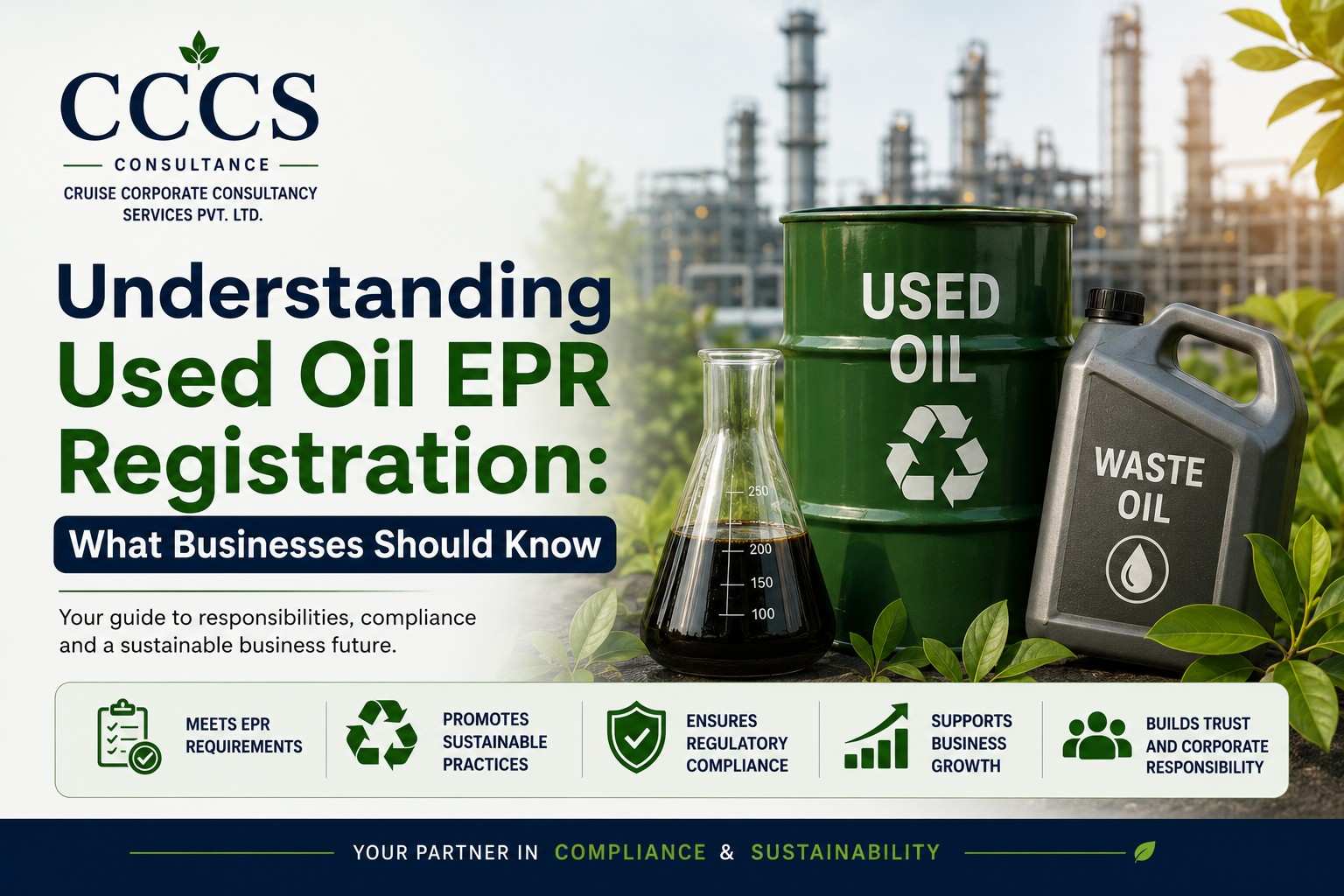

In many industrial environments, oil is essential for keeping machinery, engines, equipment, and production systems operating efficiently.
However, oil does not remain usable forever.
During routine operations, lubricating oil may become contaminated, lose its effectiveness, or reach the end of its intended use. At that stage, it cannot simply be treated like ordinary waste. Its collection, storage, movement, recycling, and recovery require responsible management.
This is where Used Oil EPR Registration becomes important.
India’s Extended Producer Responsibility framework for used oil has been introduced under the Hazardous and Other Wastes (Management and Transboundary Movement) Second Amendment Rules, 2023. CPCB operates a dedicated EPR portal to support registration and compliance management for entities involved in used oil.
For businesses, this is not merely an environmental formality. It reflects a larger shift toward traceability, responsible resource use, recycling, and accountability across the oil lifecycle.
This article explains the business relevance of EPR Oil Registration, the organizations that should review their responsibilities, and why a planned compliance approach matters—without providing a do-it-yourself registration process.
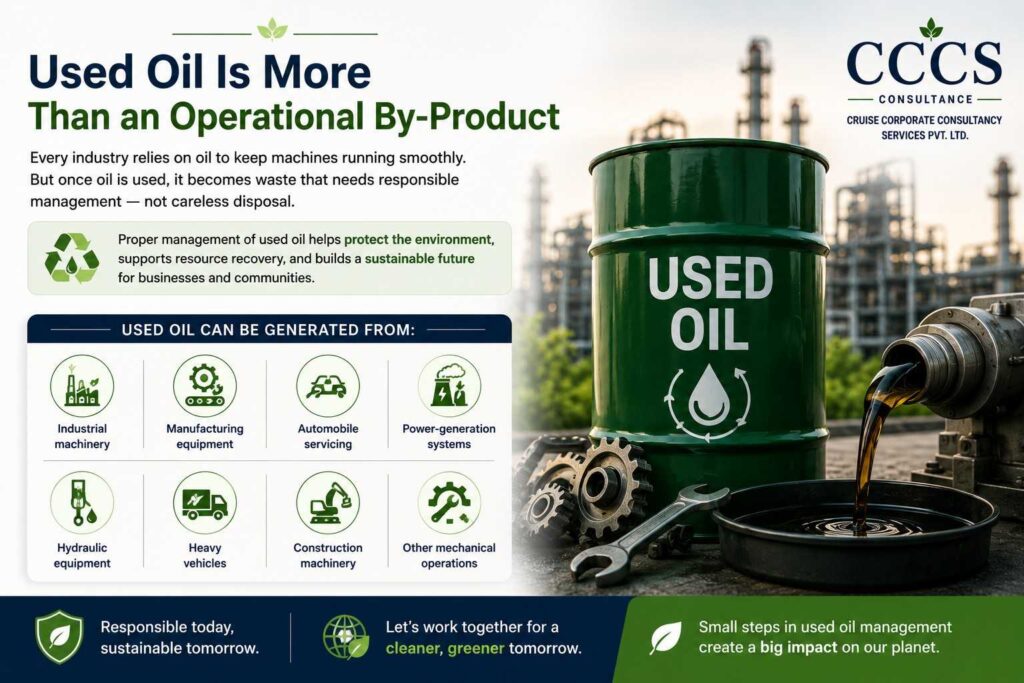
Used Oil Is More Than an Operational By-Product
Many businesses pay close attention to purchasing lubricants, reducing machine downtime, and maintaining equipment performance.
What Does Used Oil EPR Registration Mean?
Used Oil EPR Registration forms part of the Extended Producer Responsibility framework for managing used oil.
The framework creates defined responsibilities for relevant entities involved in producing, importing, collecting, recycling, or processing used oil.
The official CPCB portal identifies entity categories including:
- Producer
- Used Oil Importer
- Collection Agent
- Recycler or Co-Processor
Registration helps create a structured compliance system in which participating entities can be recognized and their responsibilities managed through an official platform.
The CPCB portal is also intended to support functions such as registration and the filing of required information and returns by applicable entities.
However, not every business has the same role or obligation.
A company’s responsibilities may depend on factors such as:
- The products it manufactures or imports
- Whether it introduces lubricating oil into the market
- Its position in the supply chain
- The nature and scale of its operations
- Its involvement in collection, recycling, or processing
- Applicable regulatory definitions
Therefore, businesses should avoid assuming that another company’s compliance approach will automatically apply to them.
Why This Compliance Framework Matters
Used oil management affects more than waste disposal.
It connects environmental responsibility with resource conservation, business traceability, and long-term sustainability.
Supporting Resource Recovery
Used oil may retain recoverable value even after it is no longer suitable for its original purpose.
Responsible recycling can help conserve resources and reduce unnecessary dependence on fresh raw materials.
Improving Waste Traceability
A structured framework helps businesses understand where used oil enters the waste-management chain and how it is handled afterward.
This supports more accountable business practices.
Strengthening Environmental Responsibility
Businesses are increasingly expected to consider the environmental impact of their products beyond the point of sale.
Responsible used oil management demonstrates that a company takes this wider responsibility seriously.
Building Regulatory Preparedness
Environmental requirements change as regulations and implementation systems evolve.
Businesses that organize their compliance responsibilities early are generally better prepared than those that wait until an issue becomes urgent.
Businesses That Should Review Their Used Oil Responsibilities
Instead of assuming that EPR requirements apply only to oil recycling companies, several types of organizations should review whether the framework is relevant to their operations.
Lubricant and Oil Producers
Businesses producing lubricating oils or related products may have responsibilities depending on the products they place in the market and the applicable regulatory definitions.
Importers
Organizations importing relevant oil products or used oil should carefully evaluate their registration category and compliance obligations.
The official CPCB portal includes a separate category for Used Oil Importers.
Collection Agents
Entities involved in organized collection activities may also require registration and may have specific operational responsibilities under the framework.
Recyclers and Co-Processors
Businesses involved in recycling, recovery, or co-processing must understand the requirements applicable to their operations and authorization status.
Businesses Operating Across Multiple Roles
Some organizations may perform more than one activity—for example, manufacturing, importing, collecting, or processing.
Such businesses should determine whether separate or additional responsibilities arise from their operational structure.
A Practical Business Scenario
Consider a company that supplies lubricants for industrial machinery.
Its immediate business focus may be:
- Product quality
- Distribution
- Customer supply
- Pricing
- Operational performance
However, the environmental responsibility connected with the oil does not necessarily end after it is sold.
Once the oil is used and becomes unsuitable for its original purpose, its collection and recycling become part of a broader compliance chain.
This means businesses must understand not only the product they sell, but also the environmental responsibilities connected with its end-of-use stage.
That broader lifecycle perspective is the foundation of Extended Producer Responsibility.
Why Businesses Should Avoid a Generic Compliance Approach
Online information often presents environmental registration as a simple checklist.
In practice, compliance depends on the business’s actual activity.
Two companies working in the same industry may still have different responsibilities because one manufactures oil, another imports it, and a third operates as a recycler.
A generic approach may lead to:
- Selection of the wrong entity category
- Inconsistent business information
- Misunderstanding of ongoing responsibilities
- Avoidable delays
- Incorrect compliance planning
A proper assessment should begin with the organization’s real business model, not with a copied checklist.
Compliance Is Not Only About Initial Registration
One of the biggest mistakes businesses make is treating registration as the final objective.
The CPCB framework also includes compliance functions relating to information and return filing for applicable entities.
Therefore, businesses should consider:
- Ongoing record accuracy
- Periodic reporting responsibilities
- Changes in operational activities
- Updates to company or product information
- Applicable EPR obligations
- Future regulatory developments
A business that receives registration but ignores later responsibilities may still face compliance difficulties.
The better approach is to treat environmental compliance as an ongoing management function rather than a one-time certificate exercise.
Where Professional Guidance Adds Value
Information about EPR Oil Registration may be publicly available, but applying that information to an individual business requires careful interpretation.
Professional guidance can help an organization:
- Understand its appropriate entity category
- Review business-specific applicability
- Identify relevant documentation
- Reduce inconsistencies in submitted information
- Understand continuing compliance obligations
- Monitor important regulatory developments
The purpose is not simply to complete an application. It is to help the business build a compliance approach that matches its actual operations.
Environmental responsibilities may differ depending on the product category. Businesses dealing with packaging, electronics, batteries, or tyres can also read our guides on CPCB EPR Registration for Plastic Waste, EPR E-Waste Registration, EPR Battery Registration, and EPR Tyre Registration.
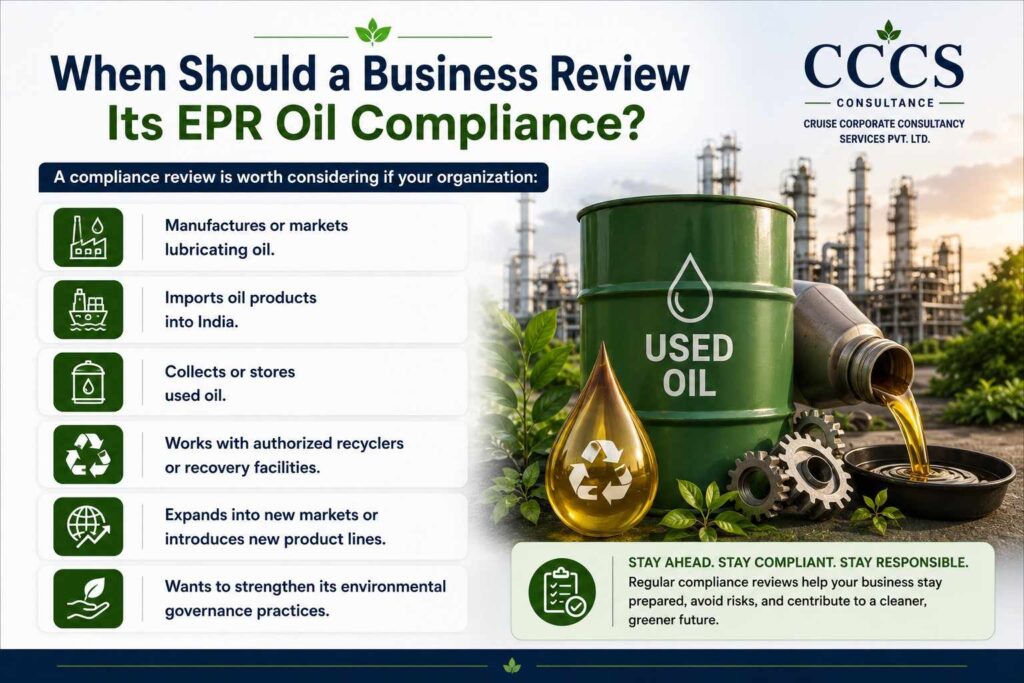
When Should a Business Review Its EPR Oil Compliance?
Many organizations assume environmental compliance only becomes relevant when a regulatory notice is received. In reality, businesses should evaluate their responsibilities much earlier.
Regular compliance reviews help businesses identify responsibilities before operational challenges arise.
Warning Signs That Your Business May Need Compliance Support
Environmental compliance is not always straightforward. Many organizations only realize they need guidance after encountering delays or uncertainty.
Some common warning signs include:
Uncertainty About Applicability
Businesses often ask:
“Does this regulation actually apply to our operations?”
The answer depends on the business model, products handled, and the role played within the supply chain.
Business Operations Have Changed
An organization that initially manufactured products locally may later begin importing lubricants or working with multiple distributors.
As business activities change, compliance responsibilities may also change.
Difficulty Understanding Regulatory Requirements
Environmental regulations are often technical.
Business owners and operational teams may understand their industry well but still require expert interpretation of compliance obligations.
Expansion Into New Markets
Businesses expanding operations, opening new facilities, or introducing additional products should periodically review whether new compliance responsibilities arise.
Responsible Used Oil Management Creates Business Value
Environmental compliance is increasingly viewed as part of overall business performance rather than merely fulfilling legal requirements.
Organizations that proactively manage used oil responsibilities often experience broader operational advantages.
Stronger Corporate Image
Customers, investors, and business partners increasingly value organizations demonstrating responsible environmental practices.
Environmental responsibility contributes positively to corporate reputation.
Better Business Relationships
Large organizations frequently prefer suppliers and partners that maintain organized compliance systems.
Responsible environmental management can strengthen long-term business relationships.
Improved Operational Confidence
When compliance responsibilities are properly understood, management teams can make business decisions with greater confidence.
Clear processes reduce uncertainty and support smoother operations.
Long-Term Sustainability
Responsible waste oil management supports broader sustainability objectives by encouraging recycling, resource recovery, and environmentally responsible practices.
Common Misconceptions About EPR Oil Registration
Businesses often make assumptions that may not accurately reflect regulatory expectations.
Here are some of the most common misconceptions.
“Only Large Companies Need Compliance”
Business size alone does not determine compliance responsibilities.
Applicability depends on business activities rather than turnover or workforce size.
“Registration Is the Entire Process”
Many organizations believe receiving registration completes their responsibility.
In reality, environmental compliance often involves ongoing obligations that should be reviewed regularly.
“Every Company Follows the Same Rules”
Different organizations perform different roles.
Manufacturers, importers, collection agents, and recyclers may each have distinct responsibilities.
“Online Information Is Enough”
General information available online may not accurately reflect an individual company’s operational structure.
Business-specific evaluation is often necessary.
Documentation Depends on Your Business
One of the first questions organizations ask is:
“What documents are required?”
There is no universal checklist suitable for every applicant.
Documentation generally depends on:
- Nature of business activities
- Registration category
- Products handled
- Business structure
- Applicable regulations
For this reason, businesses should avoid preparing documentation based solely on another company’s experience.
Documentation should always reflect actual business operations.
Why Many Businesses Prefer Professional Assistance
Environmental compliance involves much more than completing forms.
Professional consultants help organizations understand:
- Whether compliance applies.
- Which registration category may be appropriate.
- Business-specific documentation.
- Changes in applicable regulations.
- Long-term compliance responsibilities.
- Practical compliance planning.
Professional guidance helps reduce uncertainty while allowing businesses to focus on their core operations.
Looking Beyond Compliance
Today’s businesses are expected to demonstrate responsible environmental practices.
Customers, investors, government authorities, and supply-chain partners increasingly appreciate organizations that actively support sustainability.
Responsible management of used oil contributes to:
- Environmental protection
- Resource conservation
- Better governance
- Corporate responsibility
- Sustainable industrial development
Compliance should therefore be viewed as part of responsible business management rather than simply meeting a regulatory requirement.
Related Environmental Compliance Resources
If your organization also deals with other regulated product categories, you may find these guides useful:
- CPCB EPR Registration for Plastic Waste
- EPR E-Waste Registration
- EPR Battery Registration
- EPR Tyre Registration
These resources explain different environmental compliance frameworks and help businesses understand responsibilities across multiple waste streams.
Looking Ahead: Why Used Oil Compliance Will Continue to Matter
Environmental regulations are evolving alongside industrial growth and sustainability goals. As businesses expand and resource conservation becomes a greater priority, responsible management of used oil is expected to remain an important area of environmental compliance.
Organizations that establish good compliance practices today are generally better positioned to adapt to future regulatory developments, customer expectations, and industry standards.
Rather than treating compliance as an occasional requirement, forward-looking businesses view it as an investment in responsible operations and long-term business resilience.
How Cruise Corporate Consultancy Services Pvt. Ltd. Can Support Your Business
Every business operates differently. A manufacturing company, an importer, a collection agent, and a recycler may all have different responsibilities under the Used Oil EPR framework.
At Cruise Corporate Consultancy Services Pvt. Ltd., we help businesses understand their compliance obligations and provide practical consultancy tailored to their operational requirements.
Our team supports organizations in navigating complex environmental regulations while helping them focus on business growth with greater confidence.
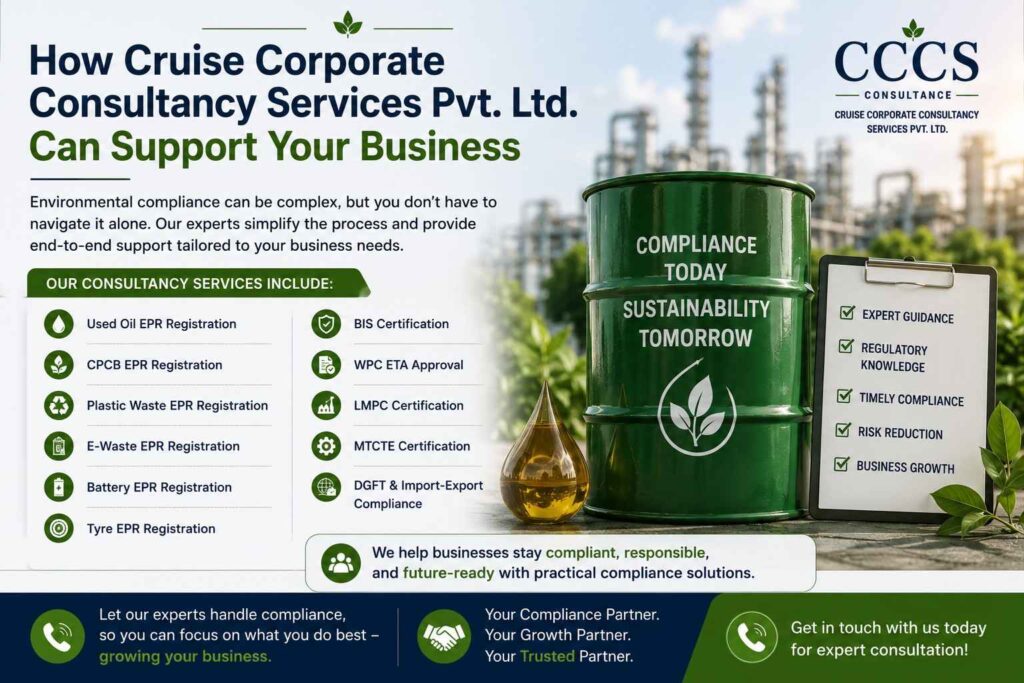
Our objective is to simplify compliance through practical guidance, reliable support, and business-focused solutions.
Frequently Asked Questions
1. What is Used Oil EPR Registration?
Used Oil EPR Registration is part of India’s Extended Producer Responsibility framework that promotes environmentally responsible collection, recycling, and management of used oil through authorized systems.
2. Does every business dealing with oil require registration?
Not necessarily.
Applicability depends on business activities, operational role, and relevant environmental regulations. Businesses should evaluate their individual responsibilities rather than assuming the same rules apply to everyone.
3. Why is proper used oil management important?
Responsible management helps reduce environmental risks, supports recycling and resource recovery, and contributes to sustainable industrial practices.
4. Can manufacturers and importers have different responsibilities?
Yes.
Responsibilities may differ depending on the role an organization performs within the supply chain and the applicable regulatory framework.
5. Is Used Oil EPR Registration only for large industries?
No.
Business size alone does not determine applicability. Compliance depends on business activities rather than company size.
6. Can regulations change over time?
Yes.
Environmental regulations continue to evolve. Businesses should periodically review official updates and reassess their compliance responsibilities.
7. Why do businesses seek professional consultancy?
Professional consultants help organizations understand applicability, identify the correct compliance approach, review documentation, and stay informed about regulatory developments.
8. Can businesses dealing with multiple products require more than one type of EPR compliance?
Yes.
Organizations handling plastics, batteries, electronics, tyres, or used oil may have different compliance responsibilities for each product category depending on applicable regulations.
Final Thoughts
Environmental responsibility has become an essential part of modern business operations.
As industries continue to grow, the importance of responsible used oil management will also increase. Businesses that understand their compliance obligations today are better prepared to manage operational risks, strengthen corporate credibility, and support long-term sustainability.
Instead of viewing Used Oil EPR Registration as simply another regulatory requirement, organizations should consider it an opportunity to build better environmental practices and stronger business governance.
Every organization is different, which is why compliance should always be assessed according to actual business activities rather than general assumptions.
Need Expert Guidance on Used Oil EPR Compliance?
Understanding environmental regulations is only the first step. The right compliance approach depends on your business activities, operational structure, and applicable regulatory requirements.
Whether you’re evaluating your responsibilities for the first time or looking for professional assistance with ongoing compliance, our experienced consultants are here to help.
At Cruise Corporate Consultancy Services Pvt. Ltd., we work closely with businesses to provide practical guidance, simplify compliance requirements, and support sustainable business growth.
Why Choose Us?
✔ Experienced compliance professionals
✔ Business-focused consultation
✔ Reliable documentation guidance
✔ Timely project support
✔ Personalized solutions for your industry
✔ Assistance across multiple environmental compliance frameworks
Get in Touch
Cruise Corporate Consultancy Services Pvt. Ltd.
🌐 Website: https://tripplecs.com/
📞 Phone: +91 9217160029
📧 Email: info@tripplecs.com
Let’s Build a Responsible Business Together
Environmental compliance doesn’t have to be complicated. With the right guidance, your business can stay compliant, reduce uncertainty, and focus on long-term growth.
Connect with our experts today to discuss your compliance requirements and receive solutions tailored to your business.
