

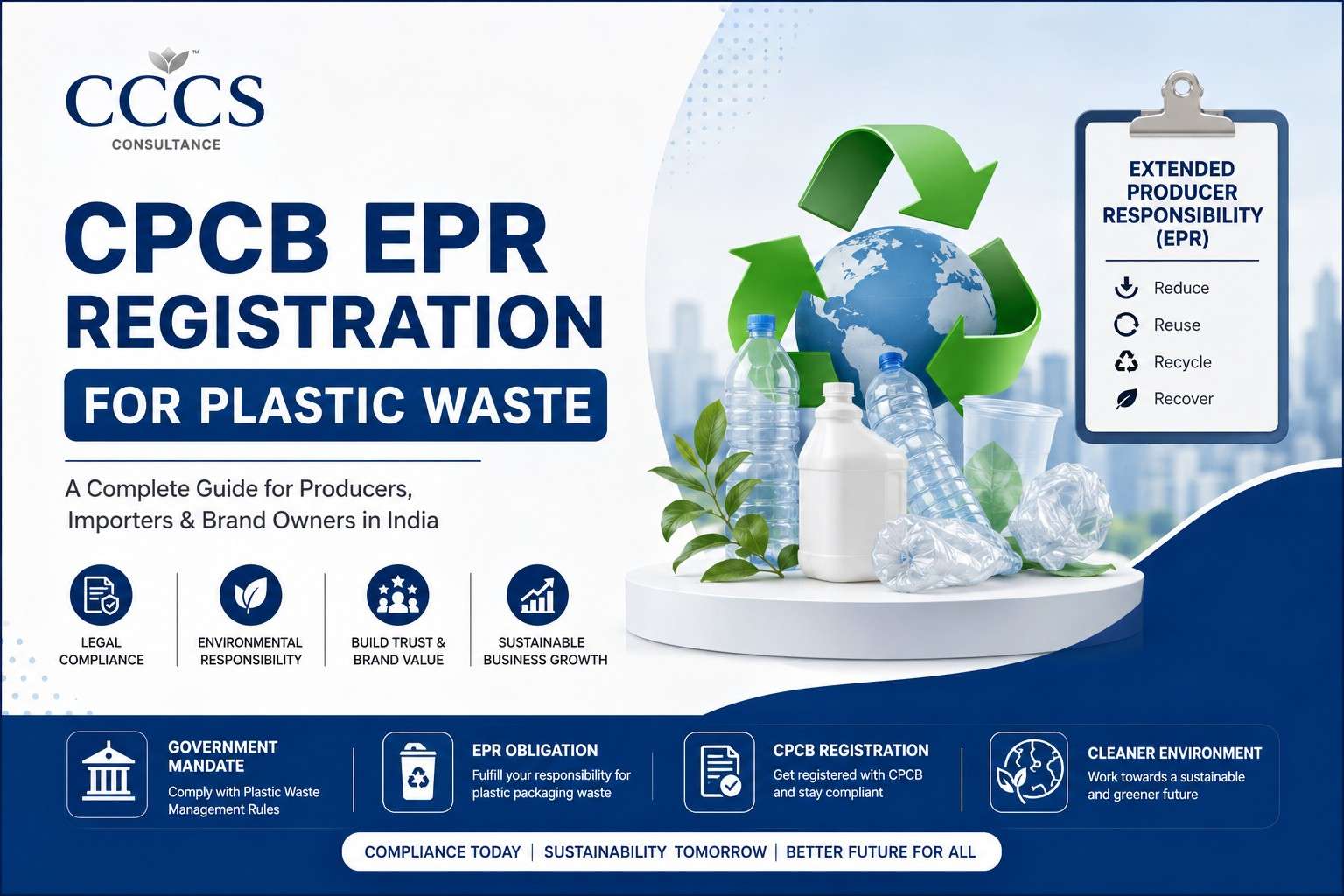

Plastic packaging has become an essential part of almost every industry, from FMCG and e-commerce to electronics, pharmaceuticals, food, and consumer goods. While plastic offers durability, affordability, and convenience, it also creates significant environmental challenges if it is not managed responsibly after use.
To address this issue, the Government of India introduced the Extended Producer Responsibility (EPR) framework under the Plastic Waste Management Rules. The objective is to ensure that businesses introducing plastic packaging into the market also take responsibility for managing the waste generated from that packaging.
This is where CPCB EPR Registration becomes important.
For many businesses, compliance is more than just meeting a legal requirement. It reflects responsible corporate practices, strengthens brand credibility, and demonstrates a commitment to environmental sustainability.
Whether you are a producer, importer, or brand owner, understanding EPR registration for plastic waste can help you identify your compliance responsibilities and make informed business decisions.
In this comprehensive guide, we explain the purpose of plastic EPR registration, who may require it, the business benefits, common compliance challenges, and why many organizations choose professional assistance instead of handling complex compliance matters alone.
Table of Contents
- What is CPCB EPR Registration?
- Understanding Extended Producer Responsibility (EPR)
- Why Was EPR Introduced in India?
- Who Needs CPCB EPR Registration?
- Industries Covered Under Plastic EPR
- Benefits of CPCB EPR Registration
- Common Compliance Challenges
- Why Businesses Prefer Professional Guidance
- Frequently Asked Questions
- Conclusion
What is CPCB EPR Registration?
CPCB EPR Registration is part of India’s environmental compliance framework that helps regulate the management of plastic packaging waste generated by businesses.
The registration framework is administered through the Central Pollution Control Board (CPCB) as part of the implementation of the Plastic Waste Management Rules.
The principle behind Extended Producer Responsibility is simple.
Businesses introducing plastic packaging into the market should also participate in ensuring that the corresponding plastic waste is collected, recycled, or processed through authorized channels.
Instead of placing the entire responsibility on municipal authorities, the EPR framework encourages businesses to become active participants in sustainable waste management.
This approach helps improve recycling, reduce environmental pollution, and promote responsible use of plastic packaging across industries.
Today, EPR registration for plastic has become an important compliance consideration for many businesses operating throughout India.
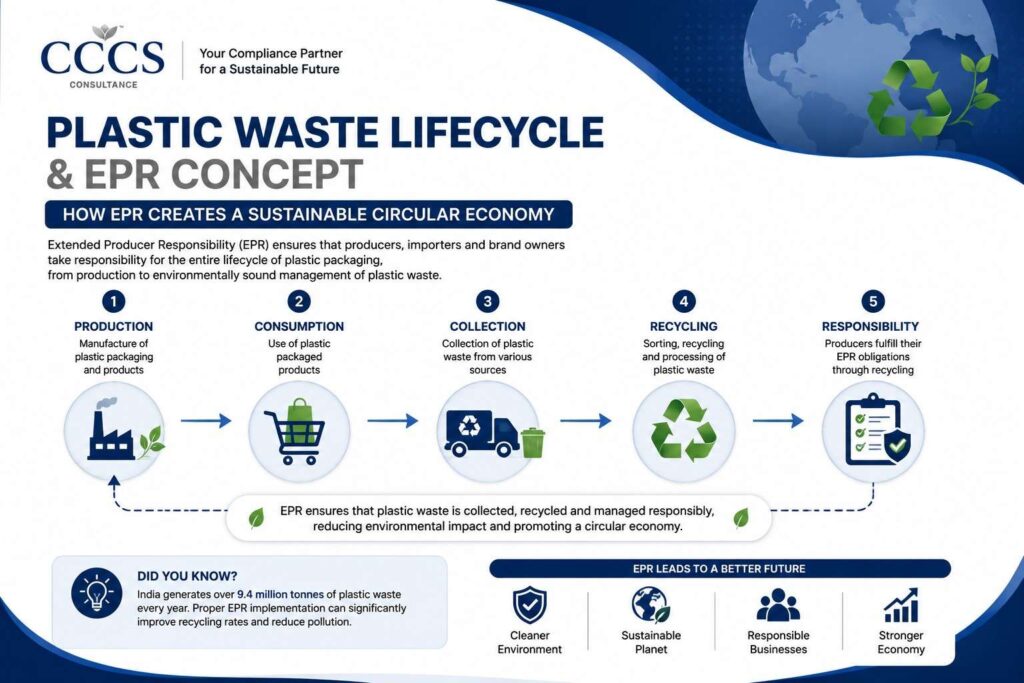
Understanding Extended Producer Responsibility (EPR)
Extended Producer Responsibility, commonly known as EPR, is an environmental policy that places responsibility on businesses for managing the lifecycle of the plastic packaging they introduce into the market.
The objective is not only to reduce plastic pollution but also to encourage businesses to adopt sustainable waste management practices.
Under this framework, organizations are expected to recognize their role in minimizing the environmental impact of plastic packaging.
Rather than viewing compliance as merely a legal obligation, many organizations now integrate EPR into their broader sustainability and Environmental, Social, and Governance (ESG) strategies.
This shift reflects a growing understanding that responsible waste management contributes to long-term business growth, customer trust, and environmental protection.
Why Was EPR Introduced in India?
India generates a significant quantity of plastic waste every year. While plastic remains an essential packaging material, improper disposal creates challenges for the environment, wildlife, and public health.
The EPR framework was introduced to encourage shared responsibility between businesses, recyclers, and waste management stakeholders.
Some key objectives include:
- Promoting responsible plastic waste management.
- Increasing recycling and recovery rates.
- Reducing dependence on landfills.
- Encouraging sustainable packaging practices.
- Supporting India’s circular economy initiatives.
- Improving accountability among producers, importers, and brand owners.
The introduction of plastic EPR registration represents an important step toward balancing economic growth with environmental sustainability.
Who Needs CPCB EPR Registration?
One of the most frequently asked questions is whether every business dealing with plastic packaging requires registration.
The answer depends on several factors, including business activities, product type, and the role the organization plays within the supply chain.
Generally, businesses that manufacture, import, or market products with plastic packaging may have compliance responsibilities under the applicable framework.
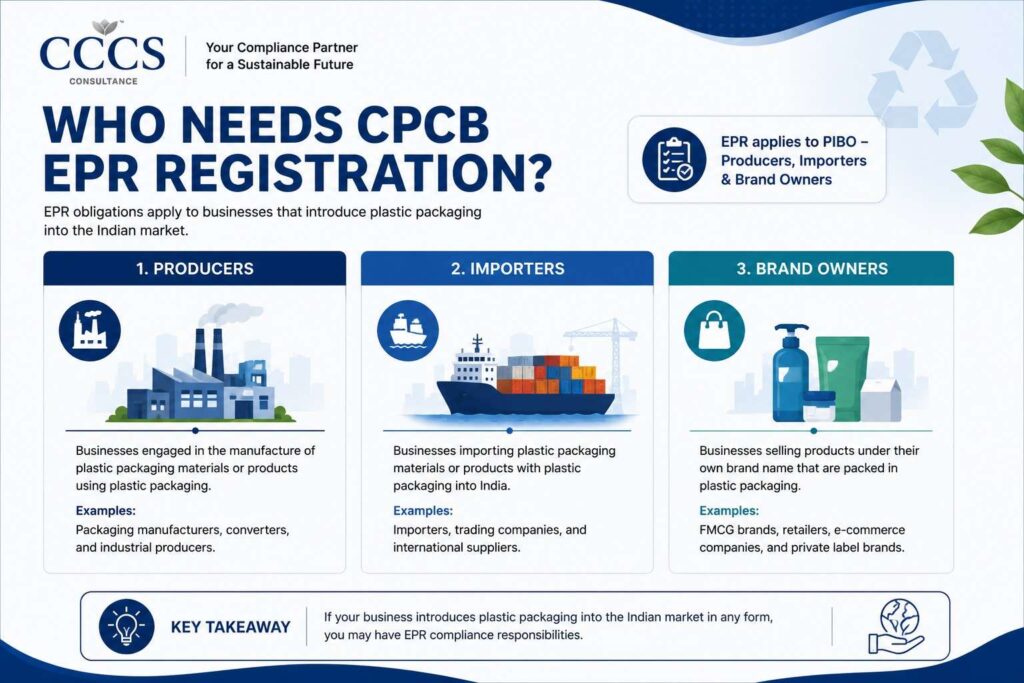
These businesses are commonly categorized as:
Producers
Organizations involved in manufacturing plastic packaging materials.
Importers
Businesses importing products or packaging materials containing plastic into India.
Brand Owners
Companies selling products under their own brand name where plastic packaging is used before products reach consumers.
These three categories are commonly referred to as PIBO (Producers, Importers, and Brand Owners).
Since every business operates differently, determining compliance obligations often requires careful evaluation of product categories, packaging materials, and business activities.
Industries That Commonly Require Plastic EPR Registration
Although the exact applicability depends on individual business operations, EPR registration for plastic waste is often relevant for industries such as:
- Fast-Moving Consumer Goods (FMCG)
- Food and Beverage Manufacturers
- Cosmetic and Personal Care Brands
- Pharmaceutical Companies
- Consumer Electronics
- Household Product Manufacturers
- Retail Chains
- E-commerce Businesses
- Packaging Manufacturers
- Import-Export Companies
- Consumer Goods Brands
Businesses introducing packaged products into the Indian market should periodically review their compliance obligations as environmental regulations continue to evolve.
Why CPCB EPR Registration Matters for Businesses
Many organizations initially see environmental compliance as a regulatory requirement. However, CPCB EPR Registration provides several long-term business advantages that extend beyond legal compliance.
Builds Customer Trust
Modern consumers increasingly prefer businesses that demonstrate environmental responsibility.
Organizations adopting responsible waste management practices often strengthen their brand reputation and customer confidence.
Supports Sustainable Business Growth
Environmental compliance has become an important consideration for investors, distributors, business partners, and procurement teams.
Organizations that prioritize sustainability are generally better positioned for long-term growth.
Strengthens Corporate Reputation
Businesses demonstrating responsible environmental practices often enjoy greater credibility within their industry.
Responsible compliance reflects professionalism and corporate accountability.
Encourages Better Waste Management
The EPR framework supports improved collection, recycling, and environmentally sound processing of plastic waste.
This contributes toward cleaner communities and better resource utilization.
Helps Businesses Stay Future Ready
Environmental regulations continue to evolve.
Organizations that establish effective compliance systems today are generally better prepared to adapt to future regulatory developments.
Benefits of CPCB EPR Registration for Businesses
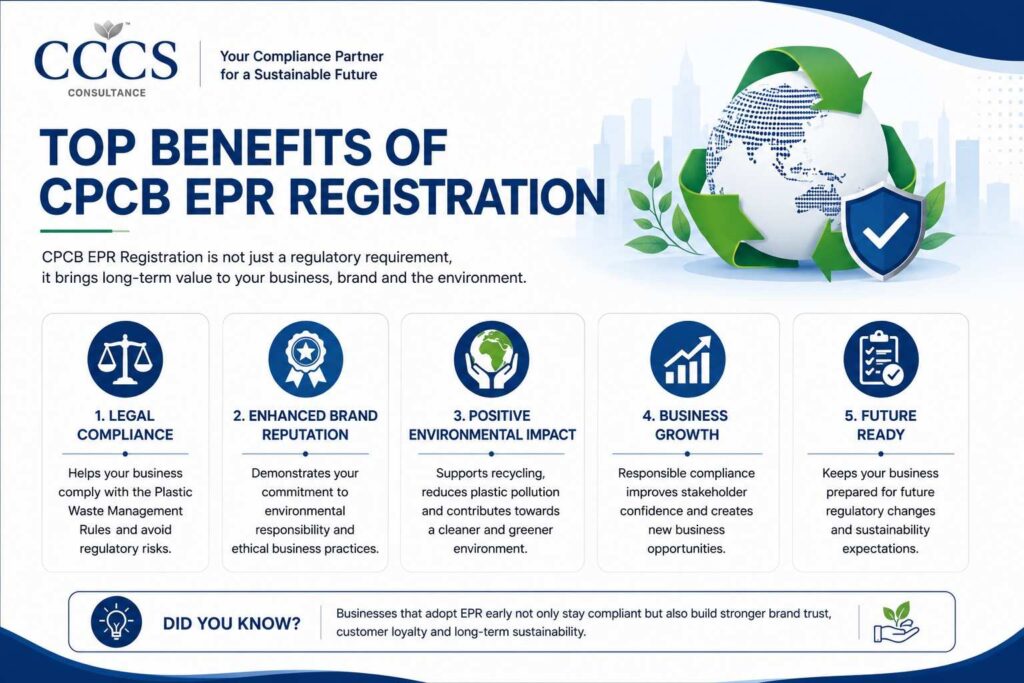
Many businesses initially consider CPCB EPR Registration as just another compliance requirement. However, organizations that take a proactive approach often discover that environmental compliance contributes to long-term business growth, operational efficiency, and brand credibility.
Here are some of the key advantages of plastic EPR registration.
1. Demonstrates Responsible Business Practices
Today’s customers, investors, and business partners increasingly prefer organizations that operate responsibly. Businesses complying with environmental regulations demonstrate a commitment to sustainability and responsible corporate governance.
This positive perception can strengthen relationships with customers, distributors, and stakeholders.
2. Improves Business Reputation
Companies that actively manage environmental compliance often enjoy stronger credibility in the marketplace.
A responsible environmental approach reflects professionalism and helps businesses position themselves as trusted organizations.
3. Supports Long-Term Sustainability
Plastic waste management is becoming a global priority.
Organizations participating in responsible recycling and waste management contribute towards a cleaner environment while supporting India’s sustainability initiatives.
4. Builds Customer Confidence
Modern consumers appreciate businesses that care about environmental responsibility.
When companies adopt sustainable practices, they often improve customer trust and brand loyalty.
5. Better Prepared for Regulatory Changes
Environmental regulations continue to evolve.
Businesses maintaining organized compliance systems generally adapt more efficiently whenever new requirements or amendments are introduced.
Common Compliance Challenges Businesses Face
Although the concept of EPR registration for plastic waste appears straightforward, practical compliance can become challenging because every business operates differently.
Some common challenges include:
Understanding Applicability
Many businesses are unsure whether they fall under the Producer, Importer, or Brand Owner (PIBO) category.
Since responsibilities differ, identifying the correct category is an important first step.
Interpreting Regulatory Requirements
Environmental regulations are periodically updated.
Businesses that rely on outdated information may unintentionally overlook important compliance requirements.
Maintaining Accurate Business Information
Consistency across business records, packaging information, and supporting documents is essential.
Even minor inconsistencies can result in unnecessary clarification requests during compliance reviews.
Understanding Packaging Categories
Different products use different packaging structures.
Understanding how packaging is categorized is often one of the areas where businesses seek professional guidance.
Managing Ongoing Compliance
Registration is only one part of environmental responsibility.
Businesses should also remain aware of their continuing compliance obligations and regulatory developments over time.
Common Mistakes Businesses Make During CPCB EPR Registration
Many compliance issues arise not because businesses intentionally ignore regulations, but because they misunderstand the requirements.
Some frequently observed mistakes include:
Assuming Every Business Has the Same Requirements
Compliance obligations depend on the business model, products, and packaging.
Applying a one-size-fits-all approach may create unnecessary complications.
Using Outdated Information
Environmental compliance frameworks continue to evolve.
Businesses should always rely on current regulatory information rather than outdated online sources.
Delaying Compliance Planning
Some organizations postpone compliance until it becomes urgent.
Early planning generally provides more time for evaluation, documentation, and smoother implementation.
Underestimating Documentation Accuracy
Accurate business information is essential for effective compliance.
Incomplete or inconsistent information may lead to avoidable delays.
Ignoring Future Compliance Responsibilities
Environmental compliance should be viewed as an ongoing business responsibility rather than a one-time activity.
Organizations that monitor regulatory developments are generally better prepared for future requirements.
Documents Required – A High-Level Overview
One of the most common questions businesses ask concerns the documentation involved in CPCB EPR Registration.
The documentation requirements vary depending on several factors, including:
- Nature of business
- Business category
- Products handled
- Packaging type
- Role as Producer, Importer, or Brand Owner
Because every organization has unique compliance requirements, there is no universal document checklist suitable for every applicant.
Businesses should carefully review their specific obligations before preparing documentation.
Professional consultants often help organizations evaluate documentation requirements based on their operational activities, reducing the risk of errors or delays.
Important: Documentation requirements vary from business to business. Always ensure that the information submitted reflects your actual business operations and complies with applicable regulatory requirements.
Risks of Non-Compliance
Environmental compliance has become an important component of responsible business operations.
Organizations that fail to understand or meet applicable compliance requirements may face challenges affecting both business continuity and reputation.
Potential risks may include:
- Regulatory scrutiny
- Delays in business operations
- Increased compliance management efforts
- Reduced confidence among business partners
- Reputational concerns
- Difficulty responding to future regulatory changes
Rather than reacting to compliance issues after they arise, businesses are encouraged to adopt a proactive approach that supports long-term operational stability.
Why Many Businesses Prefer Professional Guidance
Although information about plastic EPR registration is publicly available, understanding how regulations apply to an individual business often requires careful evaluation.
Every organization has different:
- Products
- Packaging structures
- Business operations
- Supply chains
- Import activities
- Compliance responsibilities
As a result, businesses often seek professional guidance to better understand their obligations and reduce uncertainty during the compliance process.
Professional support can help businesses:
✔ Understand applicable compliance requirements.
✔ Review business activities from a compliance perspective.
✔ Reduce documentation-related issues.
✔ Stay informed about regulatory updates.
✔ Focus on core business operations while managing environmental responsibilities more efficiently.
Professional guidance does not replace business responsibility—it supports businesses in making informed compliance decisions based on their specific circumstances.
Latest Compliance Trends Businesses Should Know
Environmental regulations continue to evolve as India strengthens its focus on sustainability and responsible waste management. Businesses dealing with plastic packaging should regularly review official notifications and stay informed about changes that may affect their compliance obligations.
Instead of waiting until new requirements become mandatory, organizations should adopt a proactive approach to compliance planning. This not only reduces uncertainty but also helps businesses respond more efficiently to future regulatory developments.
As businesses expand into new markets or introduce additional product lines, reviewing compliance responsibilities periodically becomes equally important. A well-planned compliance strategy supports long-term operational stability and responsible business growth.
Why Businesses Choose Cruise Corporate Consultancy Services Pvt. Ltd.
Environmental compliance is rarely the same for every business. The products you manufacture, import, or market, the type of plastic packaging you use, and your operational model all influence your compliance requirements.
At Cruise Corporate Consultancy Services Pvt. Ltd., we understand that businesses need practical guidance rather than generic advice. Our experienced team works closely with clients to understand their business activities and provide professional assistance tailored to their specific compliance requirements.
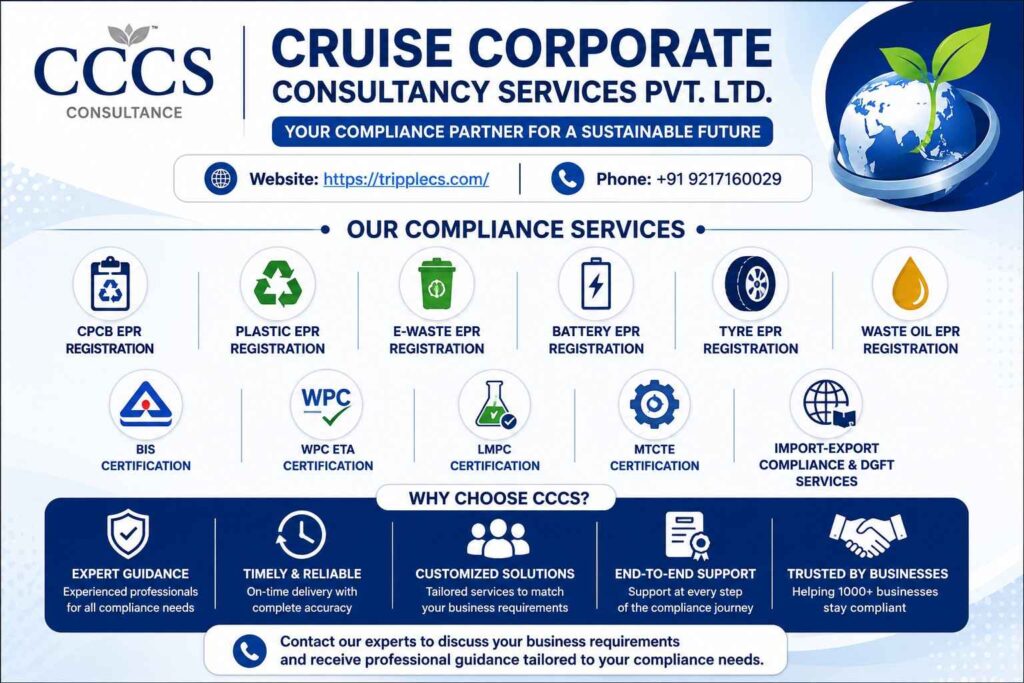
We assist businesses across India with a wide range of regulatory and compliance services, including:
- CPCB EPR Registration
- Plastic EPR Registration
- E-Waste EPR Registration
- Battery EPR Registration
- Tyre EPR Registration
- Waste Oil EPR Registration
- BIS Certification
- WPC ETA Certification
- LMPC Certification
- MTCTE Certification
- DGFT & Import-Export Compliance
Our goal is to simplify complex compliance requirements while helping businesses remain focused on their growth and day-to-day operations.
Frequently Asked Questions
1. What is CPCB EPR Registration?
CPCB EPR Registration is an environmental compliance framework designed to ensure that eligible businesses take responsibility for managing plastic packaging waste in accordance with applicable regulations.
2. Who requires EPR Registration for Plastic Waste?
Businesses operating as Producers, Importers, or Brand Owners (PIBO) may have compliance obligations depending on the nature of their products, packaging, and business activities.
3. Is CPCB EPR Registration applicable to small businesses?
Applicability depends on the business model and operational activities rather than business size alone. Each organization should evaluate its specific compliance obligations.
4. Is Plastic EPR Registration only for manufacturers?
No. Depending on business operations, importers and brand owners may also have responsibilities under the Extended Producer Responsibility framework.
5. Why is professional guidance beneficial?
Since compliance requirements differ from one business to another, professional guidance can help businesses understand their obligations, prepare appropriate documentation, and reduce avoidable compliance issues.
6. Does EPR Registration improve business credibility?
Yes. Responsible environmental compliance demonstrates commitment to sustainability and responsible corporate practices, which can strengthen customer and stakeholder confidence.
7. Can compliance requirements change over time?
Yes. Environmental regulations continue to evolve. Businesses should regularly monitor official updates and review their compliance responsibilities accordingly.
8. How can businesses determine whether they need CPCB EPR Registration?
A professional assessment of business activities, products, and packaging can help determine the applicable compliance requirements.
Final Thoughts
As environmental responsibility becomes increasingly important for businesses, CPCB EPR Registration is no longer viewed as just a regulatory obligation—it has become part of responsible corporate governance.
Whether you manufacture products, import goods, or sell products under your own brand, understanding your compliance responsibilities is essential for sustainable business growth.
Every organization operates differently, and compliance requirements vary based on products, packaging, and business activities. Taking the time to understand these responsibilities today can help businesses avoid unnecessary challenges tomorrow while strengthening their reputation in an increasingly environmentally conscious marketplace.
Rather than treating compliance as a one-time task, businesses should consider it an ongoing commitment to responsible operations, regulatory awareness, and environmental stewardship.
Need Professional Assistance?
If your business requires expert guidance regarding CPCB EPR Registration, EPR Registration for Plastic Waste, or other environmental compliance services, our team is here to help.
Cruise Corporate Consultancy Services Pvt. Ltd.
🌐 Website: tripplecs
📞 Phone: +91 9217160029
Contact our experts to discuss your business requirements and receive professional guidance tailored to your compliance needs.
