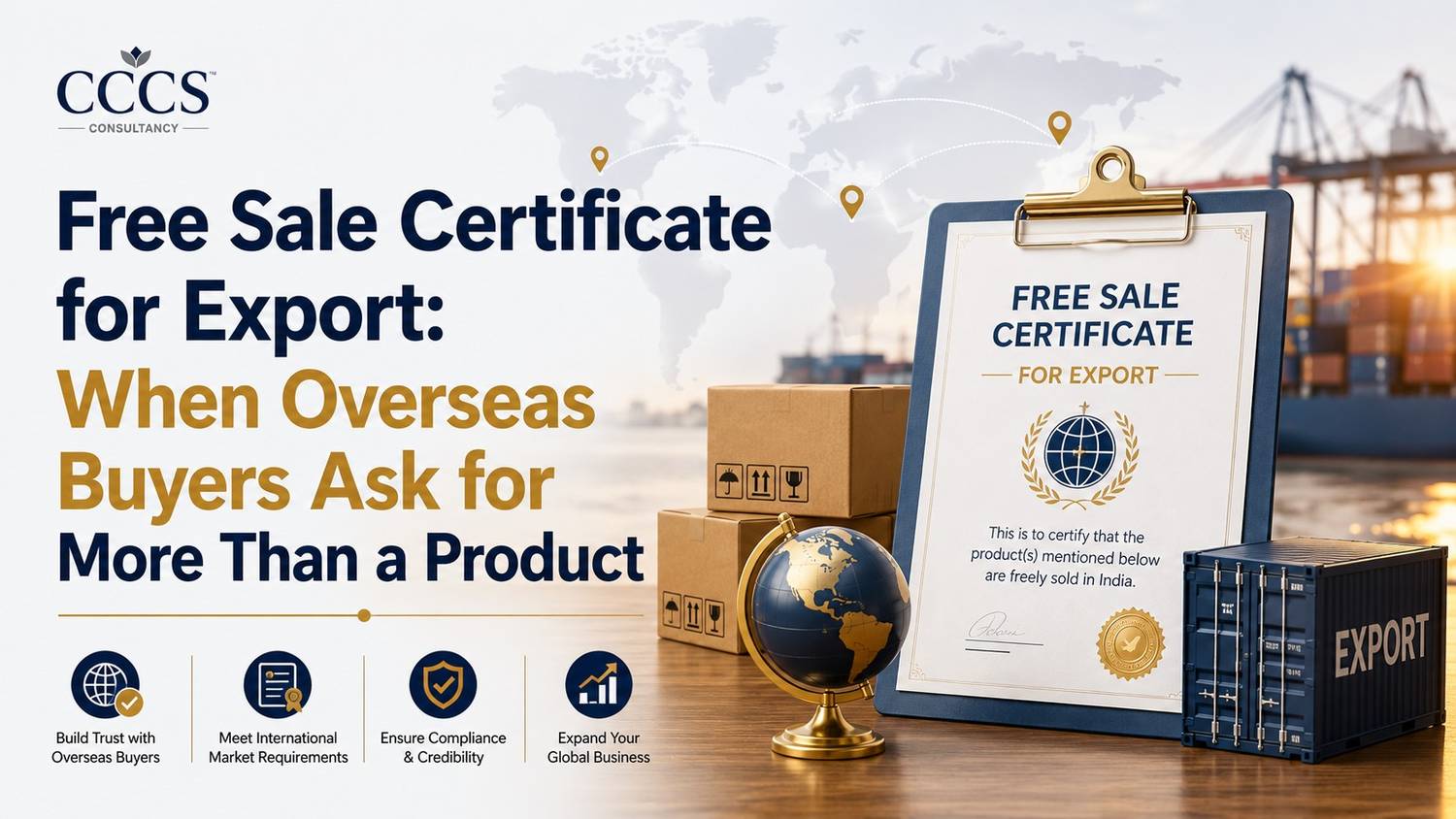

Getting an enquiry from an overseas buyer is an exciting moment for any business.
The product may already be successful in India. Pricing has been discussed. Samples have been accepted. The buyer appears ready to move forward.
Then comes an unexpected request:
“Please provide a Free Sale Certificate.”
For a company exporting for the first time, that single sentence can create several questions.
What exactly does the buyer need? Why is a certificate required when the product is already being sold in India? Which authority is relevant? Does the requirement apply to this particular product?
This is where understanding the Free Sale Certificate for Export becomes important.
It is not simply another document to collect for an export file. Depending on the product and destination market, it can form part of the evidence requested by an overseas buyer or regulatory authority before the product is accepted in that market.
A Successful Product in India Still Has to Earn Acceptance Abroad
A manufacturer may have spent years building a successful domestic business.
Its products are manufactured regularly, distributed through established channels and purchased by customers across India.
But entering another country changes the conversation.
The overseas buyer is dealing with a product originating from a different regulatory environment. The importing country may therefore request documentation concerning the product’s status in its country of origin.
A Free Sale Certificate for Export can become relevant in this context.
The exact meaning, issuing authority and supporting requirements should be assessed according to the product category and destination rather than assumed to be identical for every export.
For example, CDSCO’s current guidance specifically addresses Free Sale Certificates for Indian manufacturers holding valid licences to manufacture medical devices for sale or distribution and seeking the certificate for export purposes.
That illustrates an important lesson:
Start with the product—not just the name of the certificate.
The Buyer Is Not Always Asking for “Just Another Certificate”
Exporters sometimes receive a document request and immediately forward it to their accounts or logistics team.
But it is worth understanding why the request has appeared.
An overseas importer may be preparing for product registration, regulatory review, distribution approval or another market-entry requirement in its own country.
The buyer may therefore need supporting evidence from the country where the product originates.
That makes the certificate part of a larger commercial objective:
getting the product accepted in the target market.
The exporter should therefore understand exactly what the buyer or overseas authority expects instead of assuming that any document carrying the words “Free Sale” will be sufficient.
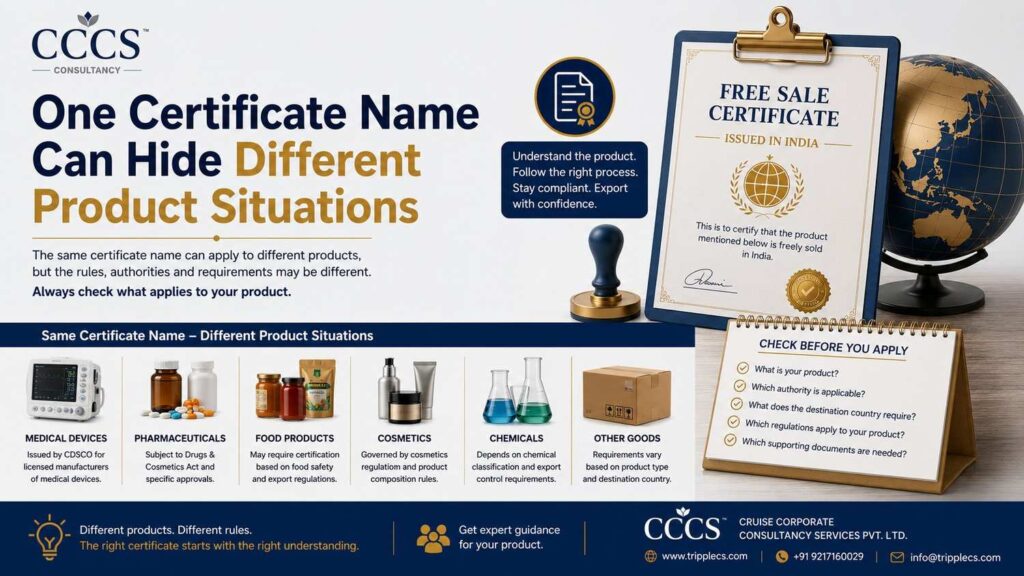
One Certificate Name Can Hide Different Product Situations
This is where exporters need to be careful.
Search online for a Free Sale Certificate and you will find information covering medical devices, cosmetics, food products and many other categories.
That does not mean one process or authority applies universally.
Product regulation matters.
A medical device manufacturer, for example, may operate under a regulatory framework different from a business exporting another category of goods. CDSCO’s medical-device guidance requires a valid manufacturing licence and identifies supporting information for the Free Sale Certificate application.
Historic DGFT guidance likewise distinguishes between certain items outside the Drugs and Cosmetics framework and medical devices covered by it.
For businesses, the practical takeaway is simple:
Do not choose a certificate route only because another exporter used it.
First identify the regulatory position of your own product.
The Destination Country Deserves as Much Attention as the Product
Export planning often begins with the product.
But for documentation, destination matters too.
A buyer in one country may request supporting documentation that another market does not ask for in the same way.
That means exporters should avoid building their documentation strategy around the assumption that:
“We exported this product before, so the same documents will work everywhere.”
Instead, businesses should clarify the destination-country requirement early.
This can involve confirming:
- What certificate has actually been requested
- Whether a particular format is expected
- Which product details must appear
- Whether additional authentication is expected
- Whether another product-specific approval is involved
This conversation is particularly valuable before a large commercial commitment is made.
A Purchase Order Is Good News. It Is Not the End of Export Preparation.
Imagine a business receives its first significant international purchase order.
The natural reaction is to move quickly.
Production is scheduled.
Packaging quantities are confirmed.
Freight quotations are requested.
Delivery commitments are discussed.
But this is precisely when regulatory and documentary requirements should receive attention.
Finding out later that the overseas customer requires a Free Sale Certificate for Export can force the exporter to deal with an unfamiliar requirement while production and delivery deadlines are already running.
The commercial opportunity remains exciting.
The difference is that it now comes with unnecessary pressure.
Strong exporters therefore treat documentation as part of order planning—not as something that begins after the goods are ready.
Your Product Description Should Remain Consistent
Export businesses handle product information across multiple records.
The same item may appear in commercial documents, licences, certificates, packaging information, buyer correspondence and regulatory records.
Inconsistent descriptions can create questions.
A product may have a marketing name, technical description, model number, brand name or regulatory identity.
Businesses should therefore pay attention to how their products are represented across relevant records.
This becomes particularly important when certificates are being used by an overseas buyer for regulatory or commercial purposes.
The goal is straightforward:
The paperwork should clearly relate to the product being exported.
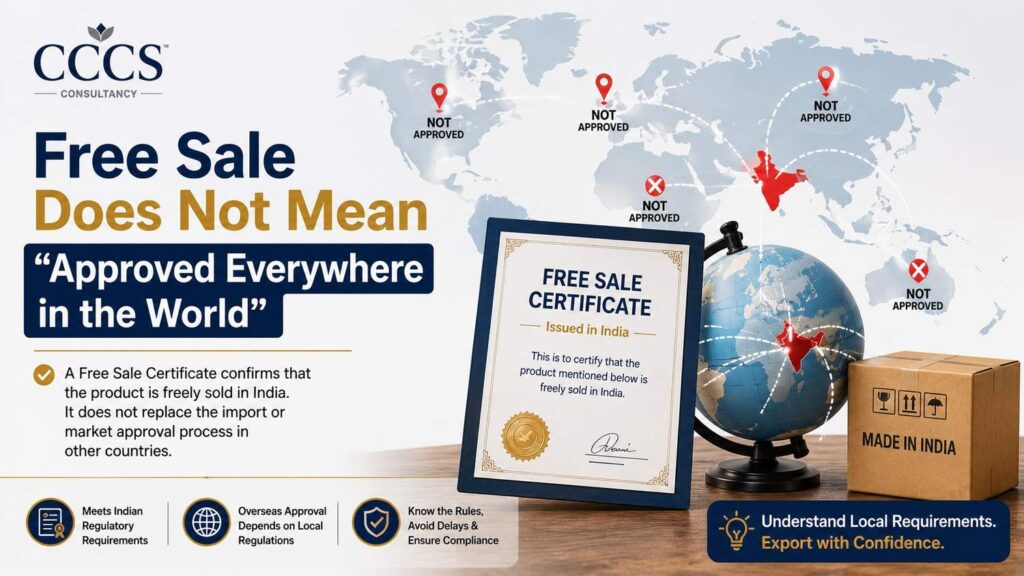
Free Sale Does Not Mean “Approved Everywhere in the World”
This distinction is important.
A Free Sale Certificate connected with the exporting country should not be interpreted as universal approval to sell a product in every foreign market.
The destination country can have its own registration, safety, labelling, technical, sanitary or product-specific requirements.
So exporters should avoid thinking:
Free Sale Certificate obtained → product can now be sold anywhere.
International market access does not work that way.
Instead, think of the certificate as one possible part of the documentation needed to support entry into a particular overseas market.
The foreign buyer or appropriate regulatory specialist should help establish what the destination country requires.
When the Buyer Sends a Certificate Request, Ask Better Questions
Instead of replying immediately with “Yes, we can provide it,” the exporter should first understand the request.
Which products need to appear?
Why is the certificate being requested?
Which country will receive the goods?
Is the buyer asking for a Free Sale Certificate, Free Sale and Commerce Certificate, or another product-specific certificate?
Does the overseas authority expect any particular wording or authentication?
These questions can prevent businesses from spending time obtaining a document that does not actually satisfy the buyer’s requirement.
The objective is not to create delay.
It is to get the requirement right the first time.
Export Growth Makes Document Management More Important
A business with one product and one international buyer may be able to manage export requirements informally.
Growth changes that.
Soon there may be:
multiple products,
multiple countries,
multiple buyers,
different regulatory requests,
different product registrations,
and different certificate requirements.
At that stage, relying on old email conversations or remembering what was used for the previous shipment becomes inefficient.
Businesses planning long-term international expansion should develop a more organized approach to regulatory documentation.
This makes future export opportunities easier to evaluate because the company understands what it already has, what may need updating and what could be required for a new market.
Sometimes the Most Important Work Happens Before the Application
Businesses often approach consultants with one request:
“We need a Free Sale Certificate.”
A useful compliance discussion should go further.
What is the product?
Who manufactures it?
Where is it currently sold?
Which country is it being exported to?
What exactly has the foreign buyer requested?
Which regulatory framework applies to the product?
These questions help determine whether the requested certificate is appropriate and what route may be relevant.
That assessment can be more valuable than rushing directly into paperwork.
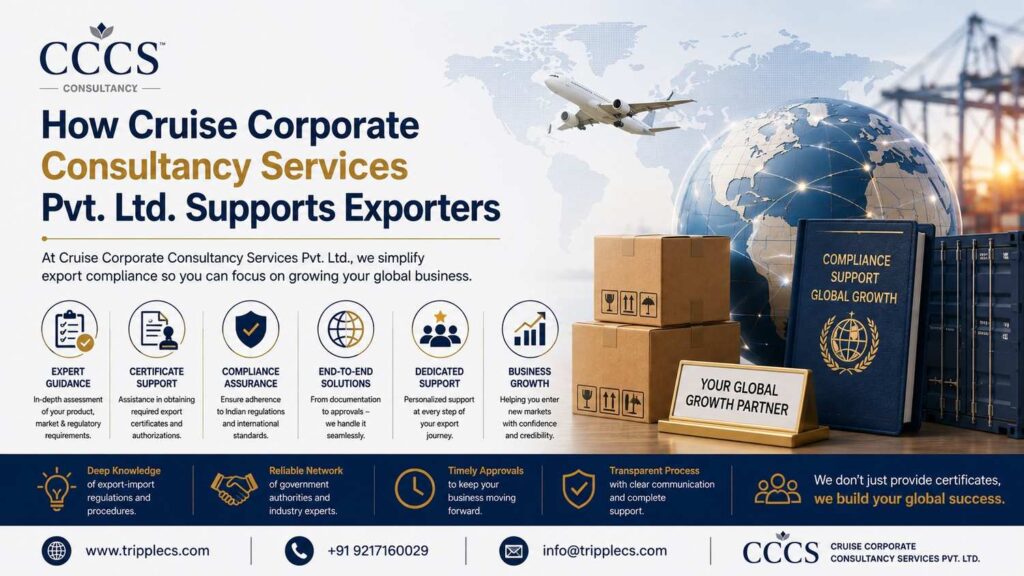
How Cruise Corporate Consultancy Services Pvt. Ltd. Supports Exporters
At Cruise Corporate Consultancy Services Pvt. Ltd., our approach begins with understanding the export requirement behind the document request.
The objective is not merely to complete paperwork.
We help businesses examine their product category, commercial situation and applicable compliance requirements so that they can approach export documentation with greater clarity.
For companies entering new international markets, professional guidance can also help connect individual certificates with the wider export-compliance picture.
That becomes increasingly useful as the company expands into more products and destinations.
The Best Time to Discuss the Certificate Is Before the Buyer Starts Waiting
International business depends heavily on confidence.
A buyer wants to know that the exporter can deliver the product.
But professional exporters also demonstrate that they understand the documentation associated with the transaction.
When certificate requirements are identified early, businesses have more room to coordinate internally, clarify buyer expectations and address regulatory questions without turning them into last-minute emergencies.
A Free Sale Certificate for Export should therefore not be viewed as paperwork that appears after an export order.
For businesses entering markets where such evidence is requested, it can be part of preparing the product for international opportunity.
Planning to Export Your Products?
If an overseas buyer has requested a Free Sale Certificate for Export, or your business is uncertain about the certificate applicable to its product category, professional assessment can help you understand the requirement before proceeding.
Cruise Corporate Consultancy Services Pvt. Ltd.
🌐 Website: tripplecs.com
📞 Phone: +91 9217160029
Our consultants support businesses with export, import, certification and regulatory compliance requirements based on their products and commercial circumstances.
A foreign order opens the door to a new market. Good compliance planning helps your business walk through it with confidence.