
An overseas buyer asks for a Free Sale Certificate.
The immediate reaction of many exporters is to search for the application process and start preparing documents.
But there is a more important question to answer first:
Are you applying for the right certificate through the right authority for your product?
A Certificate of Free Sale Application should not be treated as identical for every business or product category. The relevant authority, supporting information and regulatory route can vary depending on the product, its regulatory status and the purpose for which the certificate has been requested.
That makes understanding the requirement more important than simply completing an application.
What Is a Certificate of Free Sale Application?
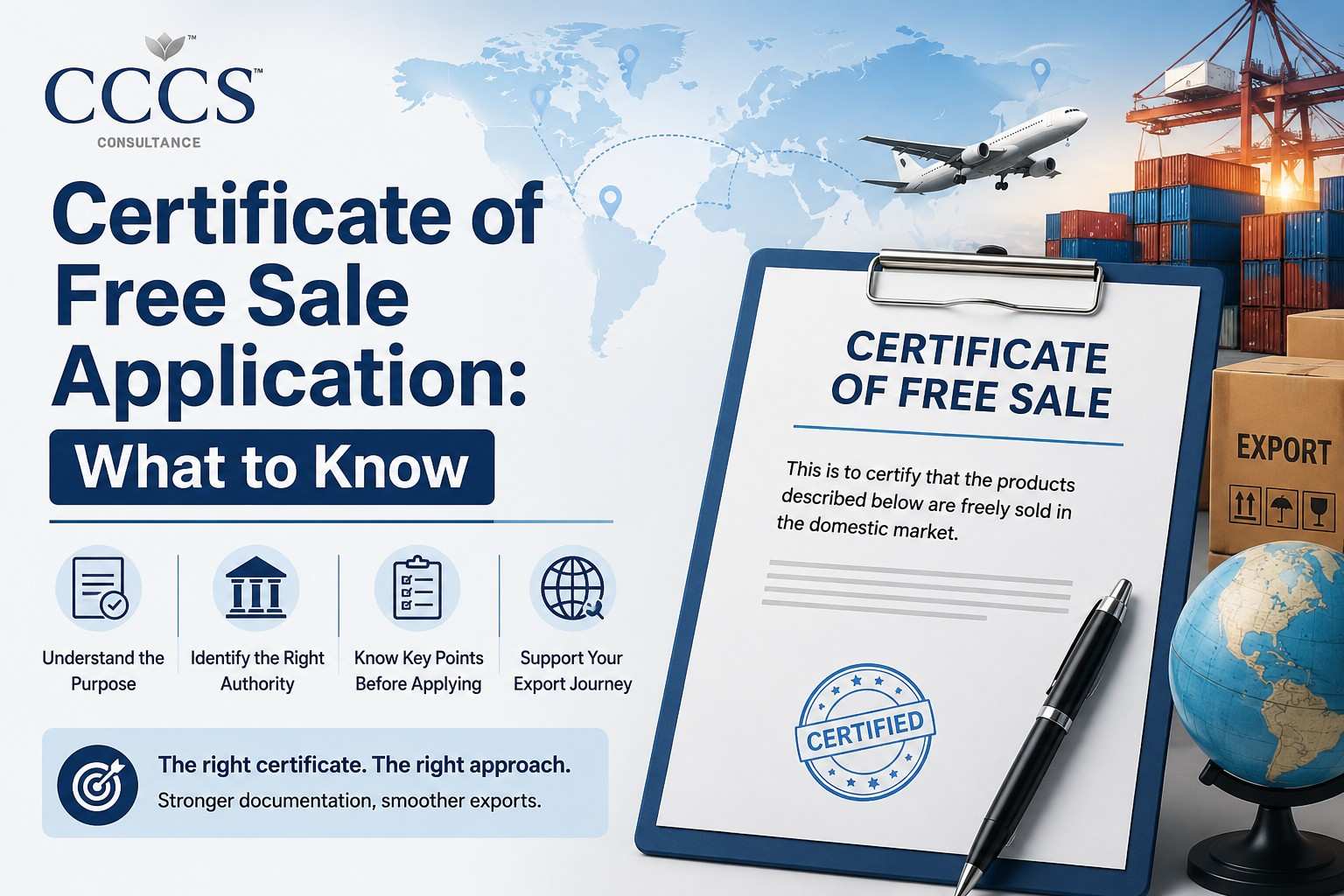
A Certificate of Free Sale Application is generally a request made to the relevant authority for a certificate concerning the sale or regulatory status of applicable products in the domestic market, often for an export-related purpose.
However, businesses should not assume that every product follows one universal route.
Different products can fall within different regulatory frameworks. The authority relevant to one category may therefore not be the same for another.
For an exporter, the better starting point is not:
“Where is the application form?”
It is:
“Which certificate and authority are relevant to our product?”
That one question can prevent a business from spending time preparing the wrong application.
Your Buyer Asked for a Certificate. What Exactly Did They Mean?
Imagine receiving an email from a new international buyer:
“Please provide the Free Sale Certificate for product registration.”
It sounds clear.
But several questions remain unanswered.
Which products need to be covered?
Is the certificate being requested directly by the buyer or because an authority in the destination country requires it?
Does the foreign authority expect a particular certificate format?
Is your product subject to a specific regulatory framework in India?
Businesses planning international sales can first understand the broader purpose of a Free Sale Certificate for Export, particularly when an overseas buyer requests evidence connected with the product’s status in its home market.
A certificate request should therefore be understood before an application begins.
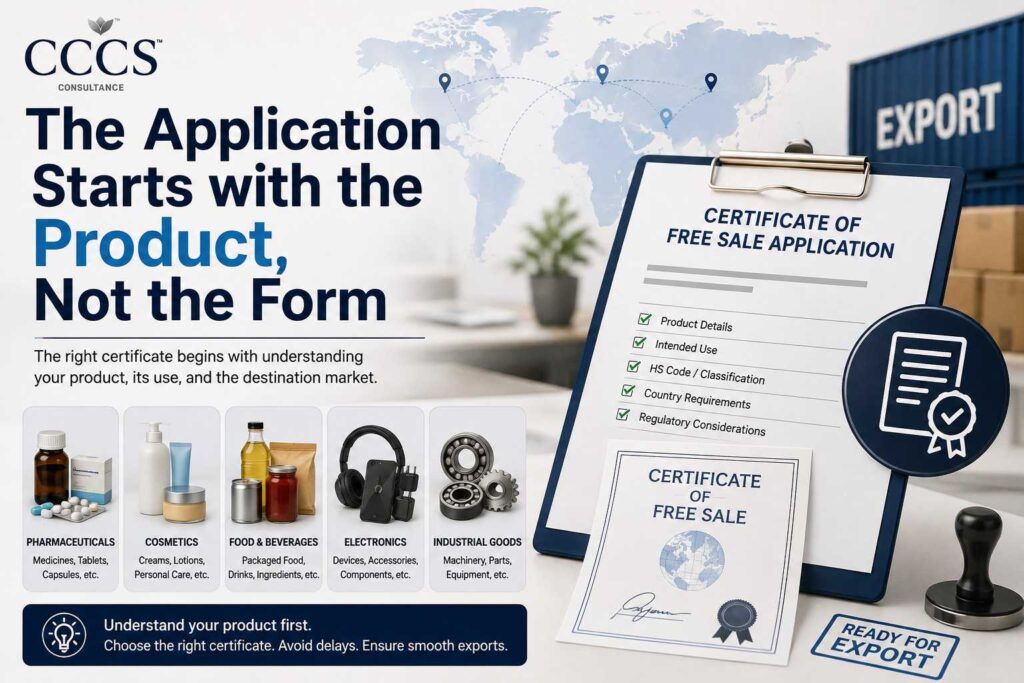
The Application Starts with the Product, Not the Form
Consider three exporters.
One manufactures medical devices.
Another deals in cosmetic products.
A third exports a different category of manufactured goods.
All three may receive a request containing the words “Free Sale Certificate.”
That does not automatically mean their application routes are identical.
This is where businesses can make an avoidable mistake.
They search for the certificate name online, find an application procedure and start preparing documents without confirming whether that information applies to their product category.
The certificate name is only one part of the picture.
Product identity and the applicable regulatory framework matter too.
Four Questions Worth Answering Before You Apply
Before an application moves forward, a business should be clear about four basic issues.
What exactly is the product?
Its category and regulatory status can influence which authority or certificate route deserves consideration.
Who has requested the certificate?
Understanding whether the request originates from the overseas buyer, distributor or destination-country authority provides useful context.
Where will the product be exported?
Documentation expectations may vary between markets.
Which Indian authority is relevant to the product?
This should be established before treating a particular application route as applicable.
Answering these questions does not make compliance more complicated.
It makes the next decision more informed.
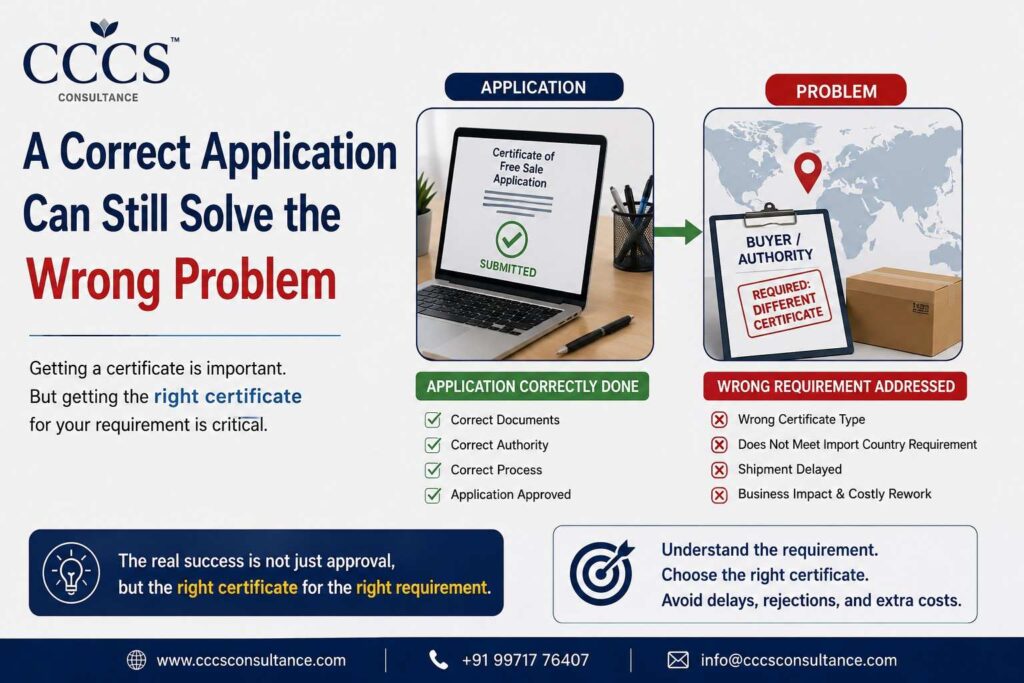
A Correct Application Can Still Solve the Wrong Problem
An exporter may complete every field correctly.
The product information may be accurate.
Supporting documents may be properly organized.
The application itself may look perfect.
Then the overseas buyer responds:
“This isn’t the certificate our authority requested.”
The paperwork was not necessarily the problem.
The requirement was misunderstood before the paperwork began.
This distinction is important.
Efficient compliance is not simply about completing an application without errors.
It is about pursuing the correct regulatory outcome from the beginning.
Product Information Should Tell One Consistent Story
Export documentation often moves through several departments.
The sales team may use the commercial product name.
Marketing may use a brand name.
Manufacturing records may contain a technical description.
Invoices may contain another variation.
The overseas buyer may describe the same product differently again.
These differences can become important when information is being used for regulatory or certification purposes.
Before preparing a Certificate of Free Sale Application, businesses should review how relevant product information appears across their records.
The objective is not to make every document look identical.
The objective is to ensure that the product being certified can be clearly understood and connected with the product being exported.
Don’t Assume an Earlier Export Gives You the Answer
Previous export experience is valuable.
But it can also create false confidence.
Suppose your company exported one product to a particular country two years ago and obtained the required documentation successfully.
Now a different buyer from another country requests a Free Sale Certificate for a new product.
Using the previous file as a reference may help.
Automatically copying the earlier approach may not.
The product has changed.
The destination has changed.
The buyer has changed.
The regulatory expectation may also be different.
Businesses should therefore treat previous certificates as useful records—not universal templates for every future export.
When an Application Gets Delayed, the Real Problem May Be Older
Companies usually notice a compliance problem when something stops moving.
An application requires clarification.
Additional information is requested.
A buyer questions the certificate.
A product description does not align with other records.
At that point, everyone focuses on fixing the application.
But sometimes the real problem began much earlier.
It began when the company received a certificate request and started acting without first understanding exactly what was needed.
This is why preparation should not be measured only by how quickly a company can submit.
Clarity before submission can be more valuable than speed after submission.
More Documents Do Not Automatically Create a Better Application
When businesses are uncertain, they sometimes start collecting everything.
Company documents.
Invoices.
Product brochures.
Manufacturing information.
Licences.
Declarations.
Old certificates.
Additional supporting records.
It can feel safer to have more paperwork available.
But regulatory applications are not judged by the size of the document folder.
What matters is whether the information and documents are relevant to the applicable requirement.
A more effective approach is to establish the correct certificate route first and then understand what information is relevant to that route.
This keeps the application focused and makes genuine documentation gaps easier to identify.
The Destination Market Still Matters
A certificate may originate in India, but the reason for obtaining it may exist overseas.
That makes the destination market an important part of the discussion.
An exporter should understand why the foreign buyer wants the certificate and what it intends to do with it.
For example, it may form part of a product registration, commercial approval or another destination-market requirement.
This is also why businesses should not interpret a Free Sale Certificate as universal approval for every country.
The importing country can have additional requirements of its own.
Exporters looking at the wider market-entry context can refer to our guide on Free Sale Certificate for Export, which explains why overseas buyers may request such documentation and why the destination market should be considered early.
One Certificate Name Can Cover Different Business Situations
The phrase “Free Sale Certificate” can appear across different industries.
That makes online research difficult.
An article discussing one regulated product category may appear beside information written for a completely different type of business.
Both may use similar certificate terminology.
Their underlying requirements may still differ.
This is why businesses should avoid combining information from several sources into a self-created application procedure.
The more useful approach is to establish:
Product → applicable regulatory framework → relevant authority → appropriate certificate route.
That sequence provides a stronger foundation than starting with the certificate name alone.
When Professional Review Becomes Valuable
Not every application requires extensive consultation.
But professional review can become particularly useful when the business is:
exporting a product for the first time,
entering a new overseas market,
uncertain about the relevant authority,
dealing with several product categories,
receiving an unclear request from a foreign buyer,
or finding inconsistencies across existing product documentation.
In these situations, the value of professional assistance is not simply filling in an application.
The more important value is helping the business understand what it should be applying for and why.
How Cruise Corporate Consultancy Services Pvt. Ltd. Approaches the Requirement
At Cruise Corporate Consultancy Services Pvt. Ltd., we prefer to understand the commercial and regulatory context before treating certification as a paperwork exercise.
What is being exported?
Which market is the business entering?
What has the overseas buyer requested?
What regulatory framework applies to the product?
These questions provide context for evaluating the appropriate course of action.
For businesses preparing a Certificate of Free Sale Application, this approach can help identify relevant considerations before unnecessary time is spent following an unsuitable route.
The objective is not to add complexity.
It is to remove uncertainty before that uncertainty becomes a business problem.
Before You Submit, Ask One Final Question
Businesses naturally want to know whether an application is complete.
There is another question worth asking first:
“If this certificate is issued, will it actually address what our overseas buyer or destination market requires?”
If the answer is clear, the business can move forward with greater confidence.
If the answer remains uncertain, that uncertainty deserves attention before submission.
A well-prepared application is valuable.
A well-understood requirement is even more valuable.
Need Assistance with a Certificate of Free Sale Application?
If your business has received a Free Sale Certificate request from an overseas buyer and you are uncertain about the appropriate certificate or regulatory route, professional guidance can help you understand the requirement before proceeding.
Cruise Corporate Consultancy Services Pvt. Ltd.
🌐 Website: tripplecs.com
📞 Phone: +91 9217160029
Our team supports businesses with export documentation, certifications and regulatory compliance requirements according to their products and commercial circumstances.
A good application doesn’t begin with a form. It begins with understanding exactly what the business needs.