
For a cosmetic brand, getting interest from an overseas buyer can feel like the difficult part is already over.
The product is ready. Packaging has been finalized. Samples may have been approved, and commercial discussions have started.
Then the buyer asks for a Free Sale Certificate for Cosmetic Products.
For businesses dealing with this requirement for the first time, the certificate can raise an important question: What does a Free Sale Certificate actually establish, and why might it be requested for cosmetic products?
In simple terms, a Free Sale Certificate is generally used as supporting evidence concerning the sale or marketing status of specified products in a particular country. In an export transaction, an overseas buyer or destination-market authority may request such evidence as part of its own regulatory or commercial requirements.
However, having a Free Sale Certificate does not automatically authorize a cosmetic product for sale in every country. The destination market can have additional cosmetic regulations of its own.
That distinction is especially important for cosmetic exporters.
Why Can a Free Sale Certificate Matter for Cosmetics?
Cosmetics travel differently from ordinary merchandise.
A distributor isn’t simply buying cartons of face cream, shampoo or serum. It may also need documentation to support the products when dealing with regulators, retailers or other parties in its own country.
This is why a request for a Free Sale Certificate for Cosmetic Products should be viewed in the context of the market the business wants to enter.
The overseas party may be trying to establish information about the products in their country of origin before proceeding further.
But the words “Free Sale Certificate” alone do not tell an exporter everything it needs to know.
The better questions are:
Which cosmetic products are involved?
Why has the certificate been requested?
Who will use it?
What does the destination market expect it to demonstrate?
Those answers give the certificate request commercial context.
A Cosmetic Brand Is Not a Single Product
This distinction is easy to miss.
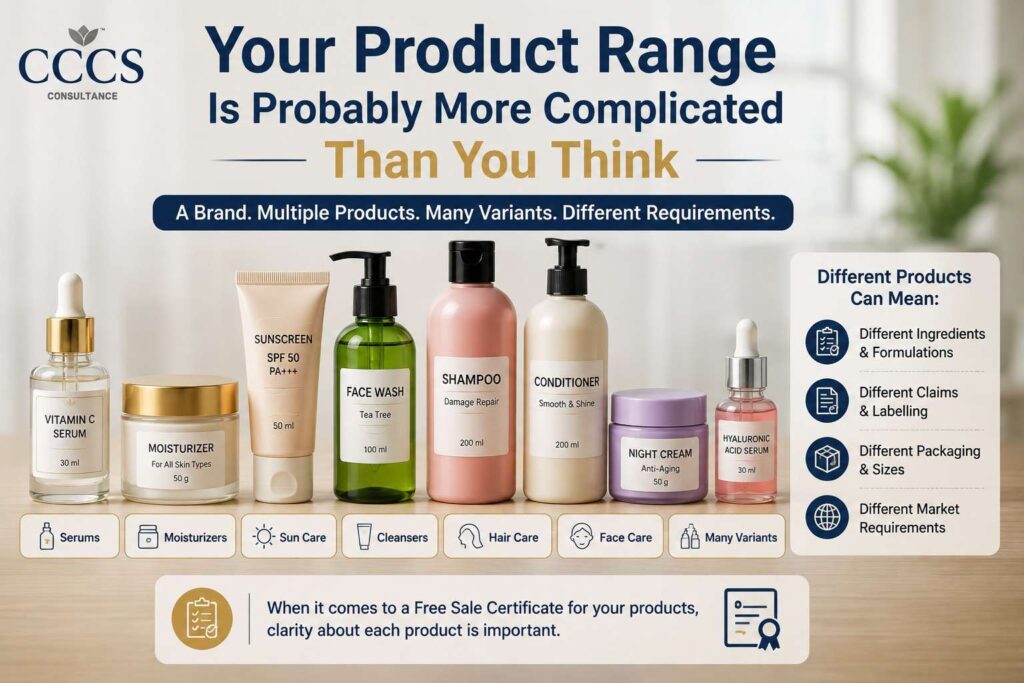
Suppose a company owns the brand ABC Beauty.
Under that brand it sells:
- face serum,
- moisturizer,
- sunscreen,
- shampoo,
- face wash,
- night cream,
- and several variants of each.
Commercially, the company may think:
“ABC Beauty is our cosmetic brand.”
For documentation purposes, however, the individual products and applicable variants can matter.
The overseas buyer may not be importing the entire brand portfolio. It may be interested in only five products.
That means businesses should know exactly which products are connected with the certificate request rather than treating the brand name alone as sufficient.
This becomes increasingly important as cosmetic portfolios grow.
The Product on the Certificate Should Be the Product the Buyer Recognizes
Imagine an overseas buyer orders:
Vitamin C Brightening Serum – 30 ml
But company records describe the product in several ways:
Marketing calls it Vitamin C Brightening Serum.
Internal manufacturing records use a technical product description.
The invoice uses an abbreviated name.
The overseas buyer has another description in its registration file.
Individually, these differences may have legitimate reasons.
But when regulatory documentation is involved, unclear product identity can create avoidable questions.
Cosmetic exporters should therefore pay attention to consistency between relevant product information and the products involved in the international transaction.
Good export documentation should make it easy to understand which product is being discussed.
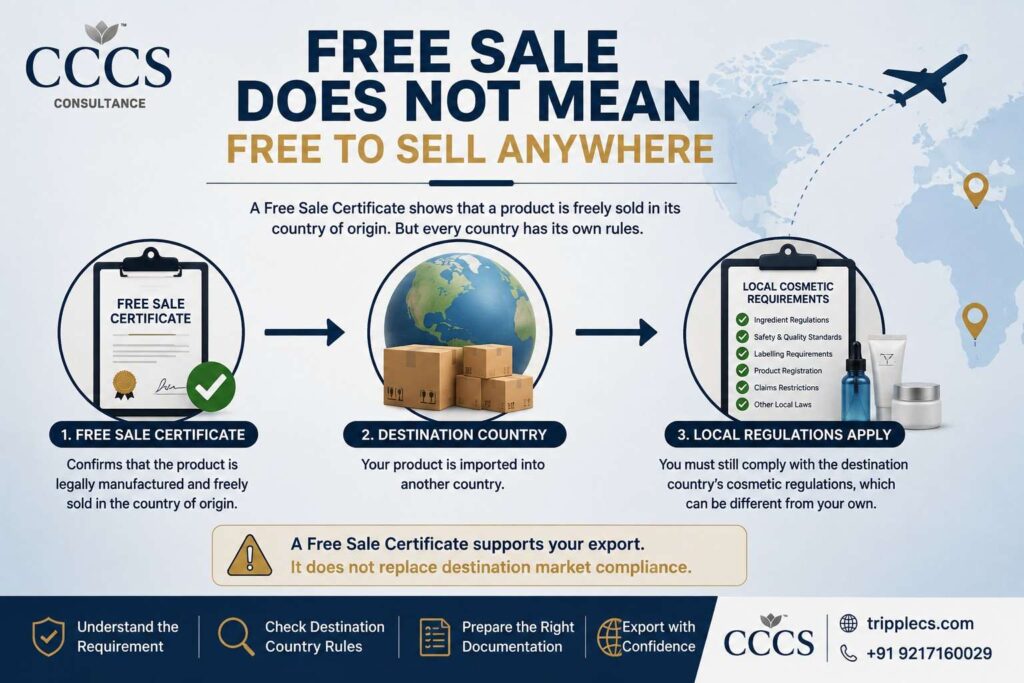
“Free Sale” Does Not Mean “Free to Sell Anywhere”
This is one of the most important misunderstandings to avoid.
A Free Sale Certificate for Cosmetic Products should not be interpreted as a worldwide cosmetic approval.
Suppose a cosmetic is marketed in its home country and supporting free-sale documentation is available.
The company now wants to enter another country.
That destination may still have requirements concerning matters such as:
- ingredients,
- product classification,
- labelling,
- safety information,
- claims,
- product notification or registration,
- local representation,
- or other cosmetic regulations.
Requirements vary by jurisdiction.
Therefore, exporters should think of the certificate as one possible part of market-entry documentation, rather than a replacement for destination-country compliance.
The Most Expensive Question Can Be the One Asked Too Late
Picture this situation.
Your overseas distributor approves the samples.
Prices are finalized.
Packaging is printed.
Production begins.
A shipment date is discussed.
Then someone asks:
“Where is the Free Sale Certificate?”
Now the certificate is no longer simply a compliance requirement.
It has become a deadline.
The business has less time to understand what is required, check its product information and respond to the overseas party.
This is why export documentation deserves attention during commercial planning—not only when the shipment is ready.
The earlier a business understands the buyer’s regulatory expectations, the more confidently it can plan the export.
Your Distributor’s Request Deserves One More Conversation
If an overseas distributor asks for a Free Sale Certificate, don’t assume the certificate name tells you everything.
Ask what the document will be used for.
For example:
Is the distributor collecting it for its own records?
Is a regulatory authority requesting it?
Does the destination country expect particular product information?
Does the requirement cover all variants or selected products?
Does the receiving party expect a particular form of certification?
This conversation can prevent an exporter from spending time pursuing documentation that does not satisfy the actual requirement.
Understanding the requirement first is not a delay. It is part of avoiding one.
What Is a Certificate of Free Sale?
Businesses researching cosmetic export requirements may encounter several similar searches:
Free Sale Certificate
Certificate of Free Sale
Free Sales Certificate
Certificate of Free Sale for Export
The terminology can vary across searches and commercial communications.
Broadly, these terms relate to documentation concerning the sale or marketing status of products in a country or market. But businesses should not assume every similarly named document, authority or procedure is interchangeable.
If you’re new to the subject, our Free Sale Certificate for Export guide explains the broader role of free-sale-related documentation when overseas buyers request it.
For cosmetic exporters, the next step is then to determine how that broader requirement relates specifically to the cosmetic products being exported.
Cosmetics Deserve a Product-Specific Review
Why not simply use the same approach as another exporter?
Because two cosmetic businesses can look similar while having very different products.
One sells ordinary skin moisturizers.
Another sells products using different ingredients or making different claims.
Another has several formulations under the same product family.
Another manufactures products for third-party brands.
The commercial category may be “cosmetics” for all four.
Their underlying circumstances are not necessarily identical.
That’s why businesses should avoid copying another company’s certification approach simply because both operate in the beauty industry.
Compliance should follow the product—not the competitor.
Claims Can Matter as Much as Packaging
Cosmetic marketing is built around claims.
Hydrating.
Brightening.
Anti-ageing.
Skin soothing.
Hair strengthening.
These descriptions help consumers understand products.
But businesses entering foreign markets should also recognize that product claims can interact with regulatory classification and requirements depending on the jurisdiction.
A company should therefore consider not only:
“What is inside our product?”
but also:
“How are we presenting this product?”
A certificate cannot compensate for every other regulatory issue surrounding a product.
That is another reason the Free Sale Certificate for Cosmetic Products should be considered within the wider export-compliance picture.
Where Does the Application Fit In?
Once the business understands why the certificate has been requested, attention naturally turns toward the application.
But application preparation should follow clarity about the product and requirement—not replace it.
We’ve covered this broader issue separately in our Certificate of Free Sale Application guide, including why businesses should understand the appropriate certificate route before treating the requirement as a form-filling exercise.
This internal structure is intentional.
The articles answer different questions:
Free Sale Certificate for Export → Why might exporters encounter the certificate?
Certificate of Free Sale Application → What should businesses understand before approaching an application?
Free Sale Certificate for Cosmetic Products → What does the requirement mean specifically for cosmetic businesses?
This gives each page its own search purpose instead of creating three versions of the same article.
Manufacturing Evidence and Free Sale Are Also Connected—but Not Identical
An overseas party may sometimes ask questions not only about a product’s sale status but also about its manufacturer.
This can introduce terminology around a Certificate of Manufacture and Free Sale.
That topic deserves separate treatment because manufacturing evidence and free-sale-related evidence should not automatically be collapsed into the same requirement.
Businesses receiving such a request should understand exactly what the buyer or destination authority expects the documentation to establish.
Certificate of Manufacture and Free Sale to your existing article on that keyword.
This gives users who have a more specific requirement a logical next page instead of forcing all certificate topics into one article.
When Should a Cosmetic Business Seek Professional Guidance?
A straightforward request may become more complicated when:
the company has several products or variants,
the destination market is new,
the overseas buyer uses unfamiliar certificate terminology,
the manufacturer and brand owner are different businesses,
product descriptions vary across records,
or the company isn’t sure which regulatory route applies.
In those situations, professional guidance can help clarify the requirement before the company makes commitments based on assumptions.
The objective isn’t to turn every certificate request into a complicated project.
It’s to identify genuine regulatory questions early.
How CCCS Supports Cosmetic Exporters
At Cruise Corporate Consultancy Services Pvt. Ltd., we begin by understanding the product and the reason behind the documentation request.
For a Free Sale Certificate for Cosmetic Products, that means looking beyond the certificate name.
What cosmetics are being exported?
Which products or variants are involved?
Where are they going?
What has the overseas buyer requested?
What is the intended purpose of the documentation?
These questions help put the certificate request into the correct business context.
Our role is to support businesses in understanding relevant certification, export documentation and compliance considerations according to their products and commercial requirements.
Before Your Cosmetics Enter a New Market
International expansion can begin with something as simple as an email from a distributor.
But turning that enquiry into sustainable business requires more than a good product.
It requires preparation.
If a Free Sale Certificate for Cosmetic Products has been requested, don’t look at the certificate in isolation.
Look at the product.
Look at the variants.
Look at the buyer’s requirement.
And most importantly, look at the destination market.
A certificate can support an export opportunity. Understanding why the certificate is needed helps protect that opportunity.
Need Assistance with a Free Sale Certificate for Cosmetic Products?
If your overseas buyer or distributor has requested free-sale-related documentation for cosmetic products, our team can help you understand the requirement in relation to your products and intended export market.
Cruise Corporate Consultancy Services Pvt. Ltd.
🌐 Website: tripplecs.com
📞 Phone: +91 9217160029
Discuss your cosmetic export and certification requirements with our compliance team before documentation becomes a last-minute issue.