
A medical device manufacturer can have a licensed product, established production and an interested overseas buyer—and still face an additional documentation request before the export moves forward.
One such request is a Free Sale Certificate for Medical Devices.
For Indian manufacturers, this is more than a generic export certificate. CDSCO has specific guidance covering Free Sale Certificates for licensed medical devices in India, including who can apply, where the application goes and what information is expected.
The important question for an exporter is therefore not simply:
“How do I get a Free Sale Certificate?”
It is:
“Does my device, manufacturing licence and intended export requirement fit the applicable Free Sale Certificate route?”
Understanding that first can prevent unnecessary delays later.
What Is a Free Sale Certificate for Medical Devices?
A Free Sale Certificate for Medical Devices is a certificate that an eligible Indian medical-device manufacturer may obtain from the relevant Licensing Authority for export purposes.
According to CDSCO’s current guidance, the framework applies to medical-device manufacturers in India who hold a valid manufacturing licence and intend to obtain an FSC for export.
The certificate may also be requested in connection with procurement or tender requirements. CDSCO’s medical-device FAQ specifically recognizes Free Sale Certificates among certificates that may be requested for procurement, tendering or export purposes.
That makes the certificate particularly relevant when an international commercial opportunity moves from a sales discussion into documentation and regulatory review.
The First Question Is Not “Which Documents Do I Need?”
This is where many businesses start too quickly.
They receive a request for an FSC and immediately begin collecting documents.
But medical devices have an additional consideration:
What class is the device?
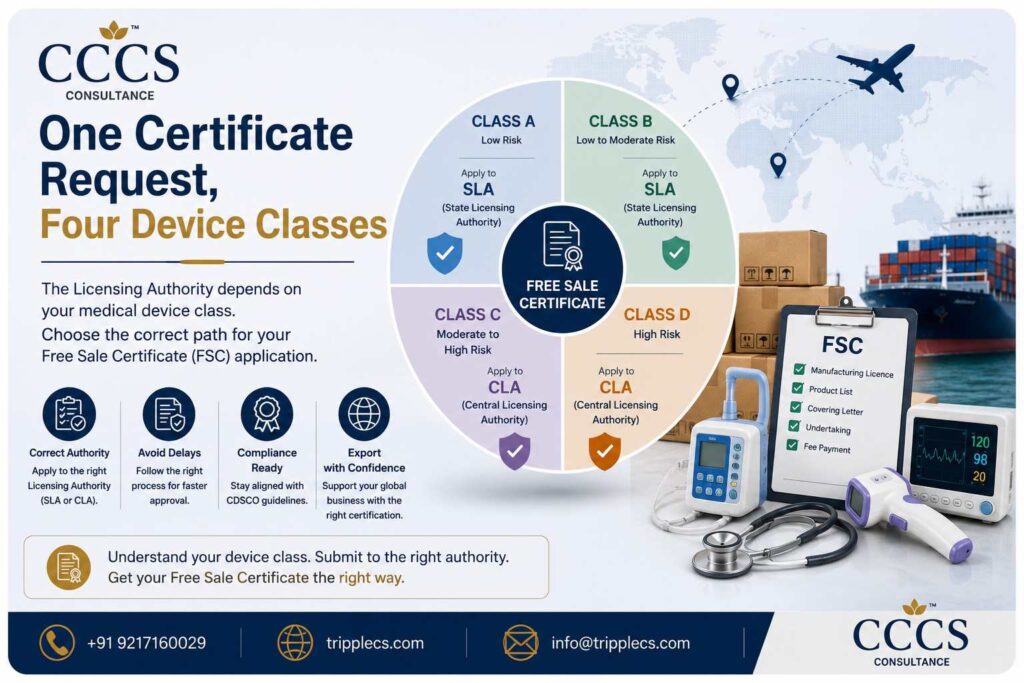
Under CDSCO’s current FSC guidance, applications for Class C and Class D medical devices covered by a valid manufacturing licence are made to the Central Licensing Authority (CLA).
For Class A and Class B medical devices licensed for manufacture for sale or distribution under the Medical Devices Rules, 2017, applications are made to the State Licensing Authority (SLA).
So classification is not merely a technical detail sitting somewhere in the regulatory file.
It can affect where the FSC application needs to go.
One Certificate Request, Four Device Classes
Consider two Indian manufacturers.
Company A manufactures a Class B medical device.
Company B manufactures a Class D medical device.
Both receive the same email from overseas buyers:
“Please provide a Free Sale Certificate.”
Commercially, the requests look identical.
Regulatorily, the route is not necessarily identical.
That’s why copying another medical-device company’s FSC approach can create confusion.
The correct starting point is your own:
device → classification → manufacturing licence → relevant Licensing Authority.
This is also what makes medical-device FSC content different from a general Free Sale Certificate for Export.
Who Can Apply for the Certificate?
This deserves a direct answer because not every business involved in an export transaction should assume it has the same eligibility.
CDSCO’s 2024 guidance states that the scope covers medical device manufacturers in India having a valid manufacturing licence who intend to obtain a Free Sale Certificate for export.
This distinction matters.
An export transaction can involve:
manufacturer → brand owner → distributor → exporter → overseas buyer.
But those commercial roles do not automatically make every party equivalent for regulatory purposes.
Before planning an FSC application, businesses should identify the licensed manufacturer and confirm the regulatory position of the devices concerned.
What Does CDSCO Expect in the Application?
Once eligibility and the appropriate authority are clear, documentation becomes important.
CDSCO’s current guidance identifies several application elements.
The covering letter should explain the intent of the application and identify the submitted documents and other relevant information. It should be signed and stamped by the authorized signatory with appropriate firm details.
The system-generated application should reflect the manufacturing licence number and product list for which the FSC is being requested.
This sounds administrative, but it highlights something commercially important:
The product list matters.
A company may manufacture dozens of medical devices while an overseas buyer wants only a specific group.
Businesses should therefore avoid approaching the FSC as though the company name alone determines what is covered.
The products for which the certificate is required deserve careful attention.
The Manufacturing Licence Is More Than an Attachment
An important connection exists between the FSC and the manufacturer’s existing regulatory position.
CDSCO’s guidance requires applicants to be licensed medical-device manufacturers, while the system-generated FSC application reflects the relevant manufacturing licence number and requested product list.
That means businesses should check consistency before submission.
For example, ask:
Is the manufacturing licence valid?
Are the relevant devices properly reflected in the approved/licensed product information?
Does the FSC request identify the intended products correctly?
Are company and licence details consistent?
A polished application cannot compensate for an underlying mismatch in regulatory information.
How Long Is a Free Sale Certificate Valid?
This is another question exporters frequently need answered before sharing timelines with overseas buyers.
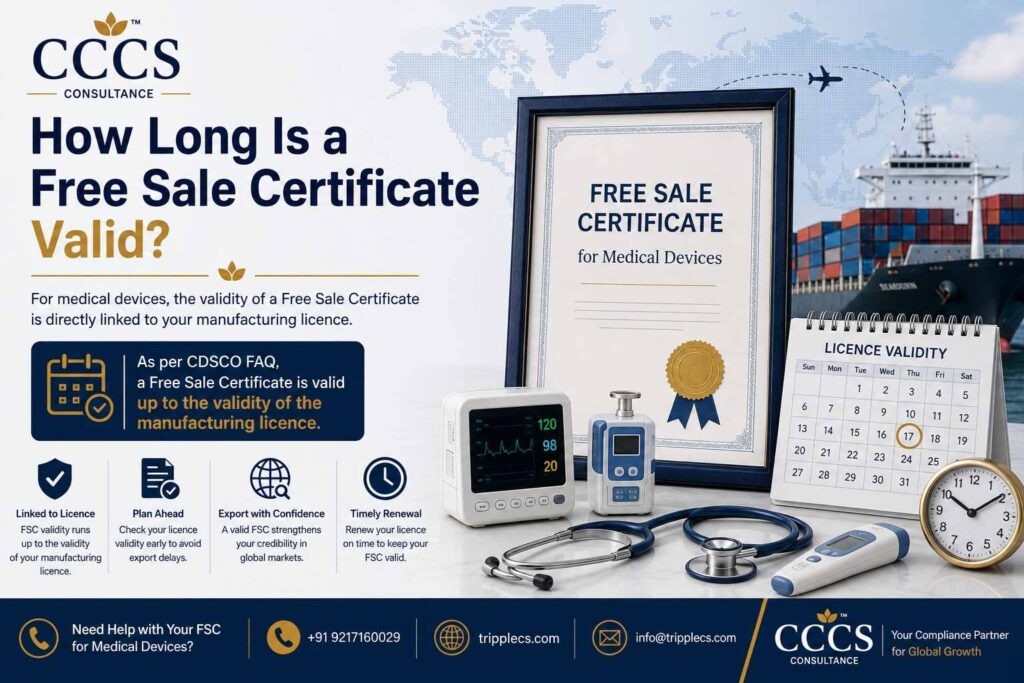
According to CDSCO’s medical-device FAQ, a Free Sale Certificate issued by the Licensing Authority is valid up to the validity of the manufacturing licence.
This creates an important practical connection.
The FSC should not be viewed entirely separately from the manufacturer’s licence status.
If an overseas project has a long commercial timeline, businesses should understand both the certificate requirement and the underlying licence validity rather than looking only at the date on one document.
The Buyer Says “FSC Required.” What Should You Ask Next?
This is where regulatory compliance meets commercial reality.
Suppose a distributor in another country asks for a Free Sale Certificate.
Before promising delivery, ask:
Which devices must appear on the certificate?
Is the certificate required by a regulatory authority, procurement agency or the buyer itself?
Does the destination country have any specific expectations for the document?
Is additional authentication or supporting documentation expected in that market?
These questions do not replace Indian FSC requirements.
They help establish whether obtaining the Indian certificate will actually satisfy the overseas party’s requirement.
That distinction matters because the ultimate purpose is not simply to obtain paperwork.
It is to support the export transaction with the correct paperwork.
Free Sale Does Not Mean Global Market Approval
This deserves particular attention with medical devices.
Receiving a Free Sale Certificate for Medical Devices from the appropriate Indian Licensing Authority should not be interpreted as automatic authorization to sell the device in every foreign country.
The importing country may have its own medical-device regulatory framework.
Depending on the market and device, additional requirements can apply before the product can legally be placed on that market.
So:
Indian FSC ≠ worldwide medical-device approval
The FSC can support an export or overseas regulatory requirement where applicable, but the destination country’s rules remain a separate consideration.
This is one of the most important things an exporter should clarify with its overseas regulatory partner or adviser.
When the Product List Creates the Delay
Imagine a manufacturer has a valid licence covering several devices.
An overseas buyer requests an FSC for three specific models.
The sales team sends commercial product names.
The regulatory team works from the licensed product list.
The overseas distributor uses model numbers.
Now three teams are discussing the same devices in three different ways.
This doesn’t automatically mean anything is wrong.
But it creates room for questions.
Before filing, businesses should ensure that the devices requested for the FSC can be clearly connected to the relevant regulatory records.
This is especially valuable when a manufacturer has:
multiple device families,
several models,
different configurations,
large product portfolios,
or different commercial names across markets.
Product clarity before application is easier than product clarification after submission.
Don’t Confuse FSC with Every Other Export Certificate
Medical-device exporters may encounter several regulatory documents during international business.
For example, CDSCO separately recognizes Free Sale Certificates, Market Standing Certificates and Non-Conviction Certificates in its medical-device framework.
They should not automatically be treated as interchangeable simply because an overseas buyer requests “a certificate from the regulator.”
The purpose of the requested document matters.
Similarly, businesses researching the broader application concept can read our Certificate of Free Sale Application article.
A Common Mistake: Promising the Certificate Before Checking the Device
International sales teams naturally want to move quickly.
A buyer asks:
“Can you provide an FSC?”
The salesperson replies:
“Yes.”
Only afterwards does the regulatory team check the product, classification, licence and certificate requirement.
That order creates unnecessary pressure.
A better business workflow is:
Buyer request → identify devices → check classification/licence → understand destination requirement → confirm FSC route → commit timeline.
This may add a little work at the beginning.
It can remove much more work later.
When Should Professional Support Be Considered?
Not every FSC enquiry has to become complicated.
But professional guidance can be particularly useful when:
- the company is exporting medical devices for the first time,
- several device classes or product categories are involved,
- the buyer has given unclear certificate instructions,
- there is uncertainty about the relevant Licensing Authority,
- commercial product descriptions differ from regulatory records,
- or the business needs to understand how the Indian FSC fits into a foreign-market requirement.
The purpose of professional support should be to create clarity—not unnecessary paperwork.
How CCCS Supports Medical Device Businesses
At Cruise Corporate Consultancy Services Pvt. Ltd., we approach medical-device export documentation from the regulatory and commercial context of the product.
For businesses seeking a Free Sale Certificate for Medical Devices, that means understanding the device, its classification, manufacturing licence, relevant product information and the purpose for which the certificate has been requested.
This helps businesses approach the requirement with better clarity before regulatory paperwork becomes a last-minute export issue.
Our team supports businesses with certification, regulatory compliance and export documentation requirements based on their specific circumstances.
Before You Commit an Export Date
An overseas buyer asking for documentation can be a good sign.
The commercial discussion is moving forward.
But medical-device exporters should resist the temptation to treat the FSC as just another certificate to collect.
Start with the device.
Confirm the classification.
Check the manufacturing licence.
Identify the relevant Licensing Authority.
Understand which products need the certificate.
And confirm what the destination market expects.
A Free Sale Certificate for Medical Devices can support an international opportunity—but its value comes from using the correct certificate for the correct devices and purpose.
Need Assistance with a Free Sale Certificate for Medical Devices?
If your business needs guidance regarding a Free Sale Certificate for Medical Devices for export purposes, Cruise Corporate Consultancy Services Pvt. Ltd. can assist you in understanding the applicable requirements based on your medical devices and regulatory situation.
Cruise Corporate Consultancy Services Pvt. Ltd.
Website: tripplecs.com
Phone: +91 9217160029
Prepare the regulatory side of your export before it becomes the reason your shipment has to wait.