


An overseas buyer is ready to place an order. Your product is manufactured in India, your commercial documents are prepared, and the shipment plan looks complete.
Then the buyer asks for one more document:
“Please provide a Certificate of Manufacture and Free Sale.”
For many exporters, this is where confusion begins.
Is it the same as a Free Sale Certificate? Who issues it? Does every exporter need one? Can a merchant exporter apply? And most importantly, what exactly is the foreign buyer trying to verify?
A Certificate of Manufacture and Free Sale is generally used to provide documentary evidence regarding a product’s manufacturing status and its lawful sale in the country of origin. Depending on the product and destination country, the exact certificate name, issuing authority and supporting documents may differ.
That difference matters.
Before applying for any certificate simply because a buyer has requested one, an exporter should first identify what the importing country actually requires for that particular product.
Why Foreign Buyers Ask for a Certificate of Manufacture and Free Sale
International buyers do not know your domestic regulatory system as well as you do.
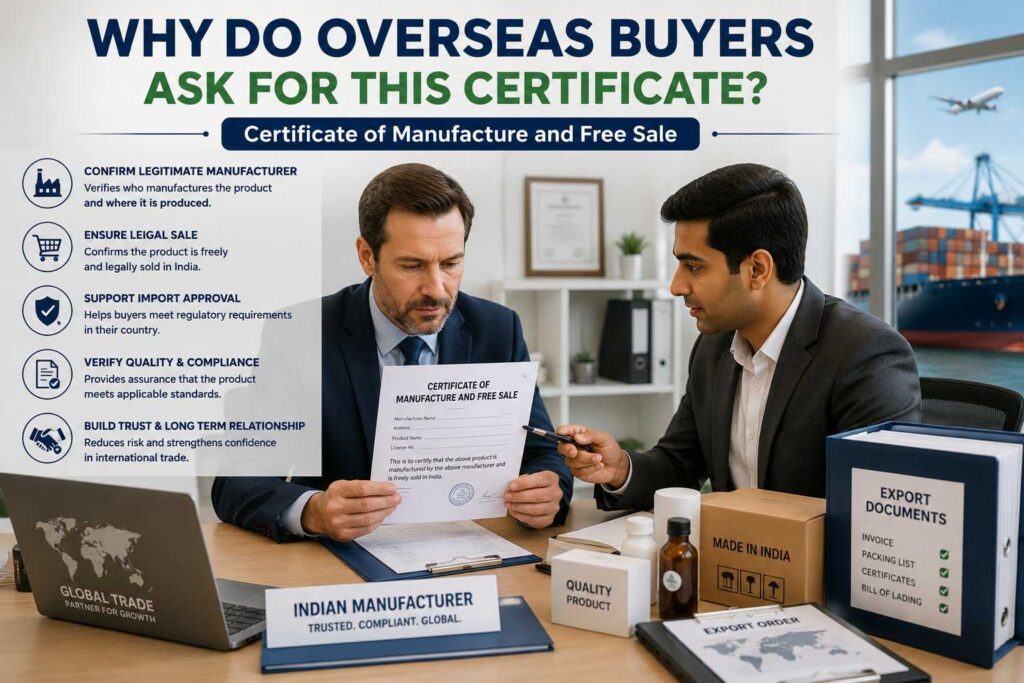
When they purchase a regulated or commercially sensitive product from another country, they may want evidence that the product is not being manufactured only for export with no recognised domestic status.
A Certificate of Manufacture and Free Sale may therefore help establish information such as:
- who manufactures the product;
- where the product is manufactured;
- whether it can legally be marketed in its country of origin;
- whether the manufacturer holds the applicable licence or approval; and
- which products or variants are covered by the certificate.
For the foreign buyer, this is not simply another piece of paperwork.
It can form part of its product registration, import approval, distributor onboarding or regulatory submission in the destination country.
This is why exporters should treat the buyer’s certificate request as a product compliance question, not merely a documentation task.
What Does “Manufacture and Free Sale” Actually Mean?
The phrase contains two separate ideas.
Manufacture
The manufacturing part normally connects the product with its manufacturer and manufacturing facility.
Depending on the relevant authority and product category, supporting records may include a manufacturing licence, product list, facility information or other regulatory documents.
Free Sale
The free-sale element generally indicates that the product is legally marketed or freely sold in the country of origin under the applicable regulatory framework.
However, exporters should be careful with the interpretation.
A free-sale document should not automatically be presented as proof that the product is approved in every country or that a foreign regulator has independently evaluated it.
The importing country can still impose its own registration, labelling, testing or product approval requirements.
Certificate of Manufacture and Free Sale vs Free Sale Certificate
These terms are sometimes used interchangeably in commercial conversations, but the document requested by a foreign buyer may not always be identical.
A buyer may ask for:
Certificate of Manufacture and Free Sale
when it wants evidence covering both the manufacturing source and lawful sale of the product.
Free Sale Certificate
when the primary requirement is evidence that the product is legally marketed in the exporting country.
Free Sale and Commerce Certificate
which may be relevant in certain Indian export situations and should be evaluated according to the product and applicable authority.
The safest approach is not to select a certificate based only on similar terminology.
Ask the foreign buyer for:
- exact certificate name;
- destination country;
- product category;
- purpose of submission;
- required issuing authority, if specified; and
- whether legalization, apostille or embassy attestation is required.
One short clarification at this stage can prevent an exporter from applying for the wrong document.
The Product Should Be Checked Before the Application
This is one of the most important parts of the entire process.
Suppose two exporters receive the same request: “Please send a Certificate of Manufacture and Free Sale.”
The first exports a medical device.
The second exports a different consumer product.
Their compliance route may not necessarily be the same.
For medical devices, for example, CDSCO’s published guidance states that Indian manufacturers holding a valid manufacturing licence may apply to the relevant licensing authority for a Free Sale Certificate for export purposes. The guidance also lists supporting requirements such as a manufacturing licence with the approved product list and other prescribed documents.
So before preparing the application, businesses should determine:
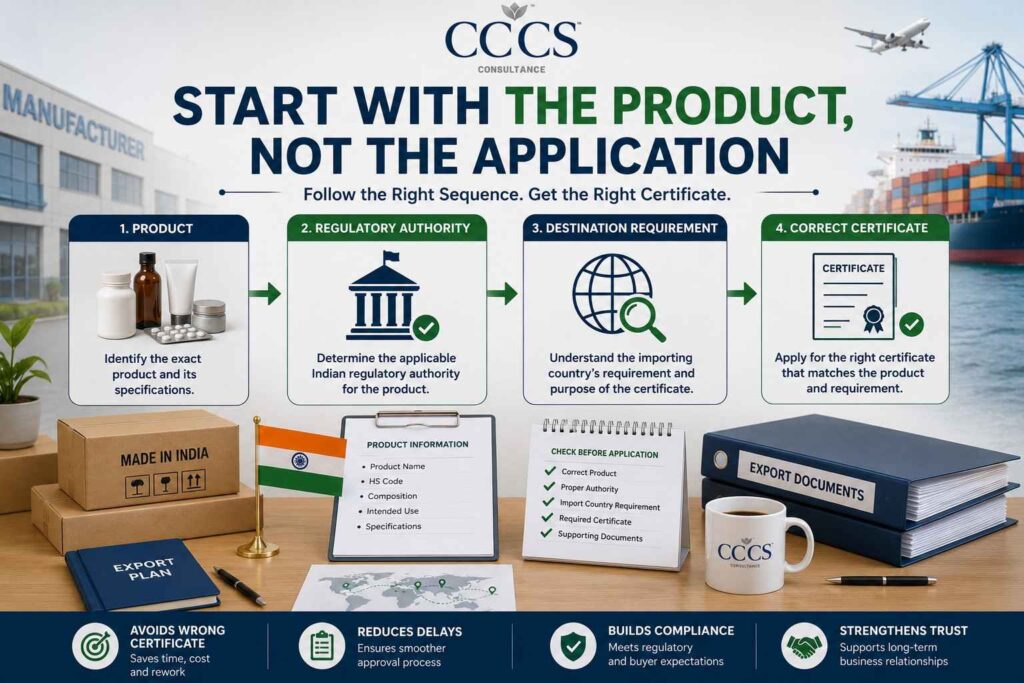
What is the product? → Who regulates it? → What does the importing country require? → Which certificate can satisfy that requirement?
This sequence is more reliable than beginning with the application form.
A Practical Example
Imagine an Indian manufacturer receives an enquiry from a distributor in another country.
The distributor says:
“We need your manufacture and free sale certificate before we can register the product.”
A rushed exporter may immediately search for a Free Sale Certificate and submit whatever documentation appears relevant.
A better response would be:
- Confirm the exact products and variants being exported.
- Ask where the certificate will be submitted.
- Identify the applicable Indian regulatory authority.
- Review the manufacturer’s current licences and product approvals.
- Ensure the names appearing on the certificate request match the supporting records.
- Prepare the application according to the authority’s requirements.
The second approach may take slightly more preparation at the beginning, but it reduces the possibility of buyer rejection later.
Who May Need a Certificate of Manufacture and Free Sale?
The requirement is commonly associated with exporters supplying products into markets where the importing authority or buyer wants evidence of the product’s status in its country of origin.
It may arise for businesses dealing with areas such as:
- healthcare and medical products;
- cosmetics and personal-care products;
- food or related regulated products;
- consumer products;
- specialised manufactured products; or
- products requiring overseas registration before commercial sale.
However, the exact requirement cannot be decided only from the broad product category.
A certificate that is required for one country may not be requested by another.
Similarly, one foreign buyer may request a Free Sale Certificate while another may specifically request a Certificate of Manufacture, Certificate of Origin, GMP Certificate or a combination of documents.
Documents That Usually Need Attention Before Filing
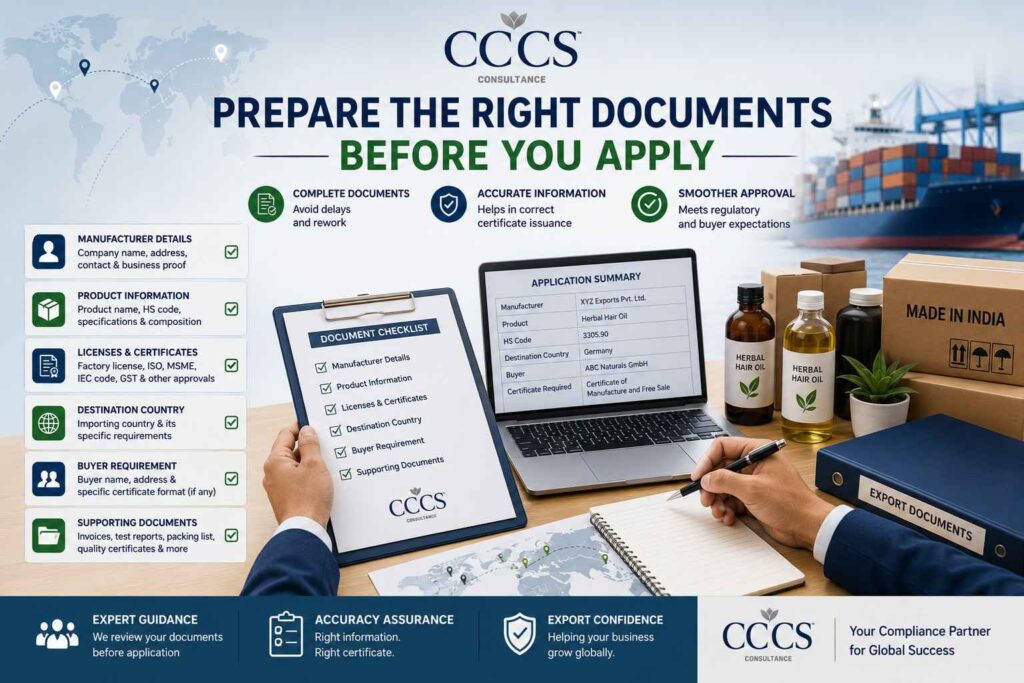
The actual document list should always be confirmed for the applicable authority, but exporters are commonly required to keep business and product records ready.
These may include:
- details of the manufacturer;
- manufacturing licence, where applicable;
- list of products or variants;
- IEC and exporter details where relevant;
- product description;
- supporting regulatory approvals;
- applicant authorisation;
- foreign buyer details;
- purchase order or export-related evidence where required; and
- declarations or undertakings prescribed by the authority.
The most common problems are often not caused by a completely missing document.
They are caused by mismatched information.
For example:
- company name differs across documents;
- manufacturer address has changed;
- product name is written differently;
- a variant is missing from the licence;
- brand owner and manufacturer are different entities;
- the submitted licence has expired;
- the buyer requests a product that is not covered by the supporting approval.
These issues are easier to resolve before filing than after a query is raised.
Manufacturer or Merchant Exporter: Why the Difference Matters
Not every exporter manufactures the product it exports.
A merchant exporter may purchase goods from another manufacturer and sell them overseas under its own commercial arrangement.
This creates an important documentation question:
Whose manufacturing credentials will support the certificate?
If the exporter and manufacturer are different entities, the application may require additional supporting documentation depending on the relevant process.
The relationship between the applicant, manufacturer and brand owner should therefore be established clearly.
Exporters should avoid assuming that holding an IEC alone establishes every product-level manufacturing requirement.
If you are still arranging your basic export setup, our related information on Spice Board Registration is an example of how product-specific export registrations can operate alongside general export documentation.
Where Applications Commonly Go Wrong
A certificate application can look simple when viewed as a form-filling exercise.
In practice, the complications usually appear before the form is submitted.
The exporter applies for the wrong certificate
A foreign buyer writes “Free Sale Certificate,” while its regulator actually expects a different format or issuing authority.
Every product is added without checking eligibility
Businesses sometimes submit their complete catalogue even though only selected products are covered by the relevant licence.
Manufacturer details do not match
Even a small difference in the legal name or manufacturing address can create questions during scrutiny or later at the buyer’s end.
The destination-country requirement is checked too late
An exporter obtains the certificate first and only afterward discovers that the buyer wanted additional authentication or a different statement on the document.
Old templates are reused
Export documentation is often copied from earlier shipments.
But a document accepted for one product, buyer or country should not automatically be assumed to be suitable for another.
Before You Apply, Ask These Five Questions
Instead of beginning with “Which form do I fill?”, begin with:
1. Which exact product is being exported?
The certificate should relate to the actual product and, where relevant, its variants.
2. Which country is receiving it?
Destination-country requirements can influence the documentation required.
3. Who asked for the certificate?
A commercial buyer, distributor, customs authority and product regulator may each have different expectations.
4. Who is the manufacturer?
Confirm whether the exporter and manufacturer are the same entity.
5. Which Indian authority regulates the product?
This determines whether additional licences, permissions or product-specific certificates need to be considered.
If these five answers are clear, the application becomes far easier to plan.
Does a Certificate Guarantee Acceptance in the Importing Country?
No exporter should treat a Certificate of Manufacture and Free Sale as a universal market-access certificate.
The document may support an overseas registration or import process, but the destination country can still require:
- product registration;
- local testing;
- labelling compliance;
- technical documentation;
- importer registration;
- conformity certification;
- legalization or apostille; or
- additional certificates.
The role of the Certificate of Manufacture and Free Sale is therefore best understood as one component of the export compliance file, rather than a replacement for destination-country requirements.
This distinction is particularly important when exporters enter a new market for the first time.
Why Early Verification Can Save an Export Order
Export documentation problems rarely remain limited to paperwork.
A delayed certificate can affect:
- buyer onboarding;
- product registration;
- purchase-order confirmation;
- shipment scheduling;
- customs documentation;
- distributor launch dates; and
- payment timelines.
That is why businesses should review the certificate requirement when the buyer first raises it—not a few days before shipment.
If a foreign buyer has already requested a Certificate of Manufacture and Free Sale, the practical starting point is to send the following information to your compliance team:
product name + manufacturer + destination country + buyer’s exact requirement.
Those four details can reveal much more than beginning with a generic certificate application.
How CCCS Can Support Your Application
CRUISE CORPORATE CONSULTANCY SERVICES Pvt. Ltd. (CCCS) helps businesses evaluate export and regulatory documentation according to their product and commercial situation.
Instead of treating every Free Sale Certificate request in the same way, the process can begin by reviewing:
- your product category;
- manufacturer details;
- existing licences;
- proposed export country;
- buyer’s certificate requirement; and
- supporting documentation.
Where additional registrations or approvals are relevant, they can be identified before the certificate application moves forward.
Businesses dealing with other product-specific regulatory requirements can also explore our guides on BIS Certification for CRS Items and PQMS Certificate.
Before Sending Documents to Your Overseas Buyer
A Certificate of Manufacture and Free Sale may appear to be a straightforward export document, but its usefulness depends on whether it actually matches the product and the requirement of the destination market.
Do not begin with the certificate name alone.
Begin with the product.
Confirm the manufacturer.
Understand why the buyer needs the certificate.
Then determine the correct regulatory route.
That approach can help reduce unnecessary applications, document queries and last-minute disruptions to an export transaction.
If an overseas buyer has asked your company for a Certificate of Manufacture and Free Sale and you are unsure which documentation applies to your product, contact CCCS with your product details and destination country for guidance.
