
A shipment may be commercially ready long before it is quarantine-ready.
The buyer is confirmed. The invoice is prepared. Logistics have been arranged. The agricultural or plant-based consignment appears ready to move.
But products connected with plants, seeds, agricultural commodities or other regulated plant material can raise an additional question:
What plant quarantine requirements apply to this shipment?
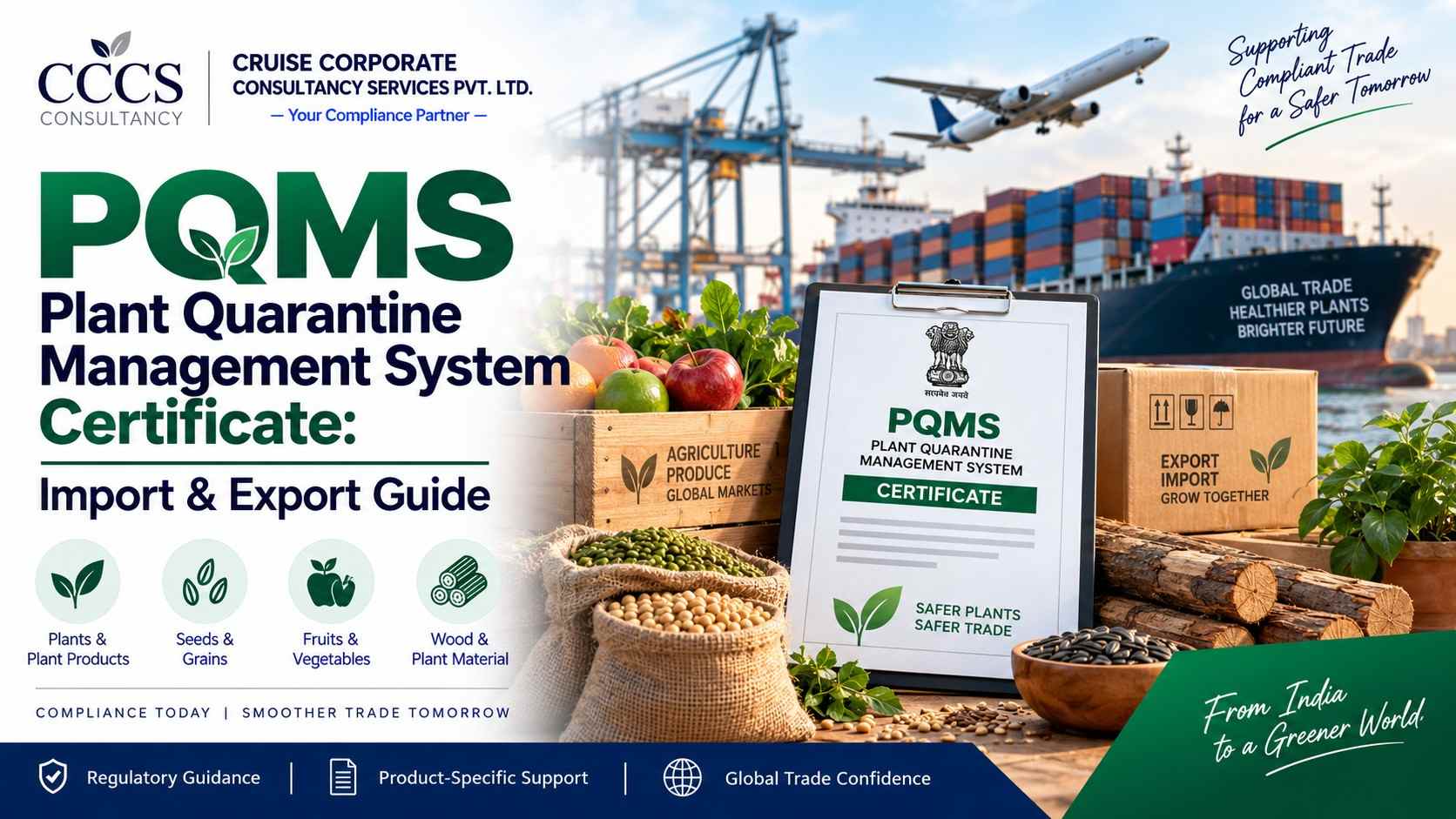
This is where businesses often encounter PQMS — Plant Quarantine Management System.
PQMS is connected with India’s plant quarantine framework and facilitates regulatory processes associated with the import and export of plants and plant material. For businesses, however, understanding PQMS should begin with the product and movement of the consignment, rather than simply searching for a “PQMS Certificate.”
What Is PQMS?
PQMS stands for Plant Quarantine Management System.
It is an online system associated with plant quarantine activities in India and is used in regulatory processes involving the movement of plants, plant products and other regulated articles.
Plant quarantine itself serves a larger purpose: reducing the risk of introducing or spreading harmful plant pests through international trade.
For an importer or exporter, this means that a shipment containing agricultural or plant-related material may require more than ordinary commercial documentation.
The exact requirement depends on the commodity, nature of the material, origin or destination and applicable plant quarantine conditions.
“I Need a PQMS Certificate” May Not Be the First Question to Ask
Businesses often contact a consultant with a very direct request:
“We need a PQMS certificate.”
But before deciding what document or regulatory action is required, there is a more useful question:
What exactly is being imported or exported?
Consider these products:
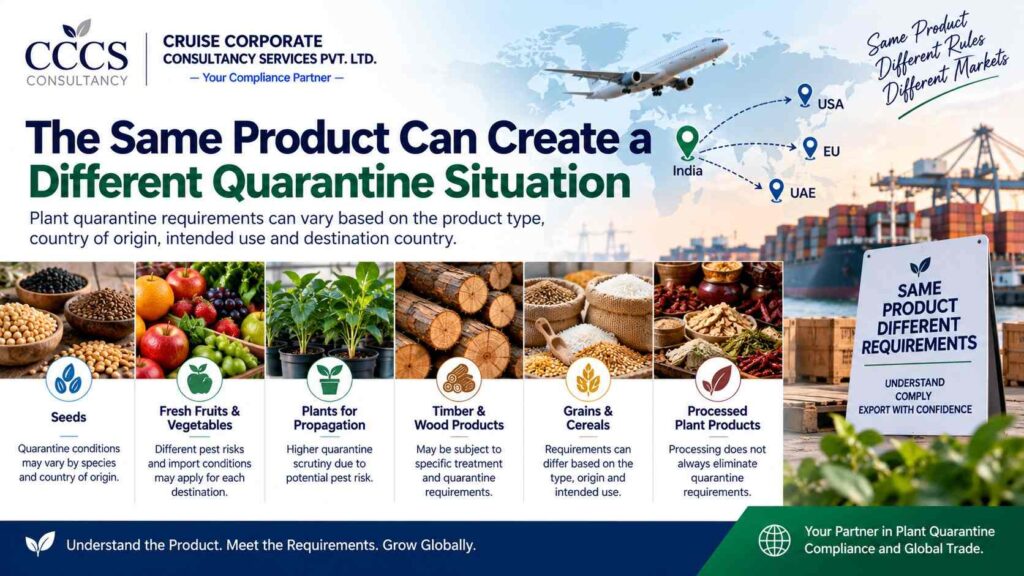
Seeds → Fresh fruits → Plants for propagation → Timber/wood material → Grains → Processed plant products
All are connected in some way with agriculture or plants.
But they should not automatically be assumed to have identical quarantine requirements.
The physical nature of the commodity matters because plant quarantine is fundamentally concerned with pest and phytosanitary risk, not simply whether a business calls something an “agricultural product.”
PQMS Certificate, Registration and Portal Are Not the Same Thing
Searches such as PQMS certificate, PQMS registration, PQMS portal and Plant Quarantine Management System Certificate are commonly used by businesses.
But these terms can describe different parts of the same regulatory environment.
PQMS is the management system or portal.
Registration/access relates to the business or applicant interacting with the relevant system.
A certificate, permit, clearance or other regulatory document may relate to a particular transaction or requirement.
Therefore, simply saying “I have PQMS registration” does not automatically establish that every future shipment is cleared from a plant quarantine perspective.
The requirement should be understood in relation to the actual consignment.
The Same Product Can Create a Different Quarantine Situation
This is where PQMS becomes particularly important for importers and exporters.
Imagine two businesses dealing in the same agricultural commodity.
The product name is identical.
But:
Business A imports it from Country X.
Business B imports it from Country Y.
It would be risky to assume that the quarantine position must therefore be identical.
Plant-health requirements can depend on factors beyond the commercial product name, including the country of origin, intended use, commodity condition and applicable phytosanitary conditions.
This is why copying the compliance documents used by another importer is not always a reliable strategy.
Same product does not necessarily mean same regulatory situation.
Why Does Plant Quarantine Matter to Importers?
When plant material or regulated agricultural commodities enter India, authorities are not only concerned with their commercial value.
They are also concerned with what could potentially enter the country with the consignment.
A pest, pathogen or other plant-health risk can have consequences for agriculture and the environment.
India’s plant quarantine framework therefore regulates the import of plants and plant materials through requirements established under the Plant Quarantine (Regulation of Import into India) Order, 2003, as amended from time to time.
For an importer, this makes early product assessment important.
The question should not be left until the cargo has already reached the port.
An Overseas Supplier Cannot Decide Your Entire Indian Compliance Position
This is a particularly important issue in imports.
A foreign supplier may tell the Indian buyer:
“We export this product worldwide. There will be no problem.”
That may sound reassuring, but it should not replace an India-specific regulatory assessment.
The overseas supplier understands the product.
The Indian importer must also understand the conditions under which that product can enter India.
A supplier’s previous shipment to another country does not automatically establish compliance with Indian plant quarantine requirements.
Similarly, a document accepted for one shipment should not automatically be assumed sufficient for a different commodity, origin or regulatory situation.
Phytosanitary Certificate and PQMS Should Not Be Treated as Identical Terms
Another common source of confusion is the Phytosanitary Certificate.
A phytosanitary certificate is an official plant-health document used in international trade to certify that consignments meet specified phytosanitary requirements.
PQMS, meanwhile, is the system through which relevant plant quarantine processes may be managed in India.
So:
PQMS ≠ simply another name for a Phytosanitary Certificate.
A shipment may involve a phytosanitary certificate along with other applicable plant quarantine requirements, depending on the particular import/export situation.
Understanding this distinction is useful because asking only for a “PQMS certificate” can hide the real regulatory requirement.
Exporters Have a Different Question to Answer
For exporters, the direction of compliance changes.
The question is no longer only:
“What does India allow?”
It also becomes:
“What does the destination country require before accepting this commodity?”
An overseas buyer may request a phytosanitary certificate or specify particular plant-health conditions.
Those requirements can depend on:
Product + Destination Country + Import Conditions + Buyer Requirement
This means exporters should avoid assuming that a document used for one destination will automatically satisfy another.
For example, an agricultural product exported successfully to one country may face different phytosanitary conditions when shipped to a new market.
The Product Name on the Invoice May Not Tell the Whole Story
Commercial teams often work with short product descriptions.
Regulatory assessment may require a more precise understanding.
Take the word:
“Seeds.”
From a sales perspective, that may appear sufficient.
From a plant quarantine perspective, additional characteristics may become important.
Similarly, fresh produce, processed plant material, wood products and planting material can create different situations.
This is why the correct compliance route should be based on what the product actually is, rather than only the wording used in a quotation or invoice.
Your Shipment History Is Useful—but It Is Not a Permanent Compliance Guarantee
A business may say:
“We imported the same product last year without any issue.”
Previous experience can be useful.
But it should not become the only basis for the next shipment.
Changes can occur in:
supplier → country of origin → product specification → treatment → intended use → applicable regulatory conditions
Regulations and notified conditions can also change.
A business should therefore review the current shipment situation rather than treating historical clearance as permanent approval for every future consignment.
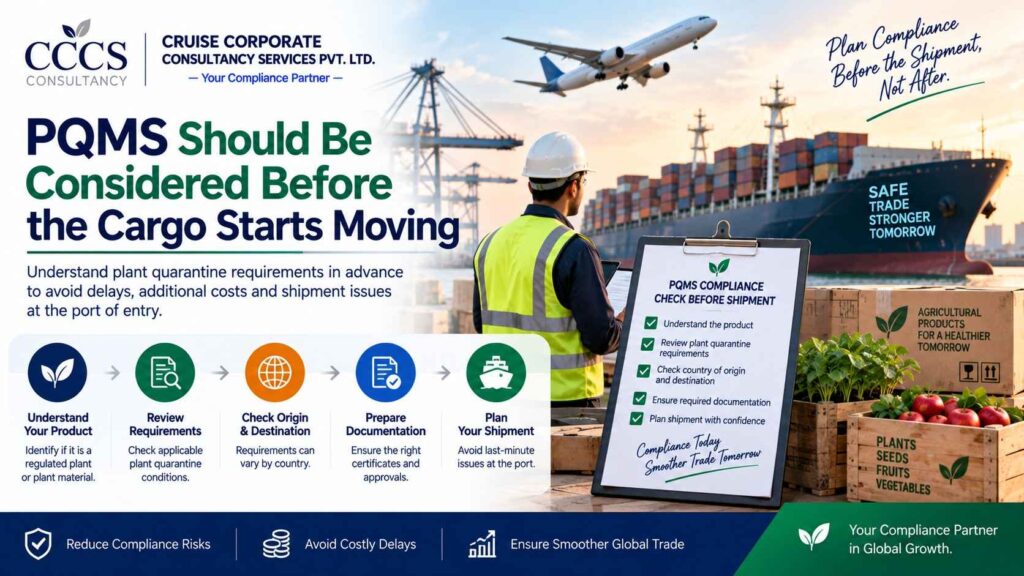
PQMS Should Be Considered Before the Cargo Starts Moving
This is perhaps the most practical lesson for businesses.
Compliance becomes harder when the sequence looks like this:
Purchase Confirmed → Cargo Dispatched → Shipment Arrives → Requirement Discovered
At that stage, the business may already be dealing with logistics commitments, buyer timelines and storage or clearance concerns.
A more controlled approach is:
Understand Product → Review Trade Situation → Identify Applicable Plant Quarantine Requirement → Prepare Compliance → Plan Shipment
This is not a DIY application procedure.
It is simply good compliance planning.
The objective is to discover regulatory questions while the business still has time to address them.
PQMS Is One Part of a Larger Export-Import Compliance Picture
Plant quarantine requirements should also not be confused with every other registration an importer or exporter may encounter.
Depending on the business and product, other requirements may involve authorities or frameworks connected with:
IEC, APEDA, FSSAI, customs, product-specific approvals or destination-country requirements.
These do different jobs.
For example, having an IEC establishes an import-export identity, but it does not automatically satisfy plant quarantine requirements for a regulated commodity.
Similarly, an APEDA registration relevant to an export business should not automatically be treated as a substitute for a phytosanitary requirement.
The correct compliance combination depends on the product and transaction.
Why PQMS Problems Often Begin Before the Application
Businesses sometimes assume regulatory delays are mainly caused by filling in a form incorrectly.
In reality, the problem can begin much earlier.
If the wrong product understanding, origin details or regulatory assumption is used at the beginning, even carefully prepared paperwork may follow the wrong compliance route.
That is why a consultant should first understand:
the commodity, whether it is being imported or exported, its origin/destination, its intended use and the regulatory requirement involved.
Only after understanding the business situation does the documentation make sense.
This is especially important for companies dealing with multiple agricultural commodities.
When Should a Business Review Its PQMS Requirement?
A PQMS and plant quarantine review becomes particularly important when a business is planning a new import or export of plants or plant material, changing its source country, introducing a new agricultural commodity, entering a new export destination or receiving a phytosanitary requirement from an overseas buyer.
It can also be worth reviewing when a company has previously traded the product but important shipment details have changed.
The goal is not to obtain every possible certificate.
The goal is to identify the correct requirement for the actual shipment.
A Strong PQMS Strategy Starts with the Shipment, Not the Portal
For importers and exporters, PQMS should not be viewed merely as another government website that needs to be accessed.
Behind the portal is a real regulatory purpose:
protecting plant health while enabling compliant international trade.
That is why the strongest starting point is not:
“Where is the PQMS login?”
It is:
“What are we shipping, where is it coming from or going to, and what plant quarantine requirement applies?”
Once those questions are clear, the relevant regulatory process becomes much easier to identify.
Need Assistance with PQMS & Plant Quarantine Compliance?
Plant quarantine requirements can vary according to the product, origin, destination, intended use and nature of the shipment.
Cruise Corporate Consultancy Services Pvt. Ltd. (CCCS) can assist importers and exporters in understanding their PQMS and plant quarantine compliance requirements before proceeding with a shipment.
If your business is unsure whether a PQMS Certificate, registration, phytosanitary documentation or another plant quarantine requirement applies, reviewing the shipment situation early can help reduce avoidable compliance problems.
Website: tripplecs.com
Phone: +91 9217160029
Email: info@tripplecs.com