


A service business often begins with very little paperwork.
A consultant may start by helping a few local clients. A digital marketing professional may work independently before building an agency. An IT company may begin with one project and suddenly receive a contract from another state. Trainers, architects, designers, accountants and other professionals can follow a similar path.
At first, the owner’s attention is usually on finding customers, delivering work and receiving payments. Tax registration may not feel urgent.
The situation changes when the business begins attracting larger clients, working across different locations or generating higher revenue. At that stage, questions about GST Registration for Services can no longer be postponed.
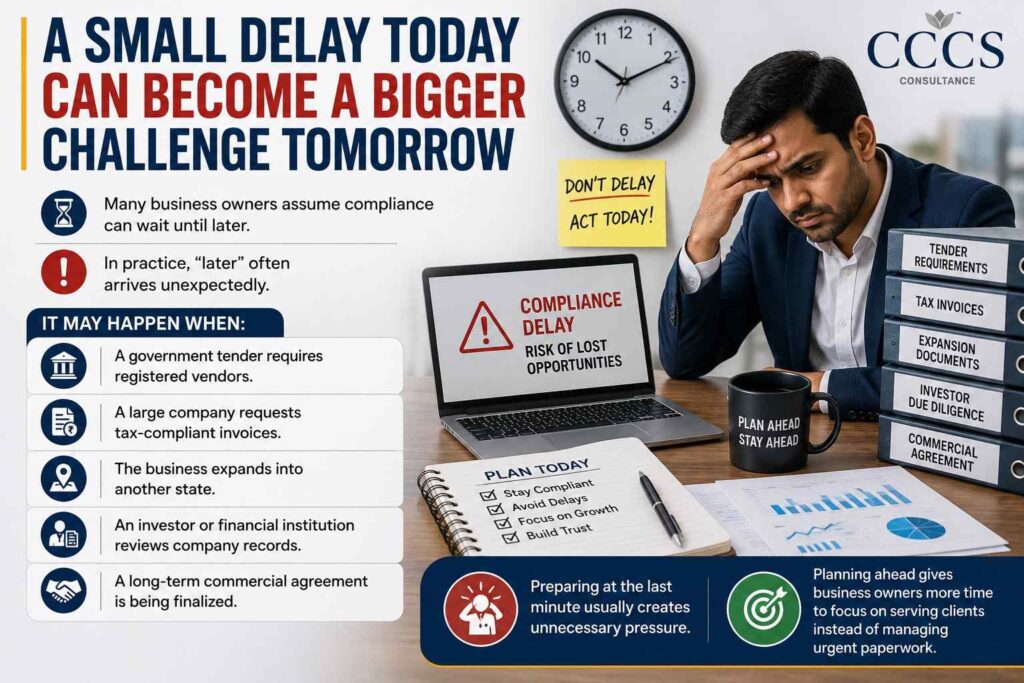
A common problem is that business growth happens gradually, while compliance is reviewed only after a customer asks for a GST invoice or an important contract is ready to be signed.
That is why service providers should review their GST position before it becomes an urgent business issue.
GST Registration Is Not Only for Product Sellers
Some professionals assume that GST mainly concerns manufacturers, traders and online sellers.
However, GST also covers taxable supplies of services. Depending on turnover, location, type of supply and other conditions under GST law, service providers may have registration obligations.
The general registration threshold commonly applicable to service providers is based on aggregate turnover calculated on an all-India PAN basis. Official CBIC guidance refers to a ₹20 lakh threshold, with a lower threshold applicable in specified special-category states, while also noting that certain cases can require registration irrespective of the normal threshold.
Because exceptions exist, a business should not decide its registration requirement using turnover alone.
Its actual position may depend on factors such as:
- Nature of services supplied
- Aggregate turnover under the same PAN
- State or states from which services are supplied
- Type of customers served
- Specific compulsory-registration provisions
- Changes in the business model
A proper review should therefore begin with the way the business actually operates.
Which Service Businesses Should Review Their GST Position?
The need for a review is not limited to one profession.
Businesses offering the following types of services may need to assess their GST position as they grow:
- Business and management consultancy
- Digital marketing and advertising
- Information technology and software services
- Website design and development
- Accounting and professional services
- Architecture and design
- Training and coaching
- Repair and maintenance
- Logistics and support services
- Freelance and independent professional work
This does not mean that every person offering these services automatically requires registration. It means these businesses should not assume GST is irrelevant simply because they do not sell physical goods.
A Practical Situation Many Service Providers Face
Consider a small consultancy that has worked with local clients for two years.
The business receives payments in its current account, issues ordinary invoices and has never faced a GST-related question. It then receives an opportunity to work with a larger corporate customer.
Before finalising the contract, the customer asks for:
- GST details
- A tax invoice
- Registered business information
- Clear billing documentation
The consultancy now starts reviewing registration at the last moment.
The opportunity may still proceed, but unnecessary pressure could have been avoided through earlier planning.
This is one reason GST registration for consultancy services can become a commercial consideration as well as a tax-compliance matter.
When Should a Service Provider Pause and Review?
A GST review should not begin only after a notice or customer complaint.
It is worth reviewing your position when:
Revenue Is Increasing
As turnover grows, the business should monitor whether it is approaching or crossing the applicable registration threshold.
Aggregate turnover is assessed across the same PAN rather than by looking at only one customer, branch or service in isolation.
Larger Clients Are Coming In
Corporate customers often expect organised invoices, vendor documentation and clear tax information.
Registration can become relevant during vendor onboarding even where the business had previously worked only with individuals or smaller clients.
Your Services or Business Model Have Changed
A freelancer may form an agency. A local consultant may start serving customers in multiple locations. An offline trainer may begin providing digital services.
Compliance should be reassessed whenever the nature or scale of operations changes.
You Are Opening Another Office or Branch
Expansion into another state or business location can affect registration and compliance planning. The business should seek advice before assuming that one existing arrangement will automatically cover every new operation.
You Are Unsure About an Exception
The normal turnover threshold is not the only rule under GST. CBIC guidance specifically notes that exceptions under compulsory-registration provisions may apply.
When applicability is unclear, checking before acting is safer than relying on general online advice.
What Does GST Registration Change for a Service Business?
GST registration brings the business into a formal tax-compliance framework.
It is not simply about obtaining a GSTIN and placing it on an invoice. A registered business must understand the responsibilities that follow registration, including correct invoicing, record management, applicable return filing and timely tax compliance.
The GST portal’s official registration system requires taxpayers to provide business and service information, including at least one supplied good or service, with space to specify principal services offered.
This is why registration should be approached as an operational decision, not as a one-time certificate purchase.
Before applying, the business should be clear about:
- What services it supplies
- From where those services are supplied
- How invoices will be issued
- How records will be maintained
- Who will manage continuing compliance
Why Voluntary Registration Needs Careful Thought
Some businesses consider registering even before registration becomes mandatory.
Possible reasons may include working with corporate customers, strengthening vendor documentation or preparing for growth.
However, voluntary registration should not be treated as a branding shortcut. Once registered, the business must be ready to manage the related responsibilities.
The right question is not only:
“Can we obtain GST registration?”
It is also:
“Are we prepared to maintain GST compliance properly after registration?”
A professional review can help the owner understand whether registration is required, commercially useful or premature for the current stage of the business.
Do Not Copy Another Business’s GST Approach
Two service businesses may appear similar but still have different tax positions.
For example:
- One may operate from a single state while another has multiple locations.
- One may serve only local customers while another works nationally.
- One may offer exempt or differently treated services.
- One may operate as an individual while another works through a company.
- Their aggregate turnovers may differ substantially.
This is why a generic checklist or another firm’s registration experience should not be treated as personalised advice.
The compliance decision should reflect the actual services, turnover and operating structure of the business.
Registration Should Support Growth, Not Interrupt It
Many business owners think about GST only as an additional responsibility.
A better way to view it is as part of building an organised service business.
When applicability is reviewed on time, the business can prepare its invoicing, accounting and customer communication properly. When it is ignored until a major contract arrives, the same requirement can feel like an obstacle.
The goal is not to register every business unnecessarily.
The goal is to understand when registration becomes relevant and prepare before poor planning affects customers, payments or expansion.
Your Clients May Notice GST Before You Do
Many service businesses don’t think about GST registration until someone else brings it up.
Sometimes it’s a corporate client asking for a GST invoice. Sometimes it’s an accounts department requesting registration details before releasing payment. In other cases, it’s during vendor onboarding when the business realizes certain compliance requirements are expected.
These situations often come as a surprise—not because the business is doing anything wrong, but because compliance planning wasn’t part of the growth strategy from the beginning.
Businesses that prepare early are usually in a stronger position when new opportunities arrive.
Growth Often Changes Compliance Requirements
A service business rarely stays the same for long.
A freelancer may become a consultancy.
A consultancy may build a team.
A local agency may begin serving clients across India.
An IT company may start working with overseas customers.
Each stage brings new opportunities, but it can also introduce new compliance responsibilities.
As the business evolves, reviewing registrations and tax obligations becomes just as important as finding new clients.
Ignoring compliance doesn’t stop growth—it simply makes growth harder to manage.
Professional Businesses Build Trust Before They Build Scale
Clients today don’t only compare pricing or service quality.
They also look for businesses that appear organised, reliable, and professionally managed.
Simple things like structured invoices, clear business information, proper documentation, and timely communication often influence purchasing decisions.
GST registration is only one part of that professional image, but it contributes to the confidence customers have when working with your business.
For many companies, choosing a compliant service provider reduces future administrative issues and makes long-term partnerships easier.
Registration Is the Beginning, Not the Finish
Obtaining a GST registration certificate is only the first step.
After registration, businesses are expected to manage compliance on an ongoing basis.
That includes maintaining proper records, issuing invoices correctly, understanding applicable return requirements, and staying updated with regulatory changes.
Many businesses underestimate this ongoing responsibility.
The objective should never be to obtain a registration simply because others have one.
The objective should be to build a compliance system that supports business operations over the long term.
Common Situations Where Businesses Seek Professional Advice
Many service providers decide to consult experts when they encounter questions such as:
- “Does my business actually need GST registration?”
- “Has my business crossed the applicable threshold?”
- “Will working with clients in different states affect my registration?”
- “How should I prepare before applying?”
- “What responsibilities will continue after registration?”
These questions don’t always have one universal answer.
The correct approach depends on the business structure, services offered, customer base, and overall business activities.
This is why many businesses prefer professional guidance instead of relying entirely on general online articles.
Think Beyond Registration—Think About Business Continuity
Compliance should support business growth, not interrupt it.
Businesses that review their obligations regularly often avoid last-minute surprises.
They are better prepared for larger contracts, new partnerships, and expansion into different markets.
Instead of treating GST as a one-time task, successful businesses usually include compliance as part of their overall business planning.
This approach creates greater stability as the business continues to grow.
As your business expands, you may also need guidance on other registrations and regulatory requirements, including:
Every Growing Business Reaches a Point Where Compliance Matters
In the early stages of a business, most decisions revolve around acquiring customers, delivering quality services, and building a reputation. Compliance often becomes a secondary priority because day-to-day operations demand immediate attention.
As the business grows, expectations also change.
Larger clients begin asking for proper invoices, financial documentation, and tax-related information before finalizing contracts. At this stage, GST registration becomes more than a legal requirement—it becomes part of running a professionally managed business.
Businesses that prepare in advance are generally better positioned to respond to new opportunities without unnecessary delays.

Why Businesses Prefer Professional Guidance
GST laws are designed to cover a wide range of business activities, and every service provider operates differently.
A digital marketing agency may have different compliance considerations than an IT company. A management consultant may work differently from an architect, trainer, or freelance professional.
Because of these differences, many business owners prefer discussing their specific situation with experienced consultants rather than relying on general information available online.
Professional guidance helps businesses understand their responsibilities, avoid common mistakes, and make informed decisions based on their actual business activities instead of assumptions.
How Cruise Corporate Consultancy Services Pvt. Ltd. Supports Service Businesses
At Cruise Corporate Consultancy Services Pvt. Ltd., we believe compliance should support business growth—not become an obstacle to it.
Our team works closely with entrepreneurs, startups, professionals, and established companies to understand their business model and provide practical compliance guidance suited to their operations.
Rather than offering one-size-fits-all solutions, we focus on understanding your business objectives and recommending the most appropriate compliance approach for your stage of growth.
Whether you’re starting a new service business or expanding your existing operations, our consultants are committed to making the compliance journey simpler and more manageable.
Let’s Build Your Business on a Strong Foundation
A successful business is built on more than excellent services.
It also depends on proper planning, organised financial practices, and timely compliance.
Reviewing your GST requirements before they become an urgent issue allows you to concentrate on serving clients, expanding your business, and creating long-term value.
A proactive approach today can help reduce uncertainty tomorrow.
🌐 Website: www.tripplecs.com
📞 Call Us: +91 9217160029
🔗 Need Expert Assistance? Visit Our Contact Page
Continue Exploring Business Compliance Services
As your business grows, you may also find these services useful:
- Company Registration
- Import Export Code (IEC)
- AD Code & IFSC Registration
- MSME Registration
- Digital Signature Certificate (DSC)
- Annual Compliance Services
- Accounting & Taxation Services
Exploring related compliance requirements early helps businesses build a stronger operational foundation and prepare for future growth opportunities.
Final Thoughts
Every successful service business eventually reaches a stage where compliance becomes part of everyday operations.
Instead of viewing GST registration as just another legal requirement, business owners should see it as an opportunity to organise their operations, strengthen client confidence, and prepare for sustainable growth.
The best time to review compliance is before it becomes an urgent business requirement.
With the right guidance and careful planning, your business can move forward confidently while staying focused on what matters most—delivering exceptional services to your clients.
