ISO certification can become important when a business is responding to customer requirements, participating in tenders, entering new supply chains, strengthening internal management systems, or demonstrating conformity with a recognized standard.
However, businesses often begin with a more basic question: Which ISO standard is actually relevant to us, and what do we need to do before certification?
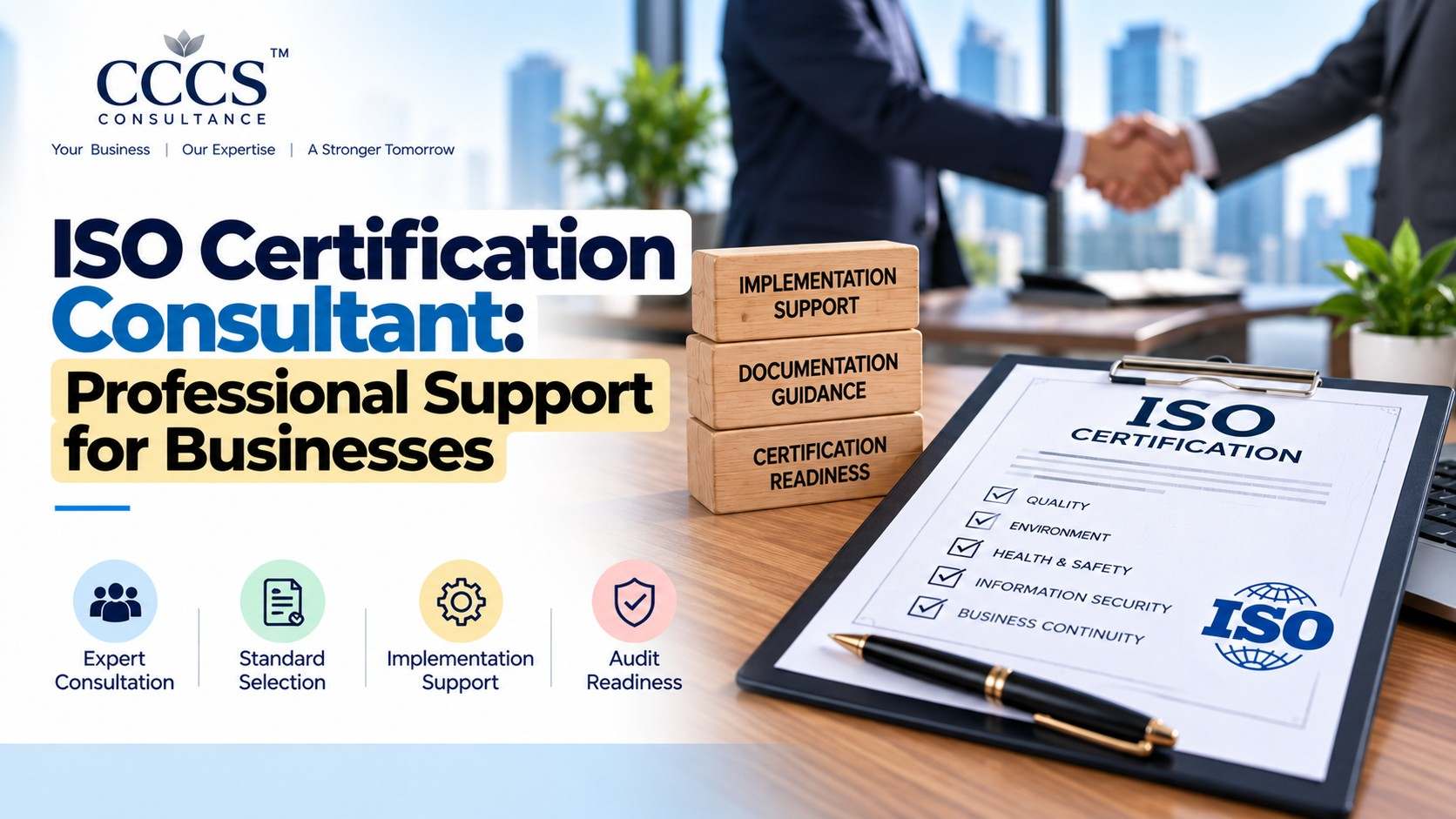
An ISO Certification Consultant can support a business in understanding the applicable standard, defining the appropriate certification scope, reviewing existing processes, identifying gaps and preparing the organization for an independent certification assessment.
It is important to distinguish consulting from certification itself. ISO develops international standards but does not certify organizations or issue ISO certificates. Certification is performed by external certification bodies. ISO
Why Do Businesses Look for an ISO Certification Consultant?
Businesses do not always approach ISO certification for the same reason.
One organization may need certification because a customer has requested it. Another may encounter an ISO requirement during vendor registration or tender participation. A growing company may want a structured management system, while another business may be responding to supply-chain expectations.
An ISO consultant can help translate the business requirement into a more practical compliance plan.
The starting point should therefore not simply be:
“We need an ISO certificate.”
The better questions are:
Which standard is relevant? What activities should the certification cover? Which locations are involved? What does the organization need to have in place before an independent certification audit?
Getting these fundamentals clear can prevent unnecessary work later.
ISO Consultant and Certification Body Are Not the Same
This distinction is particularly important for businesses searching for ISO Certification Consulting Services.
An ISO consultant may assist an organization with understanding requirements, management-system development, gap assessment, documentation, implementation support and certification readiness.
A certification body, on the other hand, independently assesses the organization and, where the applicable requirements are satisfied, issues the certification.
ISO itself confirms that it does not perform certification. External certification bodies perform that function. ISO
There is another important distinction: accreditation relates to independent recognition of the competence of a certification body. ISO notes that certification from an accredited conformity-assessment body can provide an additional layer of confidence because the accreditation body has independently confirmed the certification body’s competence. ISO
For businesses, understanding these separate roles can help avoid confusion when evaluating ISO-related services.
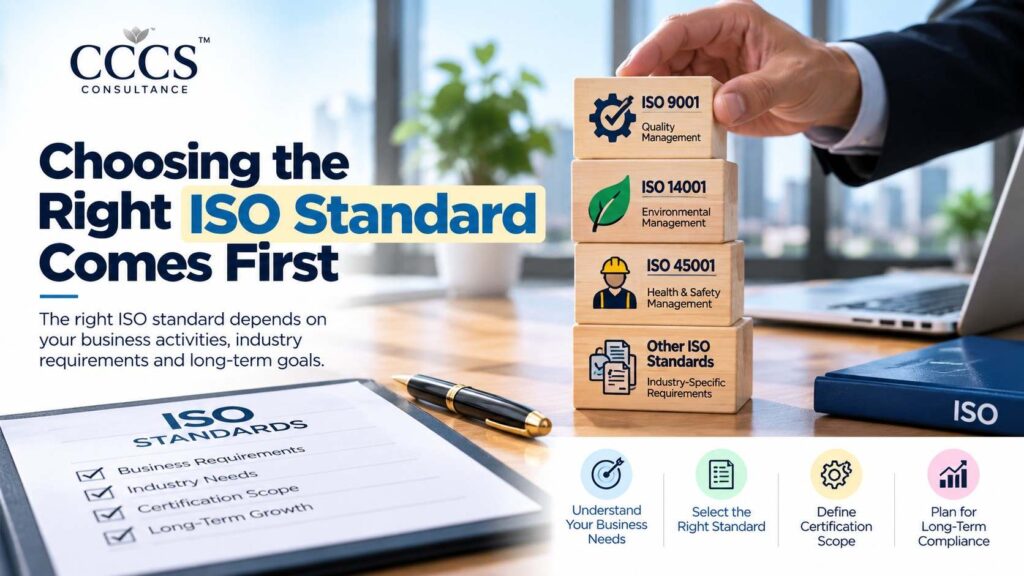
Choosing the Right ISO Standard Comes First
There is no single ISO certification that is automatically appropriate for every company.
Different management-system standards address different business areas. Common examples include:
ISO 9001 for quality management systems
ISO 14001 for environmental management systems
ISO 45001 for occupational health and safety management systems
The correct choice depends on the organization’s activities and the requirement it is trying to satisfy.
For example, a customer requesting quality-management certification may have a very different requirement from a business seeking an environmental management system.
This is one area where an experienced ISO Certification Consultant can add value: identifying the requirement before the organization spends time preparing for the wrong certification.
Current ISO 9001 note: ISO published ISO 9001:2026 in September 2026. Organizations certified to ISO 9001:2015 have a transition period rather than needing to restart certification immediately.
Certification Scope Can Matter as Much as the Standard
Selecting the ISO standard is only part of the planning.
Businesses should also consider what the certification is intended to cover.
The certification scope may need to reflect factors such as the organization’s legal entity, activities, products or services, operational locations and management-system boundaries.
Consider a company that has a corporate office, manufacturing unit and multiple operational locations. Simply saying that the company wants “ISO certification” does not answer whether all of those activities and locations are intended to fall within the certification scope.
Similarly, a business providing several services should understand which activities are actually represented by the scope appearing on its certificate.
This is why the scope should reflect the real business rather than being treated as wording added at the end of the certification exercise.
How ISO Certification Consulting Services Support a Business
Professional ISO Certification Consulting Services can support an organization from the initial requirement assessment through certification readiness.
Depending on the organization and applicable standard, support may involve understanding the certification objective, reviewing current processes, identifying gaps, helping establish appropriate management-system documentation, supporting implementation and preparing relevant teams for the independent assessment.
The objective should not be to create unnecessary paperwork.
A useful management system should correspond with how the organization actually operates.
ISO itself notes that organizations can benefit from implementing management-system standards even without certification. When certification is sought, however, an external certification body is required. ISO
This reinforces an important distinction: implementation and certification are related, but they are not the same activity.
Getting a Certificate Is Not the Same as Building a Management System
A business should be cautious about treating ISO certification as merely obtaining a document.
Management-system standards are intended to become part of how an organization manages relevant processes.
For example, ISO describes ISO 9001 as a quality-management standard whose requirements address establishing, implementing, maintaining and continually improving a Quality Management System. ISO
Therefore, documentation that looks good on paper but does not correspond with actual business practices can create problems when the system is assessed or subsequently maintained.
A consultant’s role should be to help the organization understand and implement relevant requirements—not simply prepare a set of documents disconnected from operations.
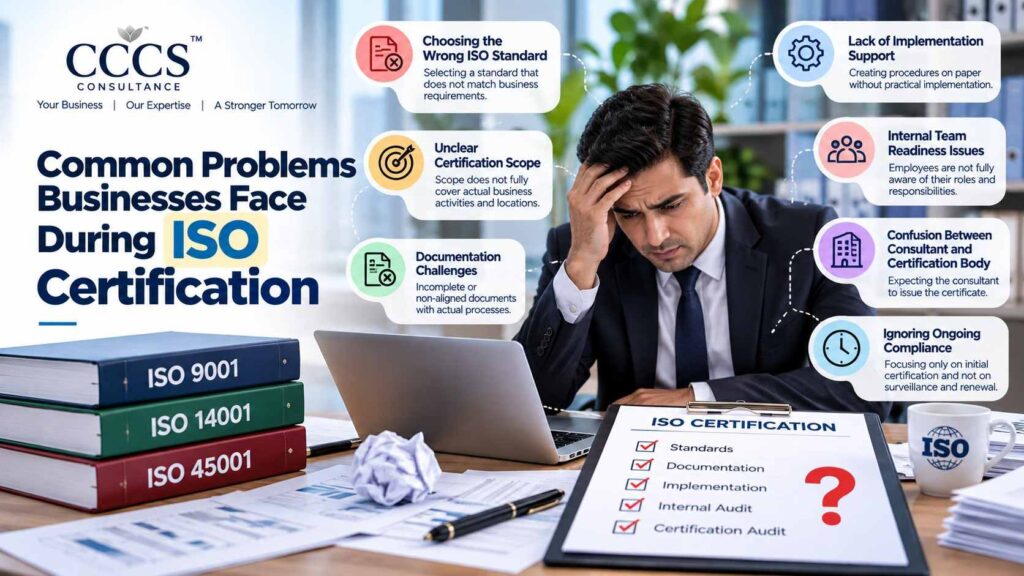
Common Problems Businesses Face During ISO Certification
ISO certification can become more complicated when important decisions are made without first understanding the business requirement.
Typical issues can include choosing a standard without confirming the customer’s actual requirement, defining an unsuitable certification scope, creating documentation that does not match actual processes, overlooking additional business locations, or confusing consultancy services with independent certification.
Businesses may also focus heavily on the initial audit while giving insufficient attention to how the management system will operate afterwards.
An effective ISO consulting engagement should therefore look beyond the certificate and consider whether the proposed system is practical for the organization.
Does Every Business Need the Same ISO Certification?
No. ISO certification requirements vary according to the organization, industry, business objective and the specific standard involved.
A manufacturer, IT company, professional-services firm and construction business can have very different management-system priorities.
Customer contracts, tenders and supply chains may also specify a particular standard or certification expectation.
Even certification itself is not automatically mandatory simply because an ISO management-system standard exists. For example, ISO states that organizations can implement ISO 9001 without seeking third-party certification, although customers or other stakeholders may request certification in particular situations. ISO
The business requirement should therefore be understood before deciding on the certification approach.
What Should You Check Before Hiring an ISO Certification Consultant?
Businesses should look beyond promises of obtaining a certificate quickly.
A consultant should first understand the organization’s business activities, the reason certification is being sought and the applicable ISO standard.
It is also useful to understand what support is actually included: whether the engagement covers initial assessment, implementation guidance, documentation support, audit readiness or coordination relating to the certification process.
Importantly, the consultant should not be presented as the independent body that certifies its own consulting work.
ISO/IAF guidance recognizes that organizations may choose to use consultants, but the contractual certification relationship is between the certification body and the organization being certified. The organization’s own management system—not the consultant—is what is assessed. ISO
That separation is an important part of credible certification.
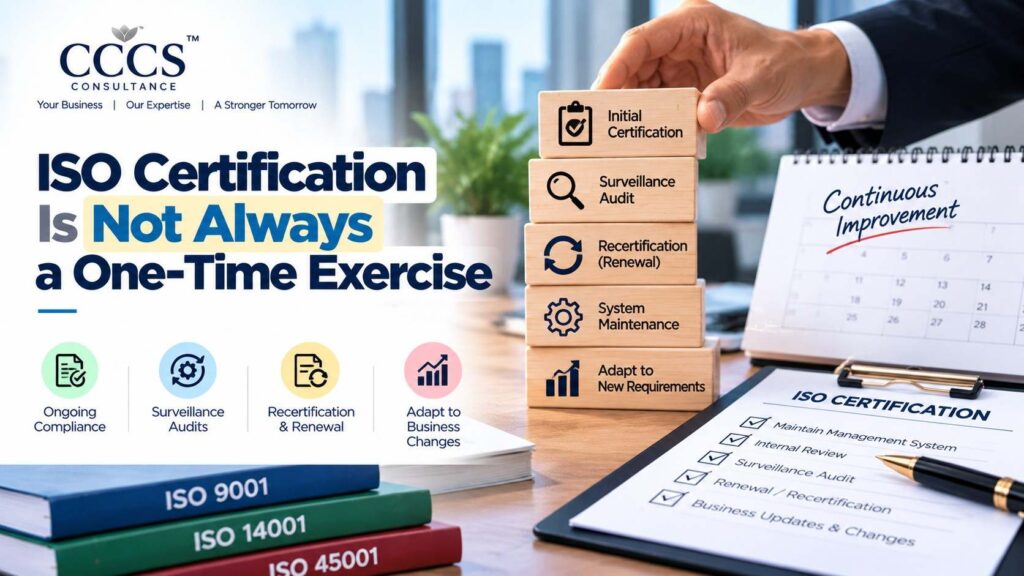
ISO Certification Is Not Always a One-Time Exercise
Businesses should plan beyond the initial certification decision.
Management systems need to remain relevant as organizations change. New locations, additional activities, operational changes and updates to applicable standards may affect how the management system is maintained.
This is particularly visible today with ISO 9001:2026, where organizations holding ISO 9001:2015 certification are expected to transition to the new edition within the specified transition timeframe. ISO
The broader point is that certification should be viewed as part of an ongoing management system rather than a one-time document collection exercise.
When Can Professional ISO Consulting Be Useful?
Professional support may be particularly useful when a business is pursuing ISO certification for the first time, is uncertain about the applicable standard, operates from multiple locations, needs to align existing processes with management-system requirements, or needs clarity around certification scope.
It can also be useful when an organization already has established procedures but needs to understand the gaps between its current practices and the applicable standard.
The level of support required will vary from one organization to another. A business with mature internal systems may require limited assistance, while a growing organization establishing its management system for the first time may need broader implementation support.
The objective should remain the same: develop a management system that reflects the organization and is appropriately prepared for independent certification.
Need ISO Certification Consulting Services?
Cruise Corporate Consultancy Services Pvt. Ltd. (CCCS) provides professional assistance for businesses seeking ISO Certification Consulting Services.
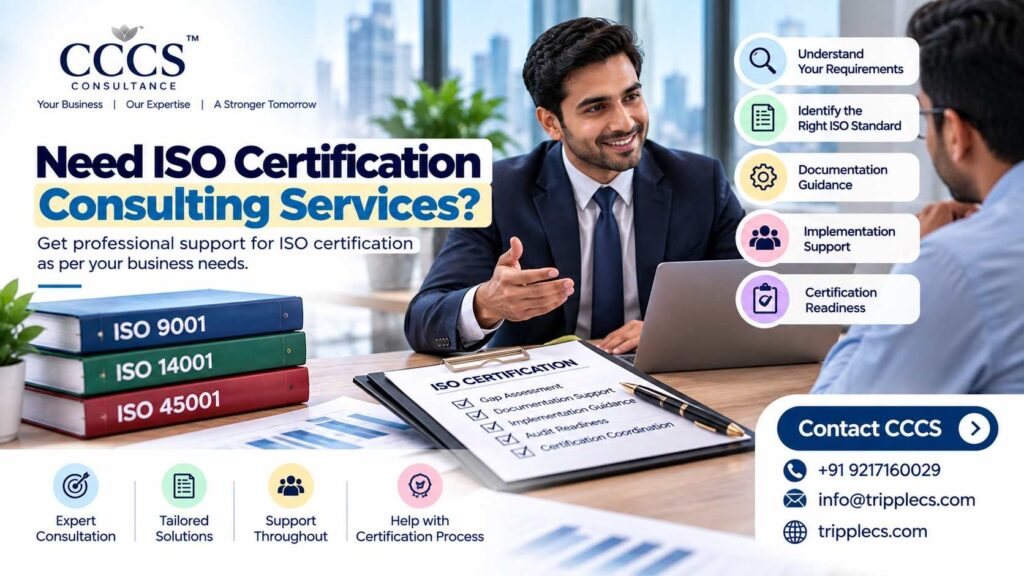
We can assist businesses in understanding their certification requirements, identifying the appropriate ISO standard, planning certification scope, preparing documentation, supporting implementation and coordinating certification-related requirements.
For professional assistance with ISO certification requirements, contact CCCS: