
A business can deliver a good product today and still struggle to deliver the same level of quality every time.
As operations grow, quality depends on more than individual experience. Customer requirements, internal responsibilities, documented processes, supplier controls, corrective actions and continual improvement all become part of the picture.
This is where Quality System Certification becomes relevant.
Quality System Certification generally provides independent assurance that an organization’s management system has been assessed against the requirements of an applicable quality management standard. One of the best-known frameworks is ISO 9001, the international standard for quality management systems.
However, there is an important distinction businesses should understand:
A certified quality management system does not automatically mean that every product manufactured or supplied by the company is individually product-certified.
That difference matters when customers, tenders or supply-chain partners ask for evidence of certification.
What Is Quality System Certification?
Quality System Certification is an independent assessment of an organization’s quality management system against the requirements of a recognized standard, such as ISO 9001.
Instead of examining only one finished product, a management-system assessment looks at how the organization manages the processes that influence its ability to consistently meet customer and applicable requirements.
This can include areas such as process control, responsibilities, monitoring, corrective actions and continual improvement.
In simple terms:
Product certification asks questions about the product.
Quality System Certification asks questions about how the organization manages quality.
The two should not be treated as interchangeable.
Quality Is Easier to Promise Than to Repeat
A small business may initially maintain quality through direct involvement of its founders or senior employees.
They know the customers.
They personally check important orders.
They resolve problems immediately.
But as the business expands, that approach becomes difficult to maintain.
More employees join. New suppliers are introduced. Production or service volumes increase. Responsibilities become distributed across departments.
At this stage, quality cannot depend entirely on one person’s memory or supervision.
A structured Quality Management System helps a business move from:
“We know how we do things”
to:
“Our organization has defined and controlled how important activities are managed.”
That is one of the practical business ideas behind quality management system certification.
Is Quality System Certification the Same as ISO Certification?
The terms are closely connected, but they should be used carefully.
ISO develops international standards; ISO itself does not certify organizations. Certification is performed by independent certification bodies.
ISO 9001 specifies requirements for a Quality Management System (QMS) and is one of the standards commonly associated with Quality System Certification.
Therefore, when a customer asks whether a company has a certified quality management system, they may be referring to certification against ISO 9001 or another applicable management-system standard.
Before proceeding, the business should identify the specific standard being requested, rather than simply asking for a generic “ISO certificate.”
A Certificate Should Match the Business Behind It
Suppose a company operates:
one manufacturing unit, one warehouse and two service locations.
It obtains a Quality System Certificate.
A potential customer later sees the certificate and assumes:
“Everything this company does must be covered.”
That conclusion may not always be correct.
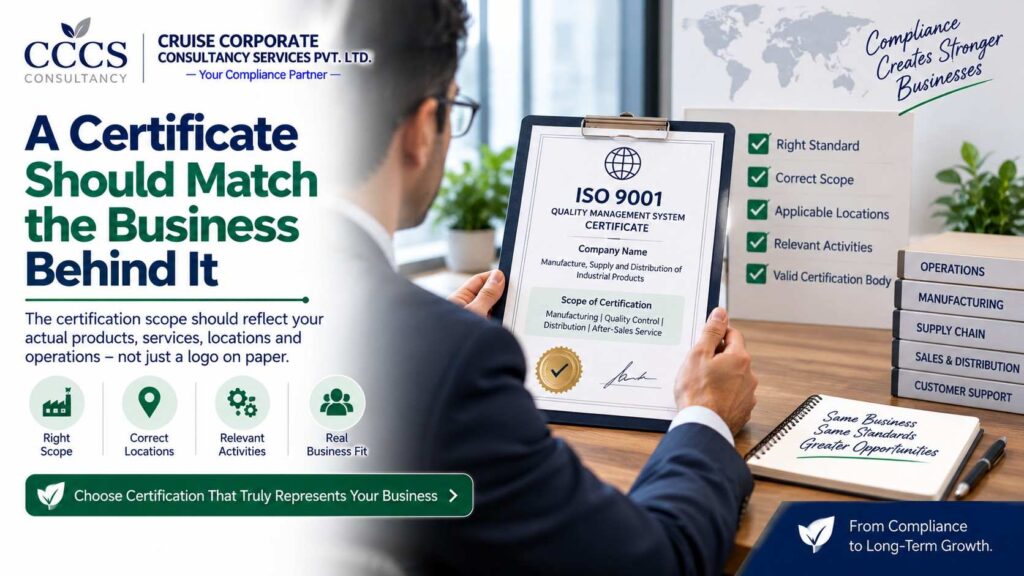
A management-system certificate has a defined scope. The scope helps identify the activities, products/services or organizational boundaries covered by the certified management system.
This makes the wording on the certificate important.
Businesses should therefore look beyond the logo and certificate number and understand:
Which organization is certified? What activities are covered? Which location or locations are included? Which standard applies?
The value of a certificate depends partly on whether its scope actually corresponds to the business activity for which it is being presented.
Your Customer May Be Asking for More Than a PDF
Imagine receiving an enquiry from a large corporate buyer:
“Please share your Quality System Certification.”
It may look like a straightforward documentation request.
But commercially, the customer may be trying to understand whether your organization has a structured system for consistently managing quality.
The certificate is evidence of a management system being assessed against a specified standard.
The buyer’s underlying concern may involve issues such as:
Can this supplier consistently meet our requirements?
How does the organization control important processes?
What happens when something goes wrong?
Is quality managed systematically rather than informally?
This is why certification should not be approached only as a document needed to complete vendor registration.
Product Certification and Quality System Certification Solve Different Problems
This distinction is especially relevant to businesses that already deal with regulatory certificates.
Consider a manufacturer whose product requires a specific regulatory approval or product certification.
The manufacturer may also operate an ISO 9001-certified Quality Management System.
Those two certifications are not automatically substitutes for one another.
A product certification generally relates to conformity of a particular product with specified product requirements.
A management system certification evaluates the organization’s management system against the relevant management-system standard.
A company can therefore encounter situations where a customer or regulation requires one, the other, or both.
For businesses operating in regulated industries, understanding this distinction early can prevent the wrong certificate from being presented to a customer or authority.
“Our Company Is ISO Certified” Is Not Always Enough Information
This phrase appears frequently on websites, quotations and company profiles:
“We are ISO certified.”
But from a compliance perspective, it leaves several questions unanswered.
Which ISO standard?
Which legal entity?
What scope?
Which locations?
Which certification body issued the certificate?
Is the certificate currently valid?
These details become particularly important when certification is being submitted for a tender, vendor approval, customer qualification or contractual requirement.
Instead of relying only on the phrase “ISO Certified,” businesses should understand exactly what their certification represents.
One Company Can Need More Than One Management System
Quality is only one area of management.
Depending on its activities and customer requirements, an organization may encounter other management-system standards dealing with areas such as environmental management or occupational health and safety.
For example:
ISO 9001 → Quality Management
ISO 14001 → Environmental Management
ISO 45001 → Occupational Health and Safety Management
These standards address different management objectives.
A company should therefore not select a certification simply because competitors display a particular ISO logo.
The better question is:
Which management-system requirement is relevant to our organization, customers and commercial objectives?
Certification Begins with Understanding the Scope, Not Choosing the Logo
Businesses sometimes approach certification by saying:
“We need ISO. Please get us the certificate.”
That starts the conversation at the wrong end.
Before certification is considered, the organization should understand what activities need to fall within the management system.
For example, a company may be involved in:
design → manufacturing → installation → distribution → after-sales service
Another company may perform only:
trading and distribution.
Although both companies may seek quality management certification, their operational realities are different.
A meaningful certification scope should reflect what the organization actually does.
This is one reason why copying another company’s certification description is rarely a good approach.
Multiple Locations Can Change the Certification Picture
Growth often makes certification more complicated.
A business may begin from one office and later add:
a factory, warehouse, branch office or additional operational location.
At that point, management should understand whether those locations fall within the certification arrangement and how they relate to the defined management system.
Simply holding a certificate at head office should not automatically be interpreted as proof that every site operated by the organization is covered.
For companies expanding geographically, certification planning should therefore consider the actual organizational structure rather than only the registered office address.
Certification Is Not Finished When the Certificate Arrives
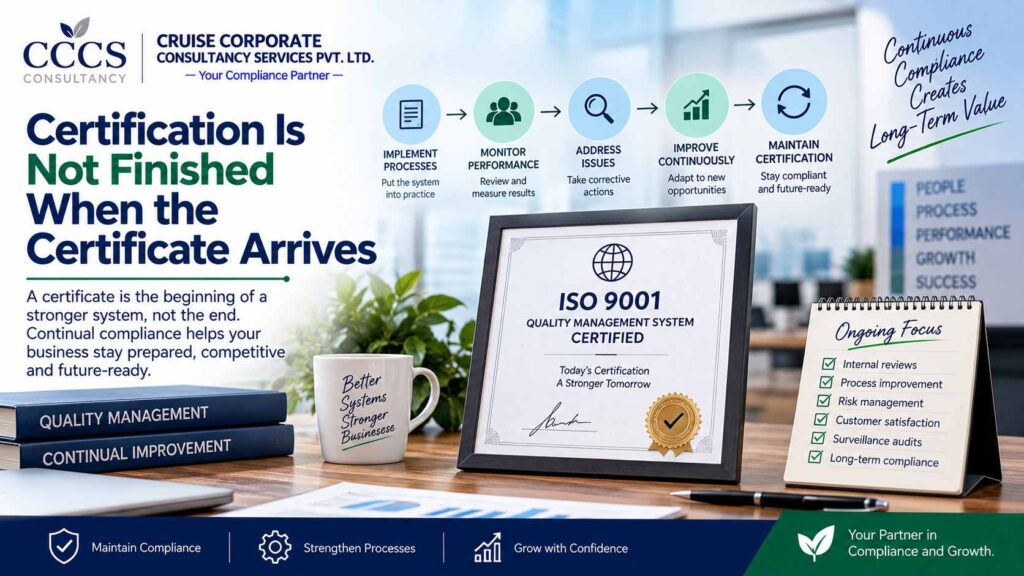
One of the biggest misconceptions is that Quality System Certification is a one-time exercise:
Prepare → Get Audited → Receive Certificate → Finished
Management-system certification works differently.
The underlying system needs to continue operating.
Processes change. Employees change. Customer expectations evolve. Problems occur. Corrective actions may be required. Internal business conditions can also change.
Certification arrangements normally include ongoing surveillance and periodic reassessment in accordance with the applicable certification programme.
So the certificate should represent a working management system, not simply a document stored in a company folder.
A Quality System Cannot Guarantee That Nothing Will Ever Go Wrong
Quality management is sometimes misunderstood as a promise of perfection.
That is not its purpose.
Even a well-managed organization can encounter defects, complaints, delays or process failures.
A Quality Management System provides a structured framework for controlling processes, evaluating performance and addressing nonconformities and opportunities for improvement.
Therefore, certification should not be marketed as:
“Our company can never make a mistake.”
A more accurate interpretation is:
“Our organization operates a management system assessed against specified quality-management requirements.”
That distinction makes certification claims more credible.
When Does Quality System Certification Become Commercially Important?
A company may start considering Quality System Certification for several reasons.
A customer may make it part of supplier qualification.
A tender may specify a particular management-system standard.
A company entering larger supply chains may encounter stronger vendor-assessment requirements.
Management may also want a more structured approach as the organization grows.
The important point is that the business should first understand why certification is being requested.
If a tender specifies ISO 9001, obtaining an unrelated ISO certification does not answer that requirement.
If a buyer asks for a certified QMS covering manufacturing, a certificate whose scope does not cover the relevant activity may create another problem.
Requirement first. Certification second.
Before Using a Supplier’s Quality Certificate, Read What It Actually Covers
Quality System Certification also matters when evaluating suppliers.
A supplier may send an impressive-looking certificate, but procurement teams should not rely only on its appearance.
The certificate should be considered in relation to the supplier, applicable standard, certified activities, locations and validity.
This becomes particularly important when certification forms part of a contractual or vendor-approval requirement.
The practical question is not simply:
“Does the supplier have a certificate?”
It is:
“Does this certification actually cover the supplier and activity relevant to our requirement?”
Quality System Certification Should Support the Business, Not Just Its Marketing
A certificate can strengthen a company’s profile.
But the larger value of a quality management system comes from how effectively it supports the organization itself.
A properly implemented system can encourage clearer responsibilities, more consistent processes, structured handling of problems and greater attention to customer requirements and improvement.
That makes certification more meaningful than simply placing an ISO logo on a website or proposal.
For growing organizations, the objective should be to develop a quality system that reflects how the business actually operates and then pursue appropriate certification against the relevant standard.
Need Assistance with Quality System & ISO Certification?
Choosing the right certification begins with understanding the business requirement.
The applicable standard, certification scope, organizational activities and locations should be considered before proceeding.
Cruise Corporate Consultancy Services Pvt. Ltd. (CCCS) can assist businesses in understanding their Quality System and ISO Certification requirements and identifying an appropriate compliance approach based on their operations and commercial needs.
If your customer, tender or business partner has requested a Quality System Certification and you are unsure which certification or scope is relevant, reviewing the requirement before starting can help avoid pursuing the wrong certification.
Website: tripplecs.com
Phone: +91 9217160029
Email: info@tripplecs.com