
An Indian business may have a product ready for export, an overseas buyer interested in purchasing it, and even an Importer Exporter Code (IEC) in place.
Then another question appears:
“Do we also need an APEDA Certificate for Export?”
The answer depends largely on what you are exporting.
APEDA—the Agricultural and Processed Food Products Export Development Authority—covers specified agricultural and processed food products under its scheduled product categories. For exporters dealing in products falling within APEDA’s scope, registration with the relevant Export Promotion Council/authority becomes an important part of export compliance.
This is why businesses should not begin with the assumption that every exporter needs APEDA registration. The better starting point is the product itself.
Does Every Exporter Need an APEDA Certificate?
No. APEDA registration is not a general certificate required for every Indian exporter.
Its relevance depends on whether the exporter deals in products covered under APEDA’s scheduled product categories.
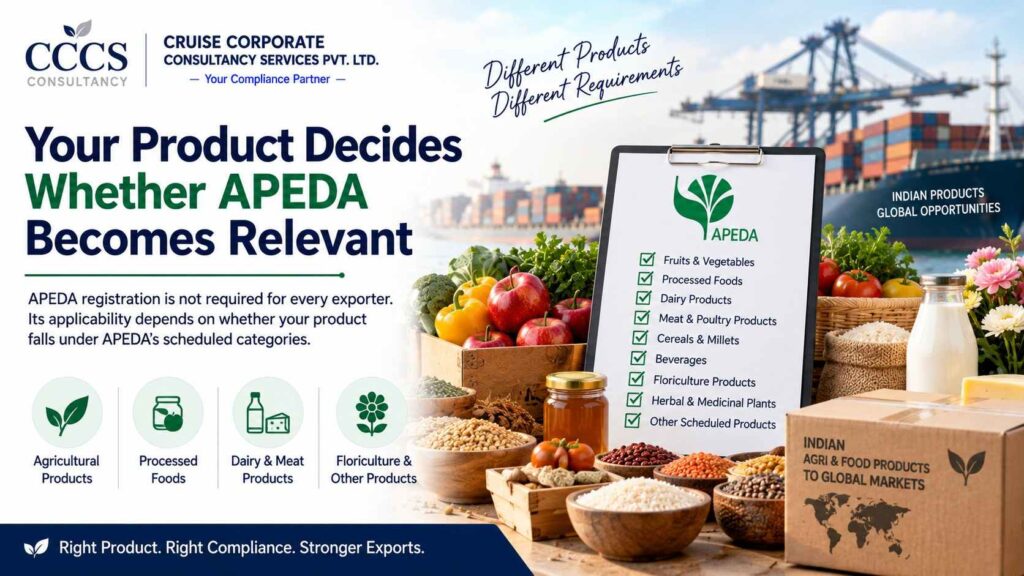
APEDA’s current product categories include areas such as fruits and vegetables, meat and meat products, poultry products, dairy products, confectionery and bakery products, honey and sugar products, cereals, alcoholic and non-alcoholic beverages, floriculture, processed foods and certain other agricultural products.
So, for example, a company exporting engineering machinery and a company exporting processed fruit products should not automatically be placed under the same APEDA compliance requirement.
The nature of the product changes the regulatory position.
Your Product Decides Whether APEDA Becomes Relevant
This is one of the most important points for a new exporter to understand.
Suppose three businesses are preparing for their first international shipment:
Business A exports fresh vegetables.
Business B exports packaged processed food.
Business C exports industrial equipment.
All three businesses are exporters.
But that does not mean all three have the same registration requirements.
For APEDA purposes, the product category must first be understood in relation to the products scheduled under the APEDA Act.
This is also why searching only for:
“Which certificate is required for export?”
can sometimes lead businesses in the wrong direction.
Export compliance is usually product-specific, not simply exporter-specific.
What Do Businesses Mean by an “APEDA Certificate”?
The phrase “APEDA Certificate” is widely used by businesses, exporters and online searchers.
However, exporters should understand the terminology behind it.
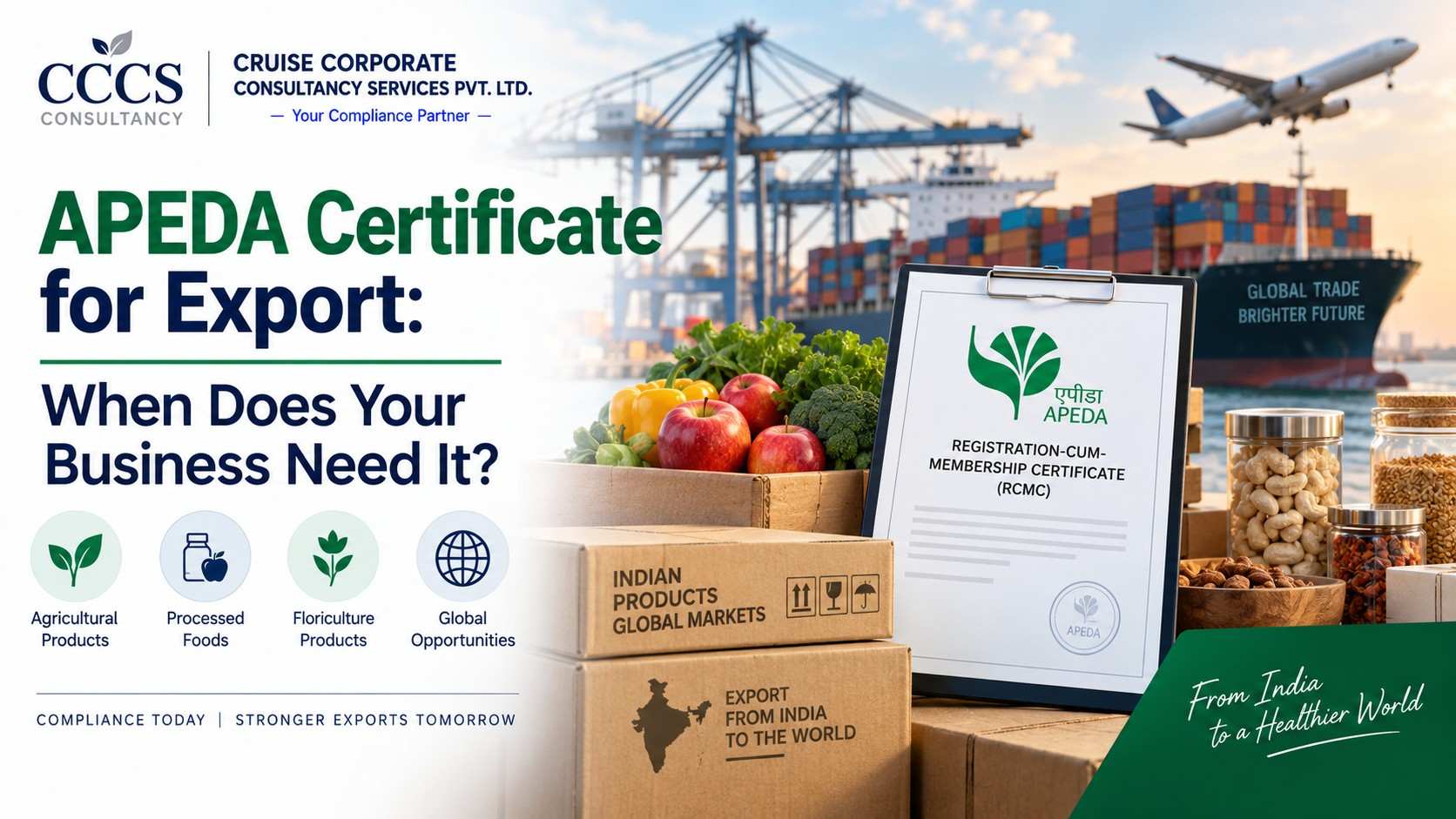
For covered exporters, the relevant registration is generally the Registration-Cum-Membership Certificate (RCMC) associated with APEDA.
Under the current system, DGFT’s e-RCMC platform facilitates applications for Registration-Cum-Membership Certificates, including applications connected with export promotion councils and commodity boards.
Therefore, when a buyer, consultant or business team refers to an APEDA Certificate for Export, they may actually be referring to the exporter having the appropriate APEDA RCMC registration.
Understanding this difference prevents confusion when preparing export documentation.
IEC and APEDA RCMC Do Different Jobs
This is where many first-time exporters get confused.
A business may already have an IEC and assume:
“We already have an export registration, so why would another registration be required?”
IEC and APEDA RCMC should not be treated as interchangeable.
An Importer Exporter Code (IEC) is the key identification associated with undertaking import/export activities in India.
APEDA registration, on the other hand, relates to exporters dealing with products falling within APEDA’s scheduled scope.
Think of the compliance situation like this:
Export Business → IEC → Product Identification → Relevant Export Authority/RCMC → Product & Destination-Specific Requirements
Having an IEC therefore does not automatically answer whether APEDA registration is relevant to your particular product.
One Food Business Can Have Several Different Product Situations
Consider a company with a large catalogue.
It may export:
- fresh agricultural produce,
- processed foods,
- cereal-based products,
- beverages, and
- products sourced from third-party manufacturers.
From a commercial perspective, all of these may sit under one company and one brand.
From a compliance perspective, however, product classification and regulatory requirements can differ.
This becomes particularly important when a company expands.
A business that initially exports one product category may later introduce another product line and assume that its existing export compliance setup automatically covers everything.
That assumption should be reviewed.
Whenever the product portfolio changes significantly, the business should reconsider which export registrations, certificates and destination-market requirements apply.
Manufacturer Exporter or Merchant Exporter? Understand Your Business Model
Not every exporter manufactures the goods it sells overseas.
Some businesses manufacture products themselves.
Others purchase products from manufacturers and export them under a trading or merchant-export arrangement.
This difference matters because export compliance should reflect the actual business and supply-chain structure.
For example, a merchant exporter may depend heavily on information and documents supplied by the manufacturer.
A manufacturer-exporter has more direct control over production but may face additional product, facility, quality or destination-specific compliance considerations.
Therefore, merely knowing the product name is sometimes not enough.
A proper review may need to consider:
Who manufactures it? Who exports it? Under whose brand is it sold? Where is it going? What does the overseas buyer require?
These questions can change the compliance picture considerably.
APEDA Registration Does Not Mean Your Product Is Automatically Ready for Every Country
This distinction is extremely important.
Obtaining the relevant APEDA registration should not be interpreted as:
“Now this product can be exported anywhere in the world without any other requirement.”
Exporting agricultural and processed food products can involve several layers of compliance.
Depending on the product and destination country, a business may encounter requirements relating to areas such as:
product standards, food safety, health or phytosanitary requirements, packaging and labelling, testing, establishment approvals, certificates requested by the importing country, or buyer-specific documentation.
The exact requirements vary considerably.
So APEDA registration may form one part of the export compliance framework, rather than replacing every other approval or certificate.
A Buyer Asking for “APEDA” May Actually Be Asking a Bigger Question
Imagine an overseas buyer sends this message:
“Please provide APEDA certificate.”
It is easy to treat this as a simple document request.
But commercially, the buyer may really be asking:
“Is your business properly registered to export this category of product from India?”
That is why businesses should understand the purpose of a requested document rather than simply forwarding whichever PDF has a similar name.
If the buyer requires additional product-specific or destination-specific evidence, an APEDA registration alone may not satisfy the complete requirement.
Do Not Decide APEDA Applicability Only from a Product’s Marketing Name
Product names can sometimes be misleading.
For example, a company may market something simply as:
“Natural Health Drink”
or
“Premium Herbal Product.”
Those marketing descriptions do not necessarily tell you the regulatory category of the product.
Its ingredients, processing, intended use and actual product classification may matter.
For businesses operating across multiple agricultural or processed food categories, determining the correct product position before proceeding can prevent the wrong compliance route from being selected.
The question should therefore move from:
“What is the product called?”
to:
“What exactly is the product from a regulatory and export perspective?”
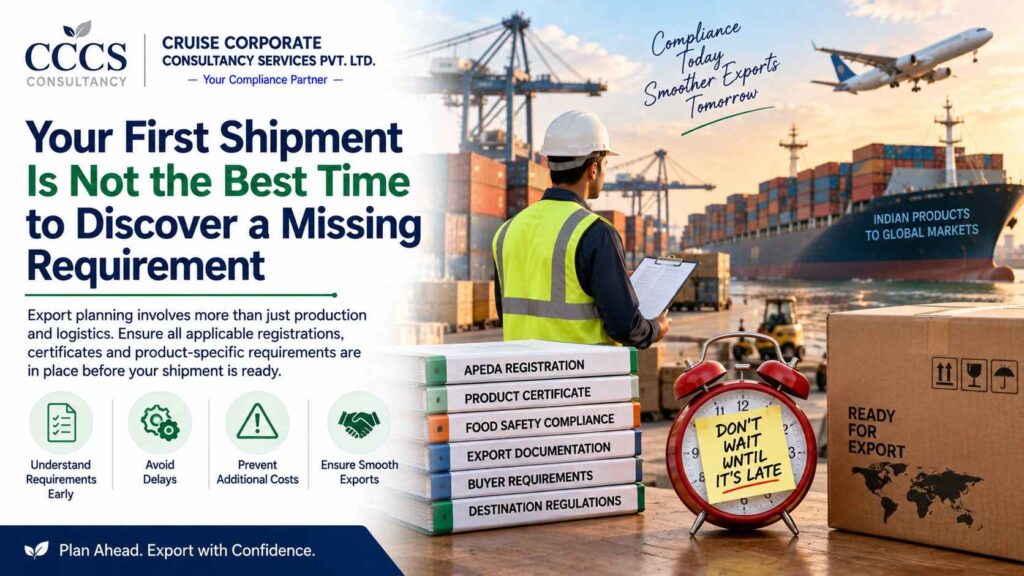
Your First Shipment Is Not the Best Time to Discover a Missing Requirement
Many export compliance problems become expensive because they are discovered too late.
Consider a business that has already:
confirmed the overseas order → completed production → printed packaging → booked logistics → prepared the shipment
and only then discovers that a registration, product certificate or destination-specific document is still required.
At that stage, even a manageable compliance issue can become a commercial problem.
The buyer is waiting.
Cargo movement has been planned.
Deadlines may already have been committed.
This is why regulatory review is more useful before the shipment becomes time-sensitive.
For APEDA-related products, the business should understand its registration position while planning the export rather than treating compliance as the final paperwork before dispatch.
Already Have APEDA Registration? Your Review Should Not End There
An existing APEDA RCMC can be important, but businesses should avoid treating it as something that never needs attention again.
Changes can occur in:
business details, export product categories, product portfolio, manufacturing arrangements, regulatory requirements or export markets.
A business entering a new product category or destination should therefore reconsider whether its current compliance framework remains appropriate.
This is especially relevant for growing exporters that started with a small number of products but now handle multiple categories.
The compliance structure that worked for the first shipment may not necessarily answer every requirement of the fiftieth.
APEDA Should Be Viewed as Part of Export Readiness
The real objective for an exporter is not simply collecting certificates.
It is being able to answer:
What are we exporting?
Does APEDA cover this product?
What registration applies to our business?
Are there additional product-specific requirements?
What does the destination country require?
What documentation has the buyer requested?
When these questions are considered together, APEDA registration becomes part of a broader export-readiness decision rather than an isolated certificate.
That approach can also reduce unnecessary registrations.
A business should neither ignore a requirement that applies nor spend time obtaining a registration simply because another exporter has one.
When Should a Business Review Its APEDA Requirement?
A review is particularly useful when a business is:
starting exports of an APEDA-scheduled product, entering a new agricultural or processed-food category, adding substantially different products, receiving an APEDA/RCMC request from an overseas buyer, or preparing exports without clarity about the applicable authority.
The objective should be to establish the correct compliance route before documentation starts accumulating around the wrong assumption.
For exporters, a small classification question at the beginning can influence several decisions later.
Need Assistance with APEDA Registration for Export?
An APEDA Certificate for Export should not be viewed as a generic document that every exporter obtains in exactly the same situation.
The product category, nature of the exporter, applicable registration framework and intended export market should be understood first.
Cruise Corporate Consultancy Services Pvt. Ltd. (CCCS) can assist businesses in evaluating APEDA-related requirements and understanding the appropriate compliance route for their export activities.
If you are planning to export agricultural or processed food products and are unsure whether APEDA registration applies to your business, reviewing the product and export situation before proceeding can help avoid unnecessary delays.
Website: tripplecs.com
Phone: +91 9217160029
Email: info@tripplecs.com