

A Nidhi Company is not simply another type of finance business. It operates under a specific legal framework designed around mutual benefit among its members.
Businesses and promoters considering Nidhi Company Registration should therefore understand an important distinction from the beginning: incorporating a public company and obtaining recognition to operate as a Nidhi are connected, but they should not be treated as the same compliance event.
Under the Nidhi framework, the core purpose is to encourage thrift and savings among members and to receive deposits from and lend to members for their mutual benefit. MCA has also emphasized that Nidhi companies are subject to Section 406 of the Companies Act and the Nidhi Rules.
For promoters, the practical question is not only “How do we register a Nidhi Company?” but whether the proposed business model can satisfy the conditions and restrictions applicable to a Nidhi.
What Is a Nidhi Company?
A Nidhi operates on a member-focused mutual-benefit model. Its financial activities are fundamentally connected with its members rather than the general public.
This distinction matters because the Nidhi Rules restrict several activities. For example, a Nidhi generally cannot accept deposits from or lend to persons other than its members, and it cannot carry on an unrelated business outside the permitted framework.
Therefore, promoters planning a broader finance business should not assume that Nidhi Finance Company Registration automatically provides permission to operate like every other type of financial institution.
The intended business activity should be reviewed first.
Nidhi Company Incorporation and Nidhi Status Should Not Be Confused
This is particularly important for anyone researching Nidhi Company Incorporation.
Under the current framework introduced by the Nidhi (Amendment) Rules, 2022, a public company seeking to be declared as a Nidhi must apply to the Central Government in Form NDH-4 within 120 days of incorporation, subject to prescribed conditions.
This means promoters should not view ordinary company incorporation as the end of the Nidhi registration process.
The proposed structure needs to be planned around the requirements applicable to obtaining Nidhi status.
The 200-Member Requirement Matters Early
Under Rule 3B introduced through the 2022 amendment, a company seeking declaration as a Nidhi must have not less than 200 members when applying under the specified framework.
For a consultancy client, this is an important planning consideration.
A promoter should therefore evaluate the proposed membership model before proceeding rather than incorporating first and considering membership requirements later.
The quality and compliance of the proposed structure matter just as much as completing the incorporation itself.
₹20 Lakh Net Owned Funds Is Another Important Requirement
The same amended framework requires Net Owned Funds of ₹20 lakh or more for a public company applying to be declared as a Nidhi under Rule 3B.
This is also an area where businesses need to be careful with older online information.
Older versions of the Nidhi Rules contain references to a ₹10 lakh Net Owned Funds requirement, while the 2022 framework introduced the ₹20 lakh threshold for companies applying under the newer Rule 3B route.
Therefore, Nidhi planning should be based on the provisions applicable to the company rather than an outdated generic checklist found online.
Promoters and Directors Are Also Part of the Compliance Review
Nidhi registration is not concerned only with capital and membership numbers.
The 2022 rules also require declarations concerning the “fit and proper person” criteria for promoters and directors as part of the NDH-4 framework. Factors considered include integrity and reputation as well as specified disqualifying circumstances.
This makes promoter and director eligibility another matter that should be reviewed before moving ahead with the proposed structure.
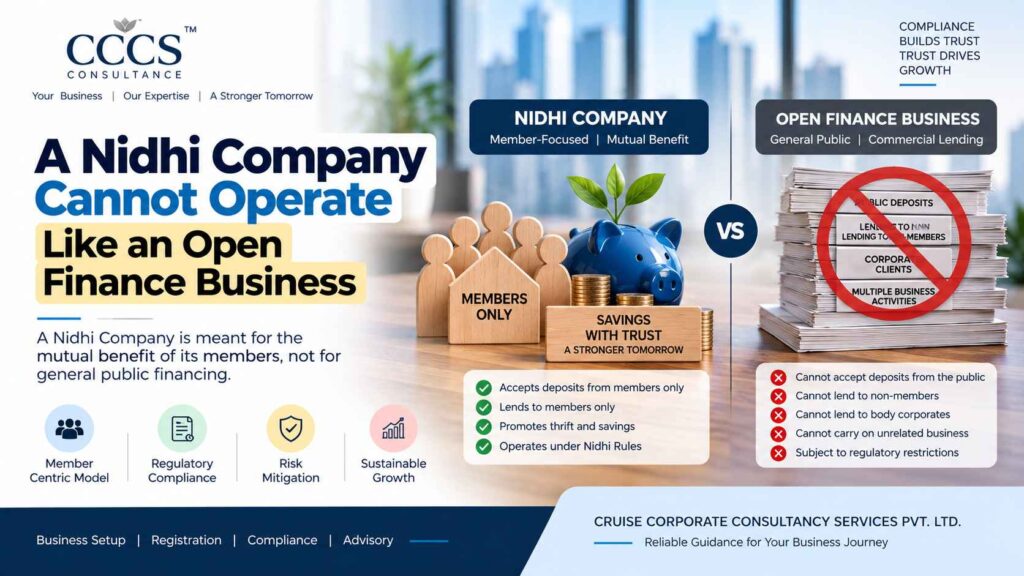
A Nidhi Company Cannot Operate Like an Open Finance Business
The word “finance” in searches such as Nidhi Finance Company can create the wrong impression about the scope of the business.
The Nidhi Rules place specific restrictions on business activities. Among other things, a Nidhi cannot generally accept deposits from or lend to non-members, take deposits from or lend money to a body corporate, or enter into partnership arrangements for its borrowing or lending activities.
This is why promoters should first understand whether their proposed financial activity actually fits the Nidhi model.
If the intended customer base is the general public rather than members, the proposed structure requires particularly careful examination.
Membership Is Central to the Nidhi Business Model
Unlike many ordinary companies where customers and shareholders may be entirely different groups, membership has a direct role in the Nidhi structure.
The rules also restrict admission of a body corporate or trust as a member, and contain specific provisions concerning minors and membership.
Therefore, membership should not be viewed merely as a number that needs to be achieved for registration.
It forms part of how the Nidhi is expected to operate.
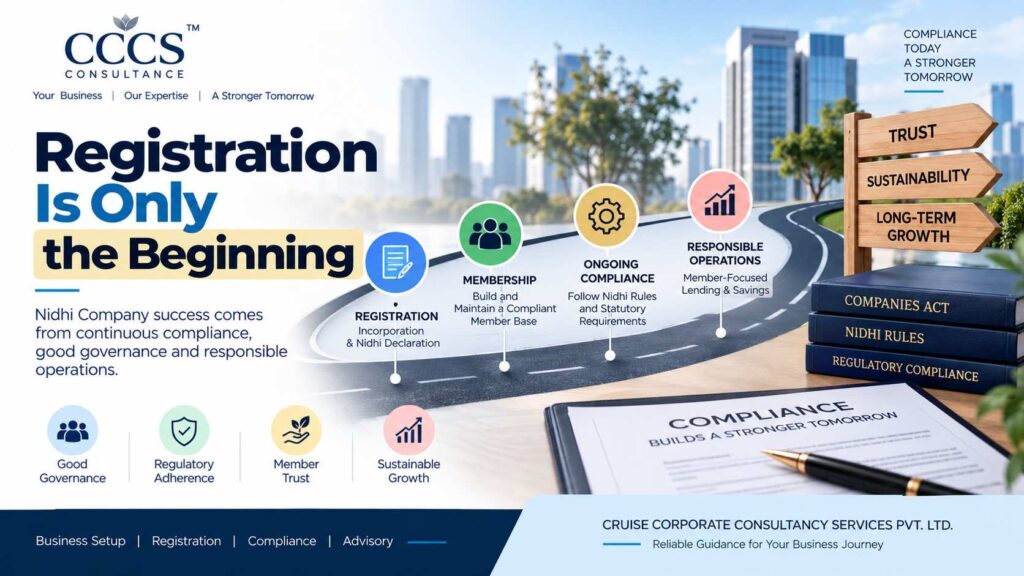
Registration Is Only the Beginning
Getting the required corporate and Nidhi approvals does not eliminate future compliance responsibilities.
A Nidhi must continue to operate within the Companies Act, applicable Nidhi Rules and other relevant requirements. Restrictions concerning membership, deposits, lending, branches and other operations can continue after registration.
MCA has also previously cautioned investors to verify whether a Nidhi has actually obtained the required status rather than relying merely on the company’s name or representation.
For promoters, this reinforces an important principle:
Incorporation → Nidhi Eligibility → Required Declaration/Approval → Compliant Operations
Each stage needs to remain aligned with the applicable regulatory framework.
Nidhi Company Registration Should Start with the Business Model
Before proceeding with Nidhi Registration, promoters should first consider what they actually intend the company to do.
If the objective is member-based savings and lending for mutual benefit, the Nidhi structure may be relevant. If the proposed model involves wider public deposits, lending to non-members, corporate customers or activities outside the permitted Nidhi framework, simply choosing “Nidhi Company” as the business structure may not solve the regulatory issue.
This is where professional assessment before incorporation becomes valuable.
Correcting an unsuitable structure after incorporation can be more complicated than reviewing the business model before the process begins.
Need Assistance with Nidhi Company Registration?
Cruise Corporate Consultancy Services Pvt. Ltd. (CCCS) provides professional assistance for Nidhi Company Registration, incorporation, documentation and related corporate compliance requirements.
Our approach begins with understanding the proposed business model, promoters, membership structure and regulatory requirements before proceeding with the appropriate registration and compliance work.
For professional assistance with Nidhi Company Incorporation and Registration in India, contact our consultancy team.
Website: tripplecs.com
Phone: +91 9217160029
Email: info@tripplecs.com
CCCS — Professional Support for Business Setup, Registration & Compliance Services.