
Starting an organization for a social purpose is very different from starting an ordinary profit-driven business.
You may want to work in education, social welfare, environmental protection, research, charity, sports, arts or another public-benefit area. But having a good cause alone does not decide the right legal structure.
For organizations considering a company structure, Section 8 Company Registration can be an important option.
A Section 8 company is formed under the Companies Act, 2013 for specified charitable or not-for-profit objectives. Its profits or other income are intended to promote its stated objectives, and dividends are not distributed to members.
Before incorporation, however, promoters should understand whether this structure actually fits their proposed activities.
What Is a Section 8 Company?
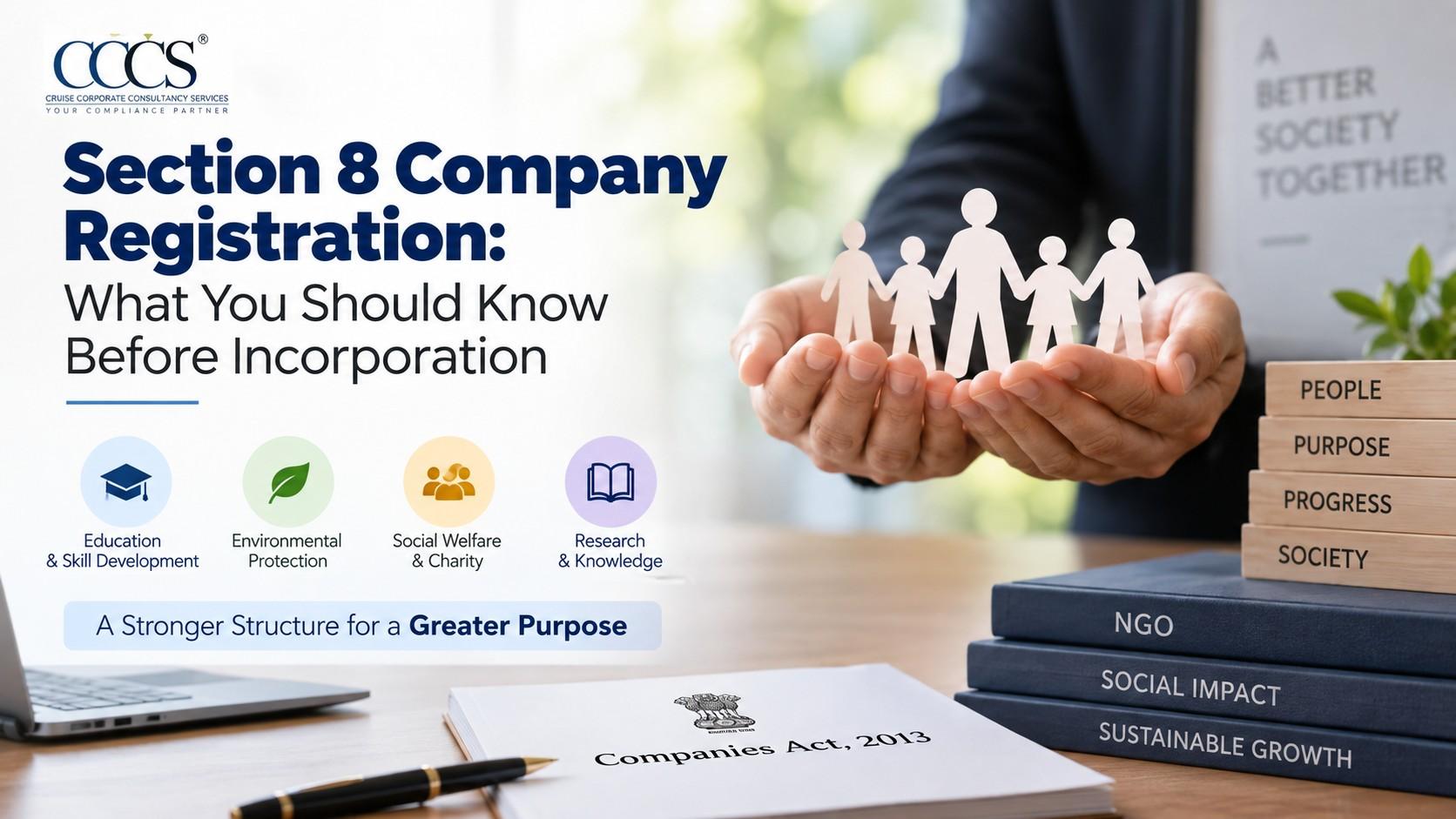
A Section 8 company is a company established for objectives such as promoting commerce, art, science, sports, education, research, social welfare, religion, charity, protection of the environment or similar purposes.
Unlike a conventional commercial company, its income and profits are applied toward promoting its stated objectives rather than being distributed to members as dividends.
This makes Section 8 companies relevant to organizations that want a formal corporate structure while operating primarily for social or not-for-profit objectives.
But “non-profit” does not mean “no income.”
A Section 8 company may generate income through activities connected with its objectives. The important issue is how that income is used and whether the organization continues to operate in accordance with its approved objects and applicable law.
Your Objective Should Be Clear Before You Choose the Structure
One of the most important Section 8 Company Registration requirements begins before incorporation documents are prepared:
What exactly will the organization do?
Consider two proposals.
Organization A: wants to provide skill-development and educational programmes.
Organization B: wants to operate an ordinary commercial consultancy and distribute profits among its owners.
Both can be legitimate businesses, but they do not necessarily belong under the same legal structure.
A Section 8 company should have objects consistent with the purposes permitted under Section 8.
This is why promoters should avoid selecting the structure merely because they have heard that Section 8 companies are suitable for NGOs.
Purpose first. Structure second.

Section 8 Company, Trust and Society Are Not the Same
People planning an NGO often encounter three terms:
Section 8 Company → Trust → Society
They are not simply three names for the same legal arrangement.
A Section 8 company operates under the corporate framework of the Companies Act, 2013, whereas trusts and societies operate under different legal frameworks depending on their nature and jurisdiction.
The appropriate choice can depend on factors such as:
- proposed activities,
- governance structure,
- number and role of founders,
- geographical operations,
- funding plans, and
- long-term organizational objectives.
Therefore, asking “Which is best?” without considering how the organization will actually operate can lead to the wrong conclusion.
The Name of the Organization Is Only One Part of Incorporation
Founders often begin by choosing a name.
The name matters, but incorporation involves much more than branding.
The proposed company’s objects, promoters, governance structure, registered office arrangements and incorporation information should work together consistently.
For example, if the proposed objects describe an educational organization while other information indicates a substantially different commercial activity, the overall structure may need closer review.
A professional-looking name cannot correct an unclear business purpose.
Can a Section 8 Company Earn Money?
Yes, earning income is not automatically prohibited simply because an entity is a Section 8 company.
The key distinction concerns the purpose and use of that income.
Section 8 requires the company to apply its profits or other income toward promoting its objects and prohibits payment of dividends to its members.
This means a Section 8 company should not be understood as:
“A company that is not allowed to receive money.”
It is better understood as an organization where income is directed toward its approved objectives rather than distributed to members as ordinary business profits.
This distinction is particularly important when founders are developing a revenue model for the organization.
Founders Should Think About Governance Before Incorporation
A new organization often begins with people who trust one another.
That is useful, but the legal structure should also work when the organization grows.
Questions may arise such as:
Who will manage the organization?
Who will make important decisions?
What responsibilities will directors or members have?
What happens when new people join?
How will the organization remain aligned with its objects?
These are not merely incorporation-day questions.
They affect the organization’s future operation.
This is why Section 8 incorporation should be approached as building an organization, not simply obtaining a registration certificate.
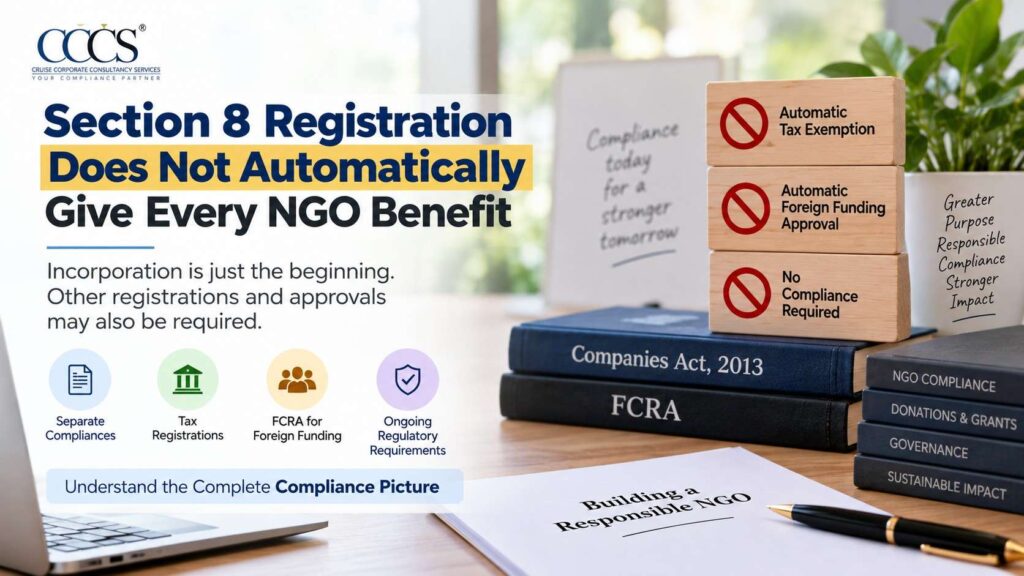
Section 8 Registration Does Not Automatically Give Every NGO Benefit
This is an important misconception.
Some founders assume:
“Once we register a Section 8 company, all NGO benefits and tax exemptions automatically apply.”
That should not be assumed.
Company incorporation and other registrations/approvals are separate compliance matters.
Depending on the organization’s activities and objectives, it may later consider other registrations or approvals under applicable laws—for example, income-tax registrations or other requirements relevant to its operations and funding.
Therefore:
Section 8 Incorporation ≠ Automatic Approval Under Every Other Law
Each requirement should be considered separately.
Donations and Foreign Funding Should Not Be Treated as Automatic Rights
Another common assumption is:
“We are a Section 8 company, so we can immediately receive any type of donation.”
The source and nature of funding matter.
Domestic donations, grants, CSR-related opportunities and foreign contributions can involve different legal and compliance considerations.
In particular, receiving foreign contributions is governed separately under the Foreign Contribution (Regulation) Act (FCRA) framework.
Therefore, Section 8 incorporation by itself should not be treated as automatic permission to receive foreign contributions.
Organizations expecting particular types of funding should understand the relevant regulatory position separately.
Your Future Activities Should Match the Objects You Choose Today
At incorporation, founders naturally focus on getting the organization started.
But the objects of the company can influence future activities.
Suppose an organization begins with a narrow educational objective but later wants to expand significantly into environmental programmes, research and social-development activities.
If future plans were never considered while defining the organization’s objects, additional compliance questions may arise later.
This does not mean promoters should insert every imaginable activity into their objects.
It means they should think carefully about the organization’s genuine present purpose and realistic future direction.
The objective clause should represent the organization—not simply be copied from another NGO.
A Section 8 Company Still Has Ongoing Compliance Responsibilities
The word “non-profit” does not remove corporate compliance responsibilities.
Once incorporated, a Section 8 company continues to operate as a company under the applicable corporate framework.
That can involve maintaining appropriate records, financial reporting, statutory filings, governance requirements and other compliances applicable to its circumstances.
So incorporation should not be viewed as:
Registration → Certificate Received → Compliance Finished
It is the beginning of the organization’s formal corporate lifecycle.
Founders should consider whether they have the capacity to maintain the structure after incorporation, not merely whether they can register it.
When Does Section 8 Company Registration Make Sense?
A Section 8 company may be worth considering when the proposed organization has a genuine not-for-profit or public-benefit objective and the founders want to operate through a structured corporate framework.
It can be relevant for organizations working in areas such as education, research, social welfare, environmental protection, charity, arts, sports and other permitted objectives.
However, the decision should be based on the actual purpose, governance and future plans of the organization.
If the founders primarily want to conduct a conventional profit-distribution business, another business structure may be more appropriate.
Before Incorporation, Think Beyond the Registration Certificate
A strong Section 8 setup begins with clarity.
Before proceeding, promoters should understand:
Why is the organization being created?
What activities will it undertake?
How will it generate and use income?
Who will manage it?
What type of funding is expected?
What additional registrations may become relevant later?
Answering these questions early can make the legal structure more aligned with the organization’s actual plans.
The goal should not simply be to obtain a Section 8 Company Registration Certificate.
The goal should be to create a structure that can support the organization’s mission over the long term.
Need Assistance with Section 8 Company Incorporation?
Setting up a Section 8 company involves more than selecting an NGO-related company type.
The proposed objects, organizational structure, promoters, intended activities and future compliance requirements should be understood before incorporation.
Cruise Corporate Consultancy Services Pvt. Ltd. (CCCS) can assist organizations in understanding their Section 8 Company Incorporation requirements and selecting an appropriate approach based on their proposed activities.
If you are planning a charitable, educational, social-welfare or other not-for-profit organization and are unsure whether a Section 8 company is the right structure, reviewing the business model before incorporation can help avoid problems later.
Website: tripplecs.com
Phone: +91 9217160029
Email: info@tripplecs.com