
A product may look completely ready for the market. The packaging is finished, the supplier has confirmed the specifications, and production has already started.
Then a buyer or compliance team asks:
“Is this product RoHS compliant?”
For businesses dealing with electrical and electronic equipment, this question can be more important than it initially appears.
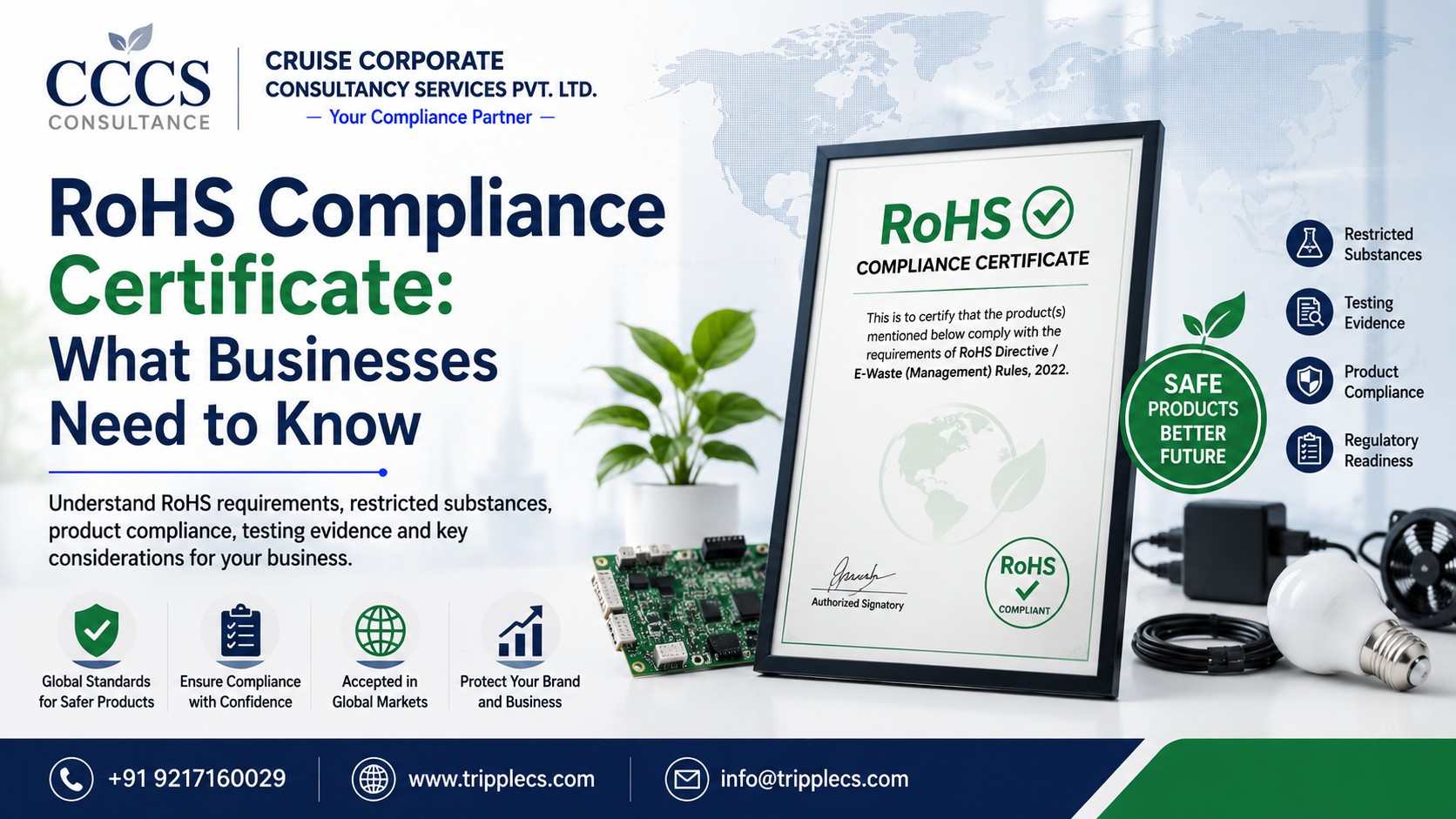
A RoHS Compliance Certificate is commonly used to demonstrate that a product meets applicable restrictions on certain hazardous substances. But businesses should understand one important point from the beginning: RoHS compliance is about the actual product, materials and supporting technical evidence—not simply possessing a document titled “RoHS Certificate.”
In India, reduction of hazardous substances for covered electrical and electronic equipment is addressed under the E-Waste (Management) Rules, 2022, including subsequent amendments.
What Does RoHS Compliance Actually Mean?
RoHS stands for Restriction of Hazardous Substances.
The basic purpose is to restrict specified hazardous substances in electrical and electronic equipment and their components, consumables, parts and spares where the applicable rules require it.
Under India’s E-Waste (Management) Rules, producers of covered electrical and electronic equipment must ensure that specified substances do not exceed prescribed maximum concentration values in homogeneous materials.
So when a business says:
“Our product is RoHS compliant.”
there should be appropriate technical evidence behind that statement.
This distinction matters because a certificate alone does not change what is actually inside the product.
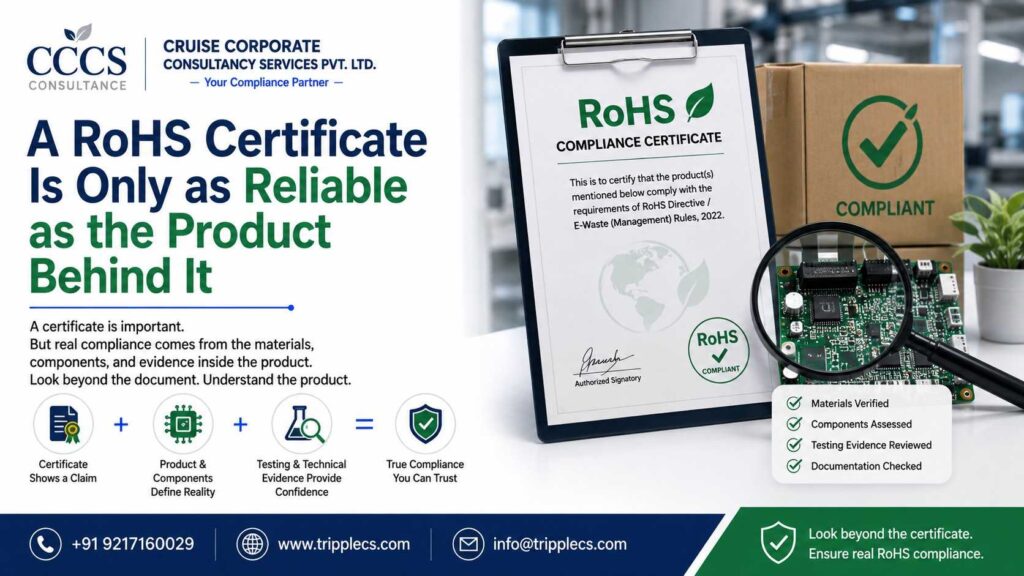
A RoHS Certificate Is Only as Reliable as the Product Behind It
Imagine an importer sourcing electronic equipment from an overseas manufacturer.
The supplier emails a PDF named:
“RoHS Compliance Certificate.”
It looks professional. It contains the manufacturer’s name, product information and a compliance statement.
Should the importer immediately consider the matter closed?
Not necessarily.
The business should understand what product or model the document covers, whether the supporting technical documentation relates to the supplied product and whether there have been material or component changes since the compliance evidence was prepared.
The right question is therefore not simply:
“Do you have a RoHS certificate?”
It is:
“Can the RoHS compliance claim for this particular product be properly supported?”
That is a much stronger compliance question.
Which Substances Are Restricted Under India’s RoHS Provisions?
For covered products under India’s E-Waste framework, Rule 16 identifies six substances and maximum concentration values.
| Restricted Substance | Maximum Concentration |
|---|---|
| Lead (Pb) | 0.1% |
| Mercury (Hg) | 0.1% |
| Hexavalent Chromium (Cr VI) | 0.1% |
| Polybrominated Biphenyls (PBB) | 0.1% |
| Polybrominated Diphenyl Ethers (PBDE) | 0.1% |
| Cadmium (Cd) | 0.01% |
These limits are measured by weight in homogeneous materials, subject to the scope and exemptions provided under the applicable rules.
For businesses, however, memorising these numbers is not the main challenge.
The bigger challenge is understanding whether the product falls within the applicable requirements and whether the materials/components used in it support the compliance claim.
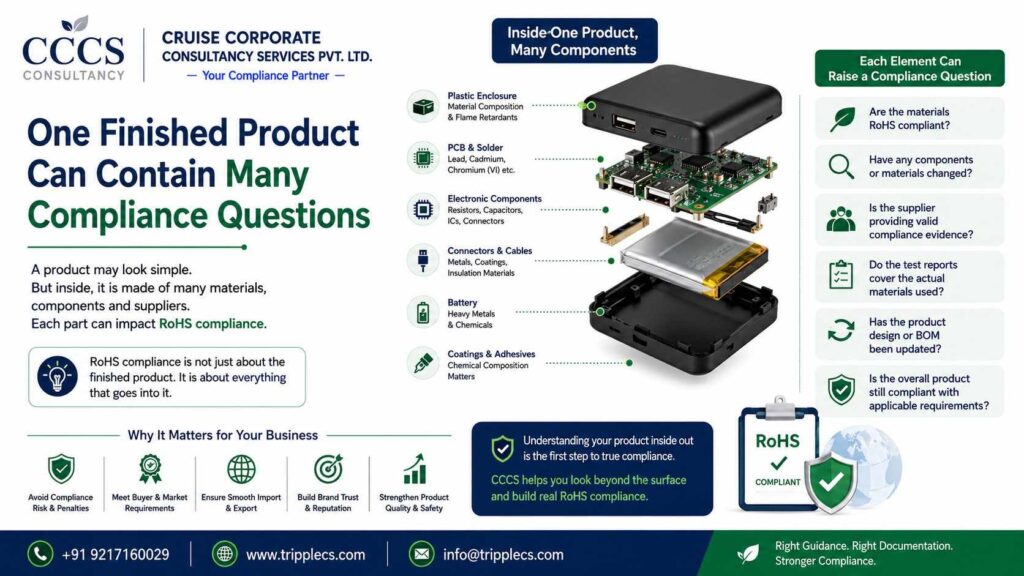
One Finished Product Can Contain Many Compliance Questions
Consider a relatively simple electronic product.
From the customer’s perspective, it is one item.
From a compliance perspective, it may contain:
PCB + solder + cable + plastic housing + connectors + metal parts + electronic components + coating
This is why RoHS compliance should not be viewed only at the finished-product level.
A finished product can contain numerous materials supplied by different vendors.
If one relevant material or component changes, the compliance position may need to be reconsidered.
This becomes especially important for manufacturers that frequently change component suppliers because of price, availability or supply-chain disruptions.
The product may look exactly the same from the outside while its internal material composition has changed.
RoHS Test Report and RoHS Compliance Certificate Are Not Automatically the Same Thing
These terms are often used interchangeably in commercial conversations, but businesses should understand the distinction.
A test report records testing and results for the samples/materials covered by that report.
A compliance declaration or certificate communicates a compliance position regarding the identified product or materials.
Supporting technical documentation is therefore important.
CPCB’s guidance for India’s E-Waste framework states that producers seeking EPR registration provide a RoHS self-declaration and a declaration regarding availability of technical documentation on RoHS compliance. CPCB also refers to technical documentation as per EN 50581 / EN IEC 63000:2018, which should be available for verification when required.
This is why businesses should avoid treating a certificate PDF as the entire compliance exercise.
“My Supplier Says the Product Is RoHS Compliant”
This is common in international sourcing.
A supplier may say:
“Don’t worry. All our products are RoHS compliant.”
That statement can be useful, but an importer or brand owner should still understand what evidence supports it.
For example:
- Which product/models does the evidence cover?
- Does it correspond to the product being supplied?
- What technical documentation is available?
- Have relevant materials or components changed?
- Which market’s RoHS requirement is being referenced?
The last question is particularly important.
“RoHS compliant” should not automatically be interpreted as universal approval for every country or regulatory framework.
Different markets can have different scopes, exemptions, documentation requirements or regulatory structures.
RoHS Compliance in India Should Not Be Confused with BIS Certification
Businesses dealing with electronics often encounter several regulatory requirements at the same time.
A product may raise questions involving:
RoHS → E-Waste/EPR → BIS CRS → WPC/ETA → other product-specific requirements
These requirements should not be treated as interchangeable certificates.
For example, BIS operates the Compulsory Registration Scheme for specified Electronics and IT Goods notified by MeitY.
RoHS requirements under India’s E-Waste framework, on the other hand, concern reduction of specified hazardous substances in covered electrical and electronic equipment.
Therefore:
BIS registration does not automatically mean “RoHS compliant,” and a RoHS compliance document does not automatically replace BIS requirements.
The regulatory requirements should be evaluated separately for the actual product.
Who Should Pay Attention to RoHS Compliance?
RoHS compliance can become relevant at several points in a supply chain.
A manufacturer may need to understand the materials and components used in production.
An importer may need appropriate compliance information from an overseas supplier.
A brand owner or producer may need to maintain supporting technical documentation.
An exporter may face RoHS requirements from overseas buyers or destination markets.
Even when another company physically manufactures the product, the business placing it into a particular market should understand what compliance claims are being made.
Under India’s E-Waste (Management) Rules, producers of covered electrical and electronic equipment have specific responsibilities concerning reduction in the use of hazardous substances.
When Should RoHS Compliance Be Rechecked?
This is where businesses can avoid future problems.
Suppose a product was assessed two years ago.
Nothing has changed in its external appearance.
But during those two years:
Supplier A became Supplier B.
A cable specification changed.
The PCB was redesigned.
A coating material was replaced.
Should an old compliance document automatically be relied upon?
That should not be assumed.
RoHS compliance should remain connected to the actual product configuration and supporting technical evidence.
A useful business trigger is:
Material Change → Component Change → Supplier Change → Product Revision → Review Compliance Evidence
This makes RoHS part of product lifecycle management rather than a document collected once and forgotten.
Why Buyers Ask for a RoHS Compliance Certificate
A buyer asking for a RoHS Compliance Certificate is usually trying to answer a larger question:
“Can you demonstrate that the product meets the applicable hazardous-substance requirements?”
This may arise during:
- vendor onboarding,
- product sourcing,
- regulatory review,
- export documentation,
- marketplace onboarding,
- customer compliance checks, or
- internal quality audits.
Therefore, businesses should avoid viewing such requests as merely a paperwork formality.
The buyer may be assessing the regulatory risk associated with sourcing the product.
Before Requesting a RoHS Certificate, Start with the Product
A common mistake is beginning with:
“Please arrange a RoHS certificate.”
A better approach is first establishing:
Product → Market/Destination → Applicable Requirement → Materials & Components → Available Technical Evidence → Appropriate Compliance Documentation
This matters particularly for businesses handling multiple models.
Two products marketed under the same brand may not necessarily have identical components or materials.
Similarly, an existing compliance document for one model should not automatically be assumed to cover an entire product range.
RoHS Compliance Should Support the Product, Not Just the File
The strongest compliance position is not having a folder containing a certificate.
It is being able to connect:
the product being sold → its relevant materials/components → technical documentation → applicable requirements → compliance declaration/evidence.
India’s regulatory framework also gives authorities powers relating to verification of RoHS compliance, and CPCB guidance emphasizes maintaining technical documentation that can be produced for verification.
For businesses, that means documentation should reflect the real product rather than exist separately from it.
Need Assistance with RoHS Compliance?
Determining RoHS requirements can involve more than obtaining a document labelled “RoHS Certificate.”
Product scope, applicable regulations, materials, components, technical documentation, testing evidence and the intended market may all need to be considered.
Cruise Corporate Consultancy Services Pvt. Ltd. (CCCS) can assist manufacturers, importers, exporters and businesses in understanding their product-specific compliance requirements and preparing the appropriate compliance documentation.
If your business is unsure whether an existing supplier document is sufficient or what compliance requirements apply to a product, reviewing the product situation before proceeding can help prevent compliance issues later.
Website: tripplecs.com
Phone: +91 9217160029