
Selling a product in India is not only a commercial decision. For foreign manufacturers, it can also become a regulatory question:
Does the product require BIS certification before it can enter the Indian market?
This question becomes especially important when a product is covered by a mandatory Indian Standard or a Quality Control Order (QCO).
Businesses searching for BIS Certification of CRS Item for ISI Mark (FMCS) should first understand an important distinction: CRS, ISI Mark and FMCS should not automatically be treated as the same certification route.
Under BIS, different conformity assessment schemes apply to different product categories. FMCS is specifically relevant to manufacturers whose factory is located outside India and who seek a BIS licence for use of the Standard Mark on applicable products. BIS states that FMCS generally applies to products other than Electronics & IT Goods notified by MeitY, which are handled under CRS.
That distinction should be checked before a manufacturer starts certification—or an importer places a commercial order.
Why Foreign Manufacturers Need to Look Beyond the ISI Mark
An ISI Mark on a product may look like the final objective, but certification starts much earlier.
The real questions are:
Which Indian Standard applies to the product?
Is certification mandatory for that product?
Which BIS certification scheme applies?
Which manufacturing premises will produce it?
BIS certification is generally voluntary, but the Government makes compliance with Indian Standards compulsory for various products through Quality Control Orders and other notifications. For such products, the applicable Standard Mark under a valid BIS licence or certificate becomes mandatory.
Therefore, a foreign manufacturer planning to supply India should not begin with:
“How do we get an ISI Mark?”
The better starting question is:
“What BIS requirement applies to this specific product?”
That difference can prevent a business from pursuing the wrong certification route.
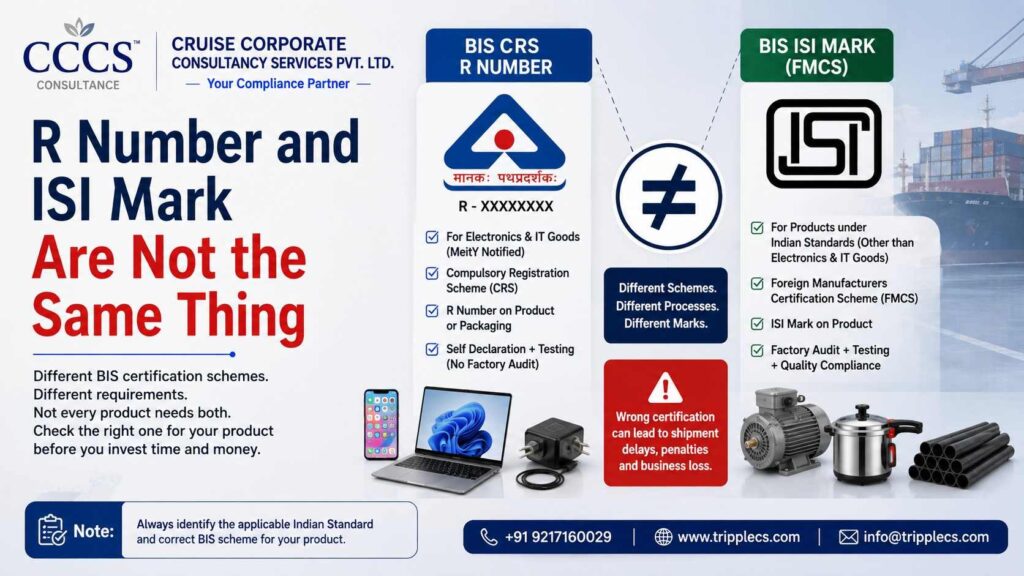
R Number and ISI Mark Are Not the Same Thing
This is one of the most important distinctions for importers and overseas manufacturers.
A business may hear terms such as BIS Certification, CRS, R Number, ISI Mark and FMCS and assume they refer to essentially the same approval.
They do not.
CRS (Compulsory Registration Scheme) is used for specified Electronics & IT Goods notified by MeitY.
FMCS (Foreign Manufacturers Certification Scheme) allows eligible manufacturers with factories outside India to obtain a BIS licence for products conforming to applicable Indian Standards. BIS specifically states that FMCS does not cover Electronics & IT Goods notified by MeitY under CRS.
This means product classification comes before certification planning.
A business should not decide that it needs an R Number or ISI Mark merely because another similar-looking product carries one.
A Similar Product Can Still Have a Different Compliance Requirement
Consider two products that appear commercially similar.
They may be sold through the same distributors, used by similar customers and even look almost identical.
But that does not automatically establish that their BIS requirements are identical.
The applicable requirement can depend on factors such as:
- actual product category,
- applicable Indian Standard,
- technical specifications,
- intended product configuration,
- manufacturing premises, and
- applicable regulatory notification or QCO.
This is particularly important for importers who depend heavily on information supplied by overseas vendors.
A supplier saying “our other product already has BIS” should not automatically be treated as confirmation for a new product.
The actual product should be reviewed.
FMCS Starts with the Manufacturer, Not the Importer
Suppose an Indian company wants to import a product manufactured in another country.
The Indian importer discovers that BIS certification is required.
Who applies?
Under FMCS, the application is made by the foreign manufacturer. BIS explicitly states that an importer cannot apply for the licence on behalf of the manufacturer.
This changes how businesses should plan compliance.
The foreign manufacturer needs to be involved because BIS certification is linked to the manufacturing operation, product conformity and the relevant manufacturing premises.
BIS also specifies that foreign manufacturers applying under FMCS should have the required manufacturing facilities and arrangements for testing products against the applicable Indian Standard.
So BIS certification cannot simply be treated as paperwork that an Indian importer completes after the goods have been manufactured.
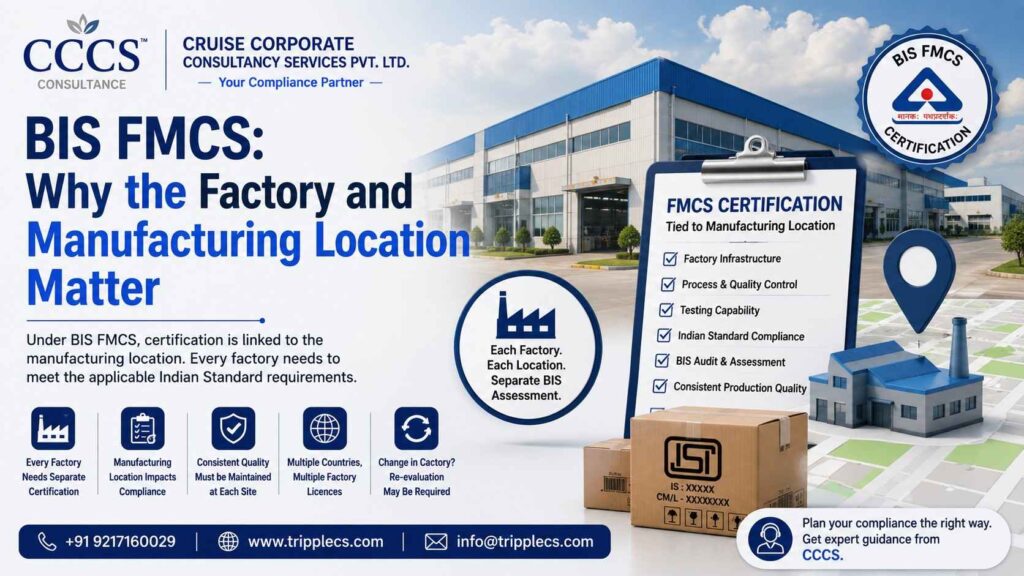
One Factory Licence Should Not Be Assumed to Cover Every Factory
Global manufacturers often operate multiple factories.
For example:
Company XYZ
Factory A — China
Factory B — Vietnam
Factory C — Thailand
Commercially, all three factories may manufacture products under the same brand.
But BIS states that separate FMCS applications are required for each product/Indian Standard and each factory manufacturing location.
Therefore, businesses should not assume that certification associated with one manufacturing premises automatically covers products manufactured at another facility.
This becomes especially important when a company changes suppliers or shifts production between countries.
A supply-chain decision can also become a compliance decision.
The Indian Standard Should Be Identified Before the Application
Before preparing documents, the business needs to identify the Indian Standard applicable to the product.
This is not merely an administrative detail.
The applicable Indian Standard influences the technical requirements against which the product and manufacturing arrangements will be evaluated.
BIS itself places identification of the applicable Indian Standard at the beginning of its product certification planning and requires manufacturers to assess their manufacturing infrastructure, process controls, quality controls and testing capabilities accordingly.
This is why starting an application before properly understanding the product can create unnecessary complications.
Product → Applicable Standard → Certification Requirement → Correct Scheme
is a much safer way to think about BIS compliance.
Why the Factory Matters Under FMCS
For foreign manufacturers, the factory is not just an address written on an application.
BIS states that a licence under FMCS is granted for products manufactured at a manufacturing premises and conforming to the relevant Indian Standard.
The manufacturer therefore needs appropriate manufacturing infrastructure, process controls, quality control and testing capabilities relevant to the product.
BIS’s certification assessment can include evaluation of the manufacturing premises and establishment of product conformity through appropriate testing.
This is why manufacturers should review their actual factory readiness rather than focusing only on documents.
A complete file cannot compensate for a manufacturing arrangement that does not align with the applicable certification requirements.
Testing Alone Does Not Mean the Product Is BIS Certified
This is another common misunderstanding.
A manufacturer may obtain a laboratory test report showing that a sample meets certain requirements.
That can be important, but a test report and a BIS licence are not the same thing.
Under the certification framework, BIS considers broader aspects such as manufacturing infrastructure, process and quality controls, testing capability and product conformity.
Businesses should therefore avoid telling customers or import partners that a product is “BIS certified” simply because some testing has been completed.
The certification status should correspond with the actual BIS licence applicable to the product and manufacturing premises.
What Is the Role of an Authorized Indian Representative?
A foreign manufacturer applying under FMCS needs an Authorized Indian Representative (AIR) in India.
The AIR is not simply a contact person for receiving emails.
According to BIS, the AIR must be an Indian resident and takes responsibility relating to compliance with the BIS Act, applicable rules, regulations and conditions connected with operation of the licence.
Where the foreign manufacturer has an Indian branch or office, an appropriate employee of that office may preferably be nominated. Where no such office exists, another eligible person may be legally appointed subject to BIS requirements.
For overseas manufacturers entering India for the first time, the AIR arrangement should therefore be considered early rather than at the final stage.
Importers Should Check BIS Requirements Before Confirming Shipment
Consider what happens when compliance is checked too late.
The importer has already:
placed the purchase order → completed production → arranged packaging → booked freight → dispatched the shipment.
Only then does someone ask whether the product requires mandatory BIS certification.
At this point, a regulatory issue can become a commercial issue.
For products covered by mandatory certification requirements, businesses should evaluate the applicable BIS position before committing to shipment. BIS notes that products made compulsory through applicable government requirements require the relevant Standard Mark under a valid BIS licence or CoC.
The better sequence is:
Identify Product → Check Applicable Standard/QCO → Determine Certification Scheme → Review Manufacturer & Factory → Prepare Compliance → Plan Shipment
This can reduce the risk of discovering a fundamental certification issue after significant money has already been committed.
“Our Supplier Already Has BIS” — What Should You Check?
This statement should lead to another question:
Does that BIS licence actually cover the product and factory supplying your goods?
Businesses should review whether the existing certification corresponds with the intended:
manufacturer + manufacturing premises + product + applicable Indian Standard + scope of licence.
This is especially important when an overseas supplier has several factories or manufactures several product varieties.
An existing BIS licence can be valuable, but its relevance should be confirmed rather than assumed.
Before Starting FMCS, Understand the Product Situation First
A foreign manufacturer preparing for the Indian market should ideally establish five things before treating certification as an application exercise:
What exactly is the product?
Which Indian Standard applies?
Is certification mandatory or voluntary?
Which BIS scheme applies?
Which factory will manufacture the product?
Once these are clear, other requirements—such as factory readiness, testing arrangements, AIR nomination and documentation—can be approached in the correct context.
This is particularly important for businesses dealing with several product models, multiple factories or complex international supply chains.
The objective should not simply be to “get an ISI Mark.”
The objective should be to establish the correct BIS compliance route for the actual product being supplied to India.
Need Assistance with BIS ISI Mark & FMCS Certification?
Foreign manufacturers and Indian importers can face difficulties when determining the applicable Indian Standard, correct certification route, factory requirements, AIR arrangements and product-specific BIS requirements.
Cruise Corporate Consultancy Services Pvt. Ltd. (CCCS) can assist businesses in evaluating their product situation and understanding the appropriate BIS certification requirements before proceeding.
For foreign manufacturers planning to enter the Indian market, early compliance assessment can help avoid making certification decisions after production or shipment has already begun.
Website: tripplecs.com
Phone: +91 9217160029