
A telecom product may be technically ready for the Indian market and still not be ready to be sold or deployed.
Why?
Because for telecom equipment covered under MTCTE, product performance is only one part of market readiness. The applicable equipment must also meet prescribed Essential Requirements (ERs) and hold the required conformity certification.
MTCTE stands for Mandatory Testing and Certification of Telecommunication Equipment. Under the current framework, notified telecommunication equipment covered by MTCTE cannot be sold, deployed in a telecom network, or otherwise used in India without a valid Certificate of Conformity Assessment against the prescribed Essential Requirements.
For manufacturers, foreign OEMs, brand owners and businesses importing telecom equipment, this makes certification a product-planning issue—not something to consider only after the goods are ready to enter the market.
Searching for “MTCTE Certification Telegraphic Product”? Start with the Correct Meaning
Businesses searching for MTCTE Certification Telegraphic Product are generally looking for information about certification applicable to telecom or telecommunication equipment in India.
The official terminology used by the Telecommunication Engineering Centre (TEC) is:
Mandatory Testing and Certification of Telecommunication Equipment (MTCTE).
TEC operates under the Department of Telecommunications, Ministry of Communications, Government of India.
The purpose of MTCTE includes ensuring that applicable telecom equipment meets prescribed requirements relating to network performance, end-user safety, RF emissions and relevant regulatory standards.
So before looking for a certificate, the first practical question should be:
Is my product covered under the applicable MTCTE requirements?
Don’t Decide from the Product Name Alone
This is where telecom compliance can become confusing.
Suppose a company plans to introduce a new networking product.
The commercial team calls it:
“Enterprise Communication Device.”
The supplier calls it:
“Network Gateway.”
The technical documentation uses another description.
Which name determines whether MTCTE applies?
Not necessarily any one of them.
The product’s actual functionality, interfaces, technical characteristics and applicable product category need to be considered against the MTCTE framework.
TEC maintains a phase-wise product list showing Essential Requirement/product names, variants, MTCTE phases and mandatory certification dates.
This is why businesses should identify the equipment correctly before assuming that a certificate is—or is not—required.
The Product List Is a Starting Point, Not a Guessing Tool
A common approach is:
“I searched the list, couldn’t immediately find my commercial product name, so MTCTE probably doesn’t apply.”
That can be risky.
Older official TEC clarifications specifically warned against assuming that equipment was outside MTCTE merely because its name did not appear in an indicative list.
The current framework provides phase-wise product and Essential Requirement information through the MTCTE portal.
For a business, the safer approach is to understand how its product fits within the applicable regulatory category rather than searching only for the exact marketing name printed on the box.
Essential Requirements Are at the Centre of MTCTE
MTCTE is not simply about submitting company documents and receiving a certificate.
Testing is an important part of the framework.
The official MTCTE portal explains that testing and certification under MTCTE Procedure TEC 93009:2024 is intended to establish conformity with TEC-prescribed Essential Requirements.
Depending on the applicable ER and product, relevant requirements can address areas such as technical performance, safety, electromagnetic compatibility and other prescribed parameters.
This means the right sequence is not:
Product → application form → certificate
A better way to understand it is:
Product → applicable category → Essential Requirements → testing/conformity → certification
That difference matters.
A Product Can Look Similar and Still Need a Separate Review
Imagine two network devices sitting next to each other.
Same size.
Similar ports.
Similar commercial purpose.
Even their product brochures look almost identical.
But internally they may have:
different hardware,
different interfaces,
different configurations,
different models,
or different technical specifications.
From a sales perspective, they may belong to the same product family.
From a certification perspective, businesses should not automatically assume that an approval associated with one model covers another.
The MTCTE portal’s certified-equipment database itself identifies information including product name, product variant, main model/family name and associated models/family models.
This shows why model and family structure deserves attention during certification planning.
Who Is Responsible When the Equipment Comes from Overseas?
This is particularly important for importers.
A foreign manufacturer may say:
“Our equipment is already certified internationally.”
That statement does not by itself establish compliance with India’s MTCTE requirements.
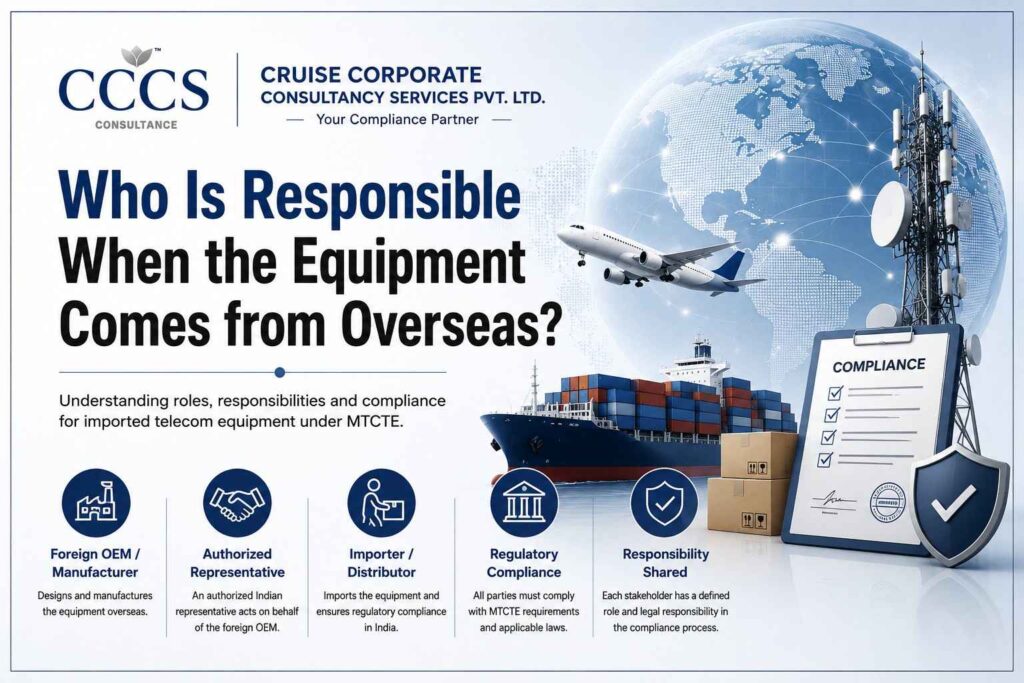
MTCTE Procedure v3.0 defines the applicant as an India-incorporated company or firm that may be an indigenous OEM or brand owner; for imported equipment, an Indian representative of the foreign OEM duly authorized by that OEM can act in the framework.
Official TEC clarification has also stated that foreign OEMs offer imported telecom equipment for testing and certification through their authorized representative in India, while importers have responsibilities regarding the import of certified equipment.
For businesses sourcing internationally, certification should therefore be discussed with the supplier before the purchase becomes difficult to reverse.
“Already Tested Abroad” Does Not Automatically Answer the MTCTE Question
International manufacturers often have extensive test documentation.
That can be useful.
But the important question is whether the available reports and evidence satisfy the applicable current MTCTE requirements.
TEC has issued and updated provisions regarding acceptance/exemptions for various parameters and test reports; its MTCTE page currently lists, among other recent updates, material concerning acceptance of ILAC test reports and exemptions for certain ER parameters/interfaces.
So businesses should avoid two extremes:
“Foreign reports are always enough.”
and
“Foreign reports are never useful.”
Neither is a good general rule.
The reports should be reviewed against the requirement applicable to the particular equipment.
MTCTE Certification Should Be Checked Before Commercial Launch
Consider the usual commercial sequence:
Supplier selected.
Price negotiated.
Purchase order issued.
Product imported.
Marketing campaign prepared.
Distributor appointed.
Then:
“Do we need TEC certification?”
That is the wrong point to discover the question.
For applicable telecom equipment, certification can directly affect the ability to place the product in the Indian market.
Current MTCTE rules state that notified equipment cannot be sold, deployed in a telecom network or otherwise used in India without the required valid conformity certificate.
Regulatory assessment should therefore sit much earlier in product planning.
Manufacturer, Brand Owner and Foreign OEM: Know Your Position
Not every telecom business has the same supply-chain structure.
One company designs and manufactures its own equipment.
Another sells products manufactured by a third party.
Another imports equipment from a foreign OEM.
Another owns the Indian brand.
These differences can affect how a certification case should be approached.
The current MTCTE procedure recognizes applicant situations involving Indian OEMs, brand owners and authorized Indian representatives of foreign OEMs.
Before preparing certification documentation, businesses should therefore establish:
Who manufactures the equipment?
Who owns the brand?
Is there a foreign OEM?
Who is the authorized Indian entity?
Getting the commercial structure clear early can make the regulatory discussion much easier.
Don’t Confuse MTCTE with ETA WPC
Telecom and wireless products can fall into more than one regulatory discussion.
This often creates confusion.
MTCTE focuses on mandatory testing and certification of applicable telecommunication equipment against prescribed Essential Requirements.
ETA/WPC, meanwhile, concerns applicable wireless/RF equipment and frequency-related regulatory requirements.
One should not automatically be treated as a substitute for the other.
A product’s technical characteristics can determine which regulatory requirements deserve consideration.
If your equipment contains Wi-Fi, Bluetooth or other RF functionality, you can also review our ETA WPC Certificate guidance.
This creates a useful connection for businesses dealing with telecom equipment that also incorporates wireless functionality.
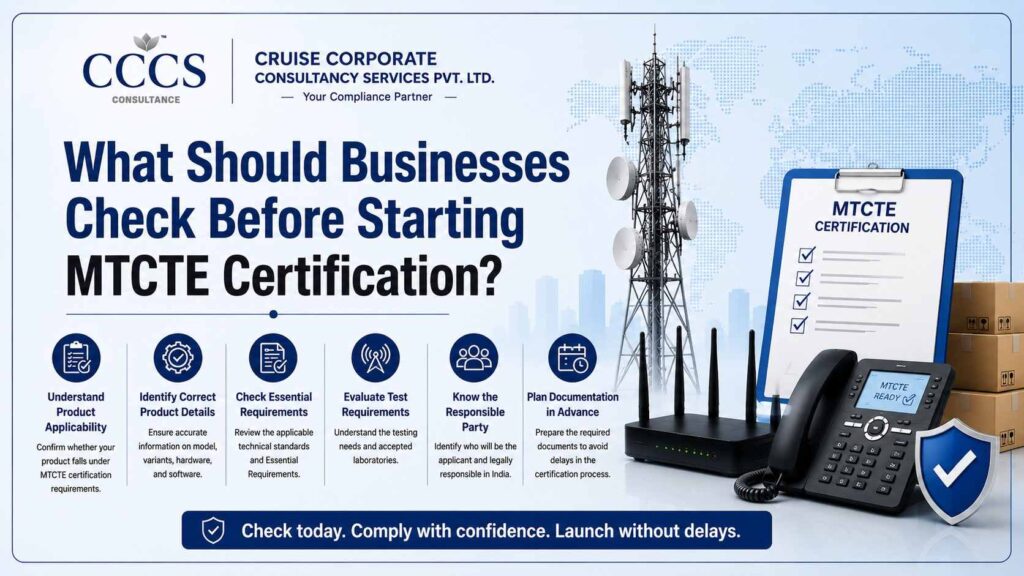
What Should Businesses Check Before Starting MTCTE Certification?
Instead of beginning with a huge document checklist, start by establishing the product situation.
Know the exact equipment.
Know the manufacturer.
Identify the model and variants.
Understand its technical functionality.
Determine the applicable MTCTE product/ER category.
Understand the testing position.
Clarify whether the equipment is manufactured domestically or supplied by a foreign OEM.
These questions help establish the regulatory path before significant effort is spent on documentation.
The official MTCTE portal provides the current product lists, Essential Requirements, instructions and certification resources businesses can use for verification.
One Mistake Can Start Before the Application Even Exists
Sometimes businesses think certification problems begin when an application is rejected or clarification is requested.
Often, they begin much earlier.
The wrong model was identified.
The product category was assumed.
Supplier information was incomplete.
The commercial team promised a launch date before compliance was reviewed.
Or another company’s certification was treated as a template.
These are not necessarily application-form problems.
They are product-planning problems.
That is why professional regulatory review can be valuable before the application stage—not only after something goes wrong.
How Cruise Corporate Consultancy Services Pvt. Ltd. Supports MTCTE Requirements
At Cruise Corporate Consultancy Services Pvt. Ltd., we approach MTCTE requirements by first understanding the equipment and the business behind it.
We consider the product category, model information, manufacturer/OEM structure, applicable technical requirements and certification context before helping businesses move forward with regulatory compliance.
For companies researching MTCTE Certification Telegraphic Product requirements, this helps turn a broad certificate search into a more specific product-level compliance assessment.
Our objective is not simply to prepare paperwork.
It is to help businesses understand what applies to their telecom equipment before the certification requirement becomes a commercial obstacle.
Before Your Telecom Product Enters the Indian Market
A product can be technologically advanced.
It can perform perfectly in laboratory demonstrations.
It can already be successful overseas.
None of those points alone answers the Indian certification question.
For applicable telecom equipment, businesses need to understand the MTCTE framework, identify the correct product category, consider the relevant Essential Requirements and ensure the appropriate certification position before sale, deployment or use in India.
So if you are searching for MTCTE Certification Telegraphic Product, don’t begin by asking only:
“Where is the application?”
Begin with:
“What exactly is our equipment, and what MTCTE requirement applies to it?”
That answer determines what should happen next.
Need Assistance with MTCTE Certification?
If your company manufactures, imports or plans to introduce telecom equipment in India and needs help understanding the applicable MTCTE certification requirements, professional guidance can help you assess the product before proceeding.
Cruise Corporate Consultancy Services Pvt. Ltd.
Website: tripplecs.com
Phone: +91 9217160029
Our team supports businesses with MTCTE, telecom certification and other regulatory compliance requirements based on their products and commercial circumstances